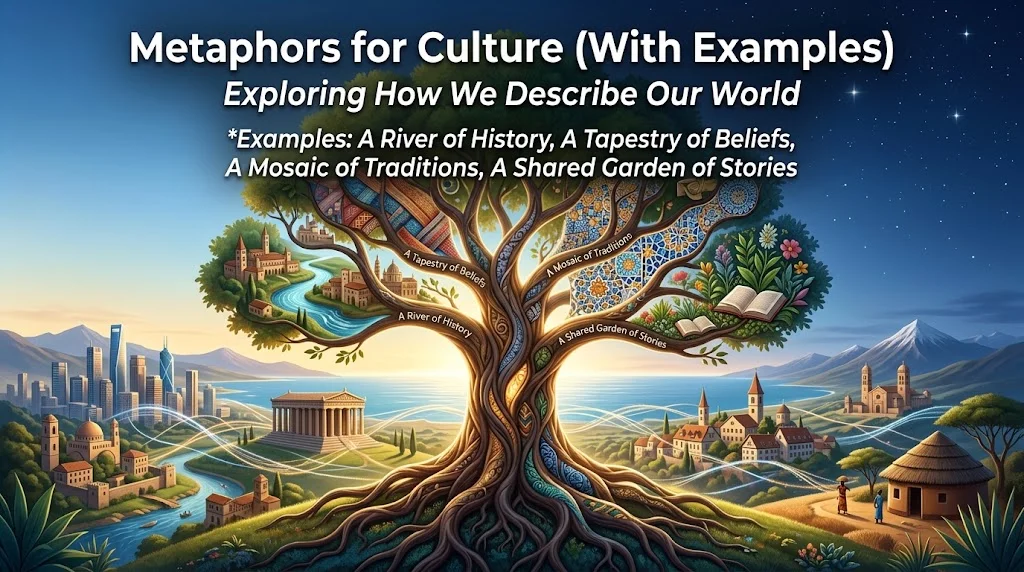
Metaphors for Culture (With Examples) help us turn culture into a collection of traditions, beliefs, values, stories, and language that people can easily understand.
Customs, art, food, and ways of life connect a community and describe an abstract idea through experiences that people live, share, and protect as they pass traditions from one generation to another generation.
Metaphors help us understand this process in a simple way. A tree can represent cultural roots, while a tapestry can show how different parts create a meaningful and lasting whole. A river can carry traditions through time, a bridge can connect generations, a mirror can reflect identity, a garden can represent growth, and a living book can preserve memory.
This kind of metaphor for culture can also describe a family gathering around a table, a shared way of welcoming guests, songs, and a common background. Such everyday details give readers a deeper voice for understanding shared experiences and the strong metaphors that shape how we see, hear, and feel cultural identity.
Cultural similes and familiar images make an abstract idea vivid and relatable, while giving writers examples and creative ways to describe cultural roots, rivers, tapestries, and mirrors.
1. Culture Is a Tapestry
Meaning: Culture is a tapestry because many different threads come together to create one larger picture.
Detailed explanation:
A tapestry contains separate threads, colors, and patterns. Yet each part contributes to the finished design. Culture works in much the same way. Language, food, traditions, music, beliefs, stories, clothing, customs, and shared memories become individual threads in a community’s cultural identity.
This metaphor also recognizes diversity. Different groups can maintain their own traditions while contributing to a broader cultural picture. If one thread changes, the overall design can change too.
Example sentence:
“Culture is a tapestry woven from generations of stories, traditions, languages, and shared memories.”
3 other ways to say it:
- Culture is a woven fabric of human experiences.
- Culture is a pattern created from many traditions.
- Culture is a rich cloth made from countless individual threads.
2. Culture Is a Garden
Meaning: Culture is a garden because it needs care, attention, and continual cultivation to thrive.
Detailed explanation:
A garden doesn’t remain healthy without care. People plant, water, protect, and sometimes remove what no longer belongs. Culture develops similarly. Families and communities teach traditions, preserve stories, celebrate customs, and pass values to younger generations.
The garden metaphor also captures cultural change. New ideas can grow alongside older traditions. Some customs may fade while others flourish.
Example sentence:
“Culture is a garden that each generation must tend, protect, and carefully replant.”
3 other ways to say it:
- Culture is a garden nurtured by generations.
- Culture is a living field of traditions and ideas.
- Culture is a landscape that people cultivate over time.
3. Culture Is a River
Meaning: Culture is a river because it flows through generations while constantly changing.
Detailed explanation:
A river moves forward, but it carries material from its past. Culture does something similar. Older generations pass down stories, customs, languages, values, and traditions, while younger generations reshape them.
A river can also merge with other rivers. Likewise, cultures interact, exchange ideas, and influence one another. The result isn’t always a complete replacement. Often, new cultural forms emerge from several influences.
Example sentence:
“Culture is a river, carrying the memories of the past toward an ever-changing future.”
3 other ways to say it:
- Culture is a stream connecting generations.
- Culture is a current that carries traditions forward.
- Culture is a flow of ideas moving through time.
4. Culture Is a Bridge
Meaning: Culture is a bridge because it can connect people who have different backgrounds and experiences.
Detailed explanation:
A bridge links places that would otherwise remain separated. Cultural traditions can create similar connections between people. Food, music, festivals, language, art, and storytelling can help people understand experiences outside their own.
This metaphor works particularly well when discussing cross-cultural communication and understanding. Culture doesn’t have to divide people. It can provide a route toward curiosity and mutual respect.
Example sentence:
“Culture can become a bridge between people whose histories and experiences seem worlds apart.”
3 other ways to say it:
- Culture is a path connecting different communities.
- Culture is a link between people and traditions.
- Culture is a gateway to understanding other perspectives.
5. Culture Is a Mirror
Meaning: Culture is a mirror because it reflects the values, history, priorities, and experiences of a society.
Detailed explanation:
A mirror shows something about what stands before it. Culture can reveal what a community considers meaningful. The way people celebrate holidays, raise children, greet one another, prepare food, or tell stories can reveal deeper social values.
However, culture isn’t a perfect mirror. Communities contain disagreements and contradictions. One cultural practice may reflect one group’s values while another group within the same society holds different views.
Example sentence:
“Culture is a mirror that reflects what a community remembers, values, celebrates, and protects.”
3 other ways to say it:
- Culture is a reflection of collective values.
- Culture is a window into a society’s identity.
- Culture is a portrait of shared experiences and priorities.
6. Culture Is a Tree
Meaning: Culture is a tree because it has deep roots, a growing trunk, and branches that develop in different directions.
Detailed explanation:
The roots represent history, ancestry, memories, and inherited traditions. The trunk represents shared identity and continuity. The branches represent different groups, regions, generations, and cultural expressions.
This metaphor shows that culture can grow without losing its connection to the past. New branches may develop while the roots remain important.
Example sentence:
“Culture is a tree whose roots reach into history while its branches stretch toward new possibilities.”
3 other ways to say it:
- Culture is a tree rooted in history.
- Culture is a living structure with ancient roots and new branches.
- Culture is a growing tree shaped by generations.
7. Culture Is a Compass
Meaning: Culture is a compass because it can guide how people understand the world and make decisions.
Detailed explanation:
A compass helps travelers choose a direction. Culture can influence people’s ideas about respect, family, responsibility, community, celebration, communication, and social behavior.
It doesn’t determine every decision. Individuals still make their own choices. Yet cultural expectations can provide a framework for interpreting situations and deciding how to respond.
Example sentence:
“Culture acts like a compass, helping people navigate relationships, responsibilities, and social expectations.”
3 other ways to say it:
- Culture is a guide for navigating society.
- Culture is an inner map of shared expectations.
- Culture is a directional guide shaped by tradition.
8. Culture Is a Storybook
Meaning: Culture is a storybook because it contains stories, memories, legends, lessons, and experiences passed between generations.
Detailed explanation:
Every culture carries stories. Some appear in books, while others survive through oral traditions, family conversations, songs, ceremonies, and community memories.
These stories help people understand where they came from. They can also teach values and preserve historical experiences that might otherwise disappear.
Example sentence:
“Culture is a storybook whose pages are filled with ancestral memories, celebrations, struggles, and dreams.”
3 other ways to say it:
- Culture is a book written by generations.
- Culture is a collection of living stories.
- Culture is a library of shared memories and traditions.
Read this: 20 Metaphors for Crying (With Examples)
9. Culture Is a Recipe
Meaning: Culture is a recipe because it combines many ingredients into a distinctive way of life.
Detailed explanation:
A recipe brings together individual ingredients. Culture does something similar with language, food, customs, beliefs, art, history, family practices, and social values.
The recipe metaphor also allows for variation. Different families may follow similar traditions while adding their own ingredients. That’s why culture can remain recognizable while still changing from one person or community to another.
Example sentence:
“Culture is a recipe made from history, language, traditions, values, and countless everyday experiences.”
3 other ways to say it:
- Culture is a blend of traditions and experiences.
- Culture is a recipe shaped by generations.
- Culture is a mixture of customs, memories, and values.
10. Culture Is a Hearth
Meaning: Culture is a hearth because it can represent home, belonging, warmth, family, and shared identity.
Detailed explanation:
A hearth traditionally represents the center of a home. It’s where people gather, share food, tell stories, and spend time together. Culture can create that same feeling of belonging.
This metaphor works especially well when discussing family traditions, heritage, community, and identity. Culture can give people a sense of connection even when they live far from their ancestral home.
Example sentence:
“Culture is a hearth where generations gather around shared memories and traditions.”
3 other ways to say it:
- Culture is a warm center of belonging.
- Culture is a home built from shared traditions.
- Culture is a fire that brings communities together.
11. Culture Is a Mosaic
Meaning: Culture is a mosaic because it consists of many distinct pieces that create a larger picture.
Detailed explanation:
A mosaic doesn’t require every piece to look identical. In fact, its beauty comes from the relationship between different pieces. Culture can work the same way.
A society may contain different languages, regional customs, religious traditions, foods, artistic styles, and family practices. Together, these differences can form a complex cultural identity.
Example sentence:
“Culture is a mosaic made from countless identities, traditions, memories, and perspectives.”
3 other ways to say it:
- Culture is a picture assembled from many identities.
- Culture is a collection of pieces forming one larger identity.
- Culture is a patchwork of different human experiences.
12. Culture Is a Living Archive
Meaning: Culture is a living archive because it preserves the past while continuing to change in the present.
Detailed explanation:
An archive stores important information. Culture stores memories in less formal ways. Songs, recipes, ceremonies, language, stories, clothing, architecture, and family customs can all preserve knowledge.
The word “living” matters here. Culture isn’t simply a dusty record of the past. People continue to reinterpret and practice it.
Example sentence:
“Culture is a living archive, preserving yesterday while adapting to the needs of today.”
3 other ways to say it:
- Culture is a living record of collective memory.
- Culture is an archive carried by people.
- Culture is a repository of inherited experiences.
13. Culture Is a Lens
Meaning: Culture is a lens because it can shape how people interpret the world around them.
Detailed explanation:
A lens changes how you see something. Culture can influence what people notice, how they interpret behavior, and what they consider normal or unusual.
For example, a gesture that communicates respect in one culture might have a different meaning elsewhere. The lens metaphor reminds us that people don’t always interpret the same event in the same way.
Example sentence:
“Culture is a lens through which people interpret relationships, behavior, traditions, and everyday life.”
3 other ways to say it:
- Culture is a filter for understanding the world.
- Culture is a frame that shapes perception.
- Culture is a perspective through which experiences gain meaning.
14. Culture Is a Symphony
Meaning: Culture is a symphony because many voices and traditions can contribute to one shared cultural experience.
Detailed explanation:
A symphony contains different instruments. They don’t all play the same notes. Instead, their differences create complexity.
Culture can work similarly. Different generations, communities, languages, traditions, and artistic expressions can exist together. Some voices may be louder than others, but each can contribute something distinctive.
Example sentence:
“Culture is a symphony in which countless voices create a complex rhythm of shared life.”
3 other ways to say it:
- Culture is an orchestra of different voices.
- Culture is a melody shaped by many traditions.
- Culture is a musical conversation between generations.
15. Culture Is a Map
Meaning: Culture is a map because it provides clues about identity, relationships, customs, and social expectations.
Detailed explanation:
A map helps you understand unfamiliar territory. Cultural knowledge can do the same thing when you enter a new community.
Understanding local customs can help you recognize appropriate greetings, communication styles, celebrations, and social boundaries. Without that knowledge, ordinary situations can feel confusing.
Example sentence:
“Culture is a map that helps people navigate the social landscape around them.”
3 other ways to say it:
- Culture is a guide through social life.
- Culture is a map of shared customs and expectations.
- Culture is an atlas of community identity.
16. Culture Is a Seed
Meaning: Culture is a seed because small traditions can grow into powerful identities across generations.
Detailed explanation:
A seed looks small, but it contains the potential for something much larger. Cultural practices can begin in equally simple ways.
A family recipe, a traditional greeting, a song, or a yearly celebration might seem ordinary. Over time, these practices can become important symbols of identity.
Example sentence:
“Culture is a seed planted by one generation and allowed to grow through the care of those who follow.”
3 other ways to say it:
- Culture is a seed carrying the potential of generations.
- Culture is a small tradition that can grow into shared identity.
- Culture is a seedling nurtured by collective memory.
17. Culture Is an Ocean
Meaning: Culture is an ocean because it is vast, deep, interconnected, and constantly moving.
Detailed explanation:
An ocean contains layers that aren’t visible from the surface. Culture has similar depth. Everyday habits may appear simple, yet deeper values and histories can influence them.
The ocean metaphor also highlights cultural exchange. Waves move between shores just as ideas, languages, foods, music, and traditions move between communities.
Example sentence:
“Culture is an ocean of memories, beliefs, traditions, and influences stretching far beyond what first appears on the surface.”
3 other ways to say it:
- Culture is a deep sea of shared experiences.
- Culture is a vast body of human traditions.
- Culture is an ocean where different influences meet and move.
18. Culture Is a Quilt
Meaning: Culture is a quilt because different pieces of history and identity can be stitched together into something meaningful.
Detailed explanation:
A quilt consists of separate pieces that become one larger object through careful stitching. Culture can bring together family memories, regional traditions, languages, food, art, and historical experiences in a similar way.
The quilt metaphor emphasizes both difference and connection. The pieces don’t need to become identical to belong together.
Example sentence:
“Culture is a quilt stitched together from family memories, regional customs, inherited stories, and shared celebrations.”
3 other ways to say it:
- Culture is a patchwork sewn from generations of experience.
- Culture is a quilt of shared memories and traditions.
- Culture is a stitched collection of identities.
19. Culture Is a Flame
Meaning: Culture is a flame because people can carry traditions forward, protect them, and pass them to future generations.
Detailed explanation:
A flame can be passed from one candle to another without becoming the exact same flame. Culture can move through generations in a similar way.
Parents, grandparents, teachers, artists, elders, and communities can transmit language, customs, stories, and values. Younger generations may preserve those traditions while giving them new forms.
Example sentence:
“Culture is a flame passed from generation to generation, glowing differently as each new hand carries it forward.”
3 other ways to say it:
- Culture is a fire carried across generations.
- Culture is a light preserved through shared memory.
- Culture is a flame that keeps heritage alive.
20. Culture Is a Dance
Meaning: Culture is a dance because it involves movement, interaction, adaptation, rhythm, and cooperation.
Detailed explanation:
A dance changes as people respond to one another. Culture does too. It isn’t frozen in one historical moment. People continually adapt traditions to new environments, technologies, relationships, and social conditions.
The dance metaphor also captures cultural interaction. When different cultures meet, they can influence one another, creating new patterns without completely erasing their original identities.
Example sentence:
“Culture is a dance between the past and the present, with every generation adding its own steps.”
3 other ways to say it:
- Culture is a dance between tradition and change.
- Culture is a rhythm shaped by generations.
- Culture is a shared performance that evolves over time.
MCQs:
1. “Culture is a ______ because different traditions come together to create one larger picture.”
A. Compass
B. Mosaic
C. River
D. Flame
Answer: B. Mosaic
2. “Culture is a ______ because it connects people from different backgrounds.”
A. Bridge
B. Seed
C. Mirror
D. Recipe
Answer: A. Bridge
3. “Culture is a ______ because it flows from one generation to another.”
A. Hearth
B. Lens
C. River
D. Quilt
Answer: C. River
4. “Culture is a ______ because its roots reach into history while its branches continue growing.”
A. Tree
B. Ocean
C. Map
D. Symphony
Answer: A. Tree
5. “Culture is a ______ because it reflects the values and experiences of a community.”
A. Garden
B. Mirror
C. Dance
D. Seed
Answer: B. Mirror
6. “Culture is a ______ because it helps people navigate social expectations.”
A. Compass
B. Tapestry
C. Flame
D. Quilt
Answer: A. Compass
7. “Culture is a ______ because it contains stories and memories passed through generations.”
A. Garden
B. Storybook
C. Bridge
D. Ocean
Answer: B. Storybook
8. “Culture is a ______ because language, food, customs, and values combine to create a distinctive identity.”
A. Recipe
B. Mirror
C. River
D. Compass
Answer: A. Recipe
9. “Culture is a ______ because it can create warmth, family connection, and belonging.”
A. Lens
B. Hearth
C. Map
D. Seed
Answer: B. Hearth
10. “Culture is a ______ because it preserves history while continuing to evolve.”
A. Living archive
B. Bridge
C. Symphony
D. Garden
Answer: A. Living archive
11. “Culture is a ______ because it influences how people interpret the world.”
A. Flame
B. Lens
C. Quilt
D. River
Answer: B. Lens
12. “Culture is a ______ because many voices can contribute to one shared experience.”
A. Symphony
B. Seed
C. Mirror
D. Map
Answer: A. Symphony
13. “Culture is a ______ because it helps people understand unfamiliar social environments.”
A. Ocean
B. Map
C. Garden
D. Tapestry
Answer: B. Map
14. “Culture is a ______ because a small tradition can grow into an important part of identity.”
A. Seed
B. Bridge
C. Mirror
D. Compass
Answer: A. Seed
15. “Culture is a ______ because it constantly moves, adapts, and responds to change.”
A. Dance
B. Hearth
C. Storybook
D. Recipe
Answer: A. Dance
FAQs:
What are some powerful metaphors for culture?
Some powerful metaphors include culture is a tapestry, culture is a tree, culture is a river, culture is a bridge, culture is a mosaic, and culture is a living archive. Each highlights a different quality of cultural identity.
What is a metaphor for cultural diversity?
“Culture is a mosaic” is an effective metaphor for cultural diversity. It suggests that different identities and traditions can remain distinct while contributing to a larger cultural picture.
What metaphor represents cultural heritage?
“Culture is a tree” works especially well for cultural heritage because its roots can represent ancestry and history, while its branches represent new generations and evolving traditions.
What is a metaphor for cultural identity?
“Culture is a tapestry” is a strong metaphor for cultural identity. Each thread can represent language, family history, traditions, values, food, music, and personal experiences.
What metaphor describes culture changing over time?
“Culture is a river” effectively describes cultural change. A river keeps moving while carrying material from its past, much like culture carries traditions forward while adapting to new circumstances.
Conclusion:
Metaphors for Culture (With Examples) give us a creative way to understand the traditions, beliefs, values, and experiences that shape communities.
By comparing culture to a tree, river, tapestry, bridge, or living book, we can make complex ideas easier to see and feel. These images show how cultural roots connect generations while stories, language, food, customs, and shared memories continue to grow and change.
Metaphors also help writers, poets, and speakers express identity, history, and human experience with greater emotion and clarity. Whether you are writing a story, speech, or essay, the right metaphor can turn an ordinary cultural description into a memorable image. Ultimately, cultural metaphors help us appreciate the invisible connections that bring people together and keep meaningful traditions alive.









1 thought on “20 Metaphors for Culture (With Examples)”