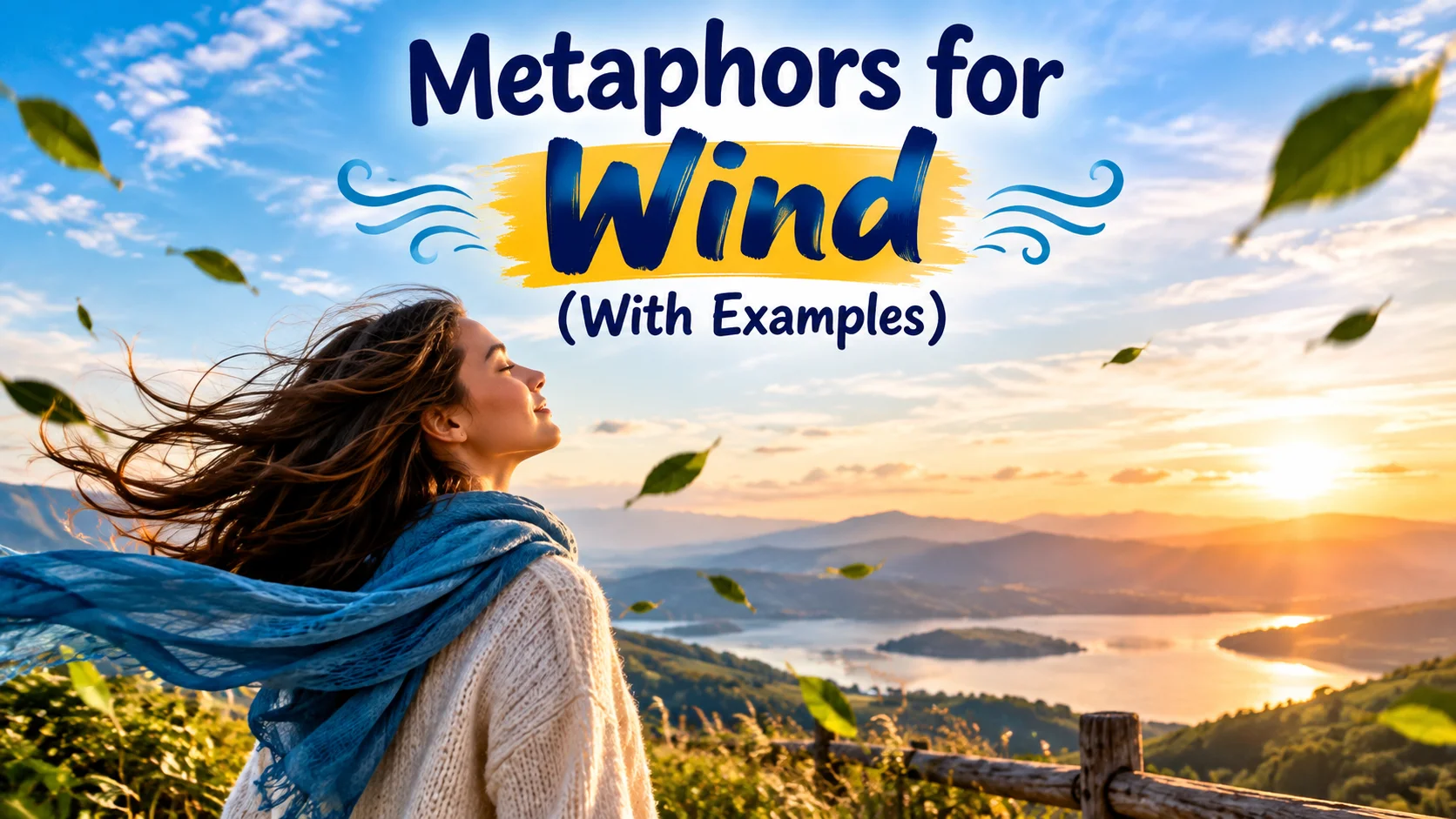
Metaphors for Wind (With Examples) make figurative language more vivid by connecting wind with emotions, situations, ideas, and experiences.
These tools help compare the movement and power of nature with abstract feelings in everyday conversations, storytelling, poetry, motivational writing, and real-life writing. Educators and authors can use wind to symbolize freedom, change, uncertainty, speed, and emotional turbulence. Although wind is invisible, it remains powerful, making it a perfect symbol for unseen forces in life.
A carefully selected metaphor can add meaning without making writing difficult. This comprehensive guide includes definitions, examples, comparisons, correct usage, common mistakes, powerful metaphor examples, meanings, and natural sentences in a clear, student-friendly format.
Have you ever stood outside and felt the wind tug your sleeves like an impatient child pulling you somewhere new? Such mysterious forces can seem unpredictable and impossible to hold, yet they help us describe things we cannot easily see or touch, including time and the unknown.
1. The Wind Is a Restless Traveler
Meaning: This metaphor presents the wind as someone who constantly moves from one place to another.
Detailed explanation:
A traveler rarely stays in one location for long. The wind behaves similarly because it crosses fields, streets, forests, mountains, and oceans without settling permanently. This metaphor works especially well when you want to emphasize freedom, movement, curiosity, or wandering.
Example:
“The wind was a restless traveler, crossing the valley before disappearing beyond the hills.”
3 other ways to say it:
- The wind wandered across the countryside.
- The breeze journeyed from place to place.
- The air moved like a traveler without a destination.
2. The Wind Is a Whispering Messenger
Meaning: This metaphor describes wind as a messenger carrying quiet sounds or hidden messages.
Detailed explanation:
Wind often produces soft noises through trees, windows, grass, and curtains. Calling it a whispering messenger gives those sounds emotional meaning. It can suggest that nature is trying to tell you something.
Example:
“The wind was a whispering messenger, carrying the secrets of the distant forest.”
3 other ways to say it:
- The breeze whispered news through the trees.
- The wind carried quiet secrets.
- The moving air seemed to speak softly.
3. The Wind Is a Wild Dancer
Meaning: This metaphor portrays wind as a dancer moving freely and unpredictably.
Detailed explanation:
Wind changes direction, speed, and rhythm. Leaves spin, branches bend, and curtains sway as it passes. These movements resemble a dancer performing without a fixed routine. This metaphor is especially useful for poetic and creative writing.
Example:
“The wind became a wild dancer, spinning golden leaves across the empty road.”
3 other ways to say it:
- The wind danced through the trees.
- The breeze moved with graceful energy.
- The air performed among the leaves.
4. The Wind Is an Invisible River
Meaning: This metaphor describes wind as a river that flows through the atmosphere.
Detailed explanation:
You cannot see wind itself, just as you cannot always see every movement within a river from a distance. Yet you can observe its effects. Grass bends, clouds drift, and branches sway. The comparison emphasizes continuous movement and natural flow.
Example:
“An invisible river of wind flowed across the wheat field.”
3 other ways to say it:
- The wind flowed across the land.
- A current of air swept through the valley.
- The breeze moved like a hidden stream.
5. The Wind Is Nature’s Breath
Meaning: This metaphor presents wind as the breath of nature itself.
Detailed explanation:
Breathing represents life, rhythm, and renewal. When wind moves gently through forests and fields, describing it as nature’s breath makes the landscape seem alive. This metaphor creates a calm and peaceful mood.
Example:
“At dawn, nature breathed through the trees as the cool wind entered the valley.”
3 other ways to say it:
- The breeze felt like the earth taking a breath.
- The forest seemed to breathe through the wind.
- The morning air carried nature’s gentle rhythm.
6. The Wind Is a Playful Child
Meaning: This metaphor portrays the wind as energetic, mischievous, and unpredictable.
Detailed explanation:
A playful child may run around, move objects, and change direction suddenly. Wind can behave in much the same way. It might lift a hat, scatter papers, shake curtains, or send leaves flying. This metaphor gives wind a cheerful and lively personality.
Example:
“The wind was a playful child, tugging at everyone’s coats and scattering leaves along the sidewalk.”
3 other ways to say it:
- The breeze mischievously played with the leaves.
- The wind bounced through the streets.
- The air seemed full of youthful energy.
7. The Wind Is a Thief
Meaning: This metaphor describes wind as something that suddenly takes things away.
Detailed explanation:
Strong wind can steal hats, umbrellas, leaves, papers, and even warmth from your skin. Calling it a thief adds drama and personality. It works particularly well when describing troublesome or powerful weather.
Example:
“The wind was a thief, stealing my hat before I could grab it.”
3 other ways to say it:
- The breeze snatched my hat away.
- The wind carried my belongings into the street.
- A sudden gust took what wasn’t tied down.
8. The Wind Is a Sculptor
Meaning: This metaphor presents wind as an artist that shapes the natural world.
Detailed explanation:
Over long periods, wind can influence sand dunes, rock formations, trees, and landscapes. It doesn’t use hands or tools, yet its movement can gradually reshape the world. Calling it a sculptor highlights the creative power of nature.
Example:
“The wind was a patient sculptor, carving strange patterns across the desert dunes.”
3 other ways to say it:
- The wind shaped the dunes like an artist.
- Years of wind carved the landscape.
- The air gradually molded the desert.
9. The Wind Is a Silver Ribbon
Meaning: This metaphor presents a gentle breeze as a long, flowing ribbon.
Detailed explanation:
A ribbon moves smoothly through the air and can twist, curl, and flutter. A soft breeze can create a similar impression. This metaphor is useful when you want to make wind seem delicate, graceful, and beautiful.
Example:
“A silver ribbon of wind slipped between the trees at sunset.”
3 other ways to say it:
- The breeze curled gently through the branches.
- A soft current drifted across the meadow.
- The wind flowed gracefully through the landscape.
10. The Wind Is an Orchestra
Meaning: This metaphor describes wind as music produced by nature.
Detailed explanation:
Wind can create many different sounds. It may whistle through cracks, rustle leaves, howl around buildings, or hum across fields. Together, these sounds can resemble an orchestra performing a natural song.
Example:
“The wind became an orchestra, with the trees providing its deepest notes.”
3 other ways to say it:
- The breeze played a natural melody.
- The trees sang beneath the moving air.
- The wind created a symphony of rustling leaves.
Read This; 20 Metaphors for Conflict (With Examples)
11. The Wind Is a Messenger From the Sea
Meaning: This metaphor portrays wind as something that carries the atmosphere and memories of distant places.
Detailed explanation:
A coastal breeze can carry the smell of saltwater and remind people of beaches, ships, and distant horizons. Calling it a messenger from the sea gives the breeze a sense of origin and mystery.
Example:
“The evening wind was a messenger from the sea, carrying the scent of salt across the town.”
3 other ways to say it:
- The ocean breeze carried the sea inland.
- The wind brought the scent of distant waves.
- The coastal air seemed to speak of the ocean.
12. The Wind Is a Wild Horse
Meaning: This metaphor presents strong wind as powerful, energetic, and difficult to control.
Detailed explanation:
A wild horse represents freedom, strength, speed, and independence. When the wind races across an open landscape, the comparison becomes especially vivid. It works well for storms and powerful gusts.
Example:
“The wind was a wild horse racing across the open plains.”
3 other ways to say it:
- The wind galloped across the fields.
- A powerful gust charged through the valley.
- The storm wind raced without restraint.
13. The Wind Is a Ghost
Meaning: This metaphor describes wind as an invisible presence that moves around you.
Detailed explanation:
A ghost is often imagined as unseen but noticeable through strange movements or sensations. Wind can create a similar feeling when a cold current suddenly passes through an otherwise quiet room. This metaphor can create a mysterious or eerie atmosphere.
Example:
“A cold wind moved through the abandoned house like a ghost searching for a forgotten memory.”
3 other ways to say it:
- A ghostly breeze passed through the room.
- The cold air seemed to come from nowhere.
- The wind moved silently through the empty house.
14. The Wind Is a Painter
Meaning: This metaphor describes wind as an artist that creates visual patterns.
Detailed explanation:
Wind can transform ordinary scenes by moving clouds, waves, leaves, snow, dust, and grass. Those movements create changing patterns across the landscape. Calling wind a painter highlights its ability to constantly alter the view.
Example:
“The wind was a painter, brushing waves across the golden field.”
3 other ways to say it:
- The breeze painted patterns through the grass.
- Wind drew moving lines across the sand.
- The air transformed the landscape into living art.
15. The Wind Is a Messenger of Change
Meaning: This metaphor connects wind with approaching change.
Detailed explanation:
A shift in wind can signal changing weather. A gentle breeze may become a storm, while warm air can suddenly turn cold. Because of this, wind can symbolize transition, uncertainty, renewal, or transformation.
Example:
“The rising wind was a messenger of change, warning the village that the weather was turning.”
3 other ways to say it:
- The wind announced an approaching storm.
- The changing breeze signaled a new season.
- The air carried a warning of transformation.
16. The Wind Is a Restless Spirit
Meaning: This metaphor presents wind as an energetic force that cannot remain still.
Detailed explanation:
Wind rarely feels completely stationary. Even a gentle breeze moves from one place to another. Calling it a restless spirit gives the natural force a human quality and creates an emotional image of something unable to settle.
Example:
“The wind was a restless spirit, circling the house throughout the night.”
3 other ways to say it:
- The breeze wandered restlessly around the house.
- The air refused to settle.
- The wind moved with endless energy.
17. The Wind Is a Messenger of Freedom
Meaning: This metaphor associates wind with independence and the freedom to move wherever it chooses.
Detailed explanation:
Wind has no visible boundaries. It travels over mountains, oceans, cities, and fields. That unrestricted movement makes it a natural symbol of liberty and independence.
Example:
“The mountain wind was a messenger of freedom, racing across the peaks without restraint.”
3 other ways to say it:
- The breeze represented freedom across the mountains.
- The wind moved without boundaries.
- The open air carried a feeling of liberty.
18. The Wind Is a Gentle Hand
Meaning: This metaphor describes a soft breeze as a comforting touch.
Detailed explanation:
A mild breeze can brush across your face or move through your hair. Comparing it to a gentle hand creates a warm, soothing feeling. This metaphor works beautifully in writing about peaceful mornings, sunsets, gardens, and quiet moments.
Example:
“The evening wind was a gentle hand resting against her face.”
3 other ways to say it:
- The breeze softly touched her cheek.
- The cool air brushed across her face.
- The wind felt like a comforting touch.
19. The Wind Is a Secret Keeper
Meaning: This metaphor describes wind as something that carries or guards hidden stories.
Detailed explanation:
Wind passes through countless places without revealing what it has experienced. It moves through forests, cities, homes, and oceans. Calling it a secret keeper gives the wind a mysterious personality.
Example:
“The old wind was a secret keeper, carrying stories from villages beyond the mountains.”
3 other ways to say it:
- The wind carried forgotten stories.
- The breeze seemed to know ancient secrets.
- The moving air held memories of distant places.
20. The Wind Is an Unseen Giant
Meaning: This metaphor presents powerful wind as a huge invisible creature with enormous strength.
Detailed explanation:
You can’t see wind itself, but you can clearly see what strong wind can do. It can bend trees, push waves, move clouds, and damage structures. Describing it as an unseen giant captures that combination of invisibility and strength.
Example:
“The wind was an unseen giant, bending the tall trees beneath its enormous strength.”
3 other ways to say it:
- An invisible force shook the forest.
- The powerful wind towered over the landscape.
- A hidden giant pushed against the trees.
MCQs:
1. Which sentence uses a metaphor for wind?
A. The wind was very cold.
B. The wind blew across the field.
C. The wind was a restless traveler.
D. The wind moved quickly.
Answer: C. The wind was a restless traveler.
2. What does “The wind was a wild dancer” suggest?
A. The wind was still.
B. The wind moved freely.
C. The wind disappeared.
D. The wind was cold.
Answer: B. The wind moved freely.
3. Which metaphor represents a gentle breeze?
A. An unseen giant
B. A wild horse
C. A gentle hand
D. A thief
Answer: C. A gentle hand.
4. What does “The wind was a sculptor” emphasize?
A. Its ability to shape landscapes
B. Its ability to speak
C. Its temperature
D. Its silence
Answer: A. Its ability to shape landscapes.
5. Which metaphor creates an eerie feeling?
A. A dancer
B. A ghost
C. A ribbon
D. A painter
Answer: B. A ghost.
6. What does “The wind was an invisible river” emphasize?
A. Color
B. Sound
C. Flow and movement
D. Temperature
Answer: C. Flow and movement.
7. Which metaphor represents powerful, uncontrolled wind?
A. A wild horse
B. A silver ribbon
C. A gentle hand
D. Nature’s breath
Answer: A. A wild horse.
8. What does “The wind was an orchestra” suggest?
A. Silence
B. Natural sounds
C. Heavy rain
D. Darkness
Answer: B. Natural sounds.
9. Which metaphor gives wind a playful personality?
A. A secret keeper
B. A playful child
C. An invisible river
D. An unseen giant
Answer: B. A playful child.
10. What does “The wind was a thief” suggest?
A. It took something away.
B. It became silent.
C. It created music.
D. It painted the sky.
Answer: A. It took something away.
11. Which metaphor represents freedom?
A. Messenger of freedom
B. A thief
C. A ghost
D. An orchestra
Answer: A. Messenger of freedom.
12. What feeling does “nature’s breath” create?
A. Peace and renewal
B. Fear
C. Anger
D. Confusion
Answer: A. Peace and renewal.
13. Which sentence contains a metaphor?
A. The wind moved through the trees.
B. The wind was cold.
C. The wind was a secret keeper.
D. The wind became stronger.
Answer: C. The wind was a secret keeper.
14. What does “messenger of change” represent?
A. Stillness
B. Transition or approaching change
C. Silence
D. Cold weather only
Answer: B. Transition or approaching change.
15. Which metaphor best describes powerful wind bending trees?
A. A silver ribbon
B. A gentle hand
C. An unseen giant
D. Nature’s breath
Answer: C. An unseen giant.
FAQs:
What is a metaphor for wind?
A metaphor for wind describes wind as another thing without using “like” or “as.” For example, “The wind was a restless traveler” compares the wind to a traveler who constantly moves.
What is a good metaphor for a gentle wind?
“The wind is a gentle hand” is an effective metaphor for a soft breeze. It suggests comfort, tenderness, and a light touch.
What is a metaphor for strong wind?
“The wind is an unseen giant” works well for powerful wind. It emphasizes the wind’s enormous strength despite being invisible.
What metaphor describes wind as peaceful?
“The wind is nature’s breath” creates a peaceful image. It suggests life, calmness, renewal, and harmony with the natural world.
Why do writers use metaphors for wind?
Writers use wind metaphors because wind is invisible but powerful. Metaphors give readers a concrete image and help communicate mood, movement, emotion, and atmosphere more effectively.
Conclusion:
Metaphors for Wind give ordinary words a fresh sense of movement, emotion, and imagination. Wind can represent freedom, change, hope, uncertainty, peace, power, or emotional turbulence, depending on the context.
These comparisons help readers understand invisible feelings through familiar images they can almost see and feel.
Whether you are writing poetry, fiction, essays, captions, speeches, or personal writing, the right metaphor can make your message more vivid and memorable. The key is to choose an image that matches your meaning and feels natural within the sentence.
With regular practice, you can use wind metaphors with greater confidence and creativity. Explore different expressions, experiment with your own ideas, and let your words move with the same freedom as the wind.











1 thought on “20 Metaphors for Wind (With Examples)”