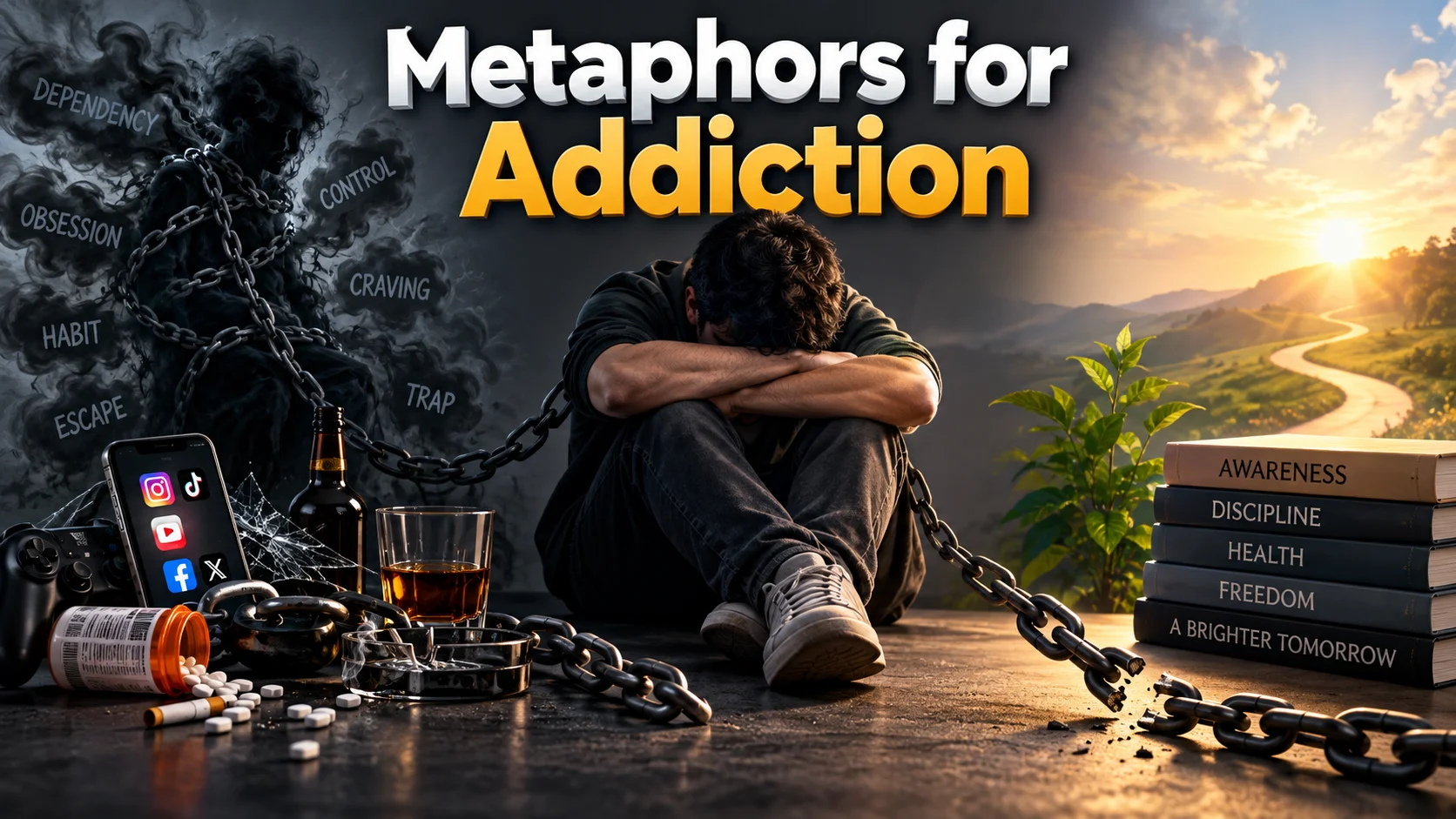
Metaphors for Addiction (With Examples) make a difficult subject easier to understand through clear and vivid mental pictures. Addiction, craving, and dependency may involve loss of control, emotional conflict, and a challenging recovery journey, yet ordinary language can struggle to describe these emotions and complexity.
A powerful metaphor can present addiction as an invisible battle, a chain that restricts movement, a storm that refuses to settle, or a maze where escape and a way out seem distant.
These images give readers greater emotional depth, clarity, and impact, whether they appear in poetry, memoirs, fiction, essays, speeches, recovery narratives, creative writing, an assignment, or personal experiences. This literary device uses figurative language, symbolism, and imagery to build communication, expression, and an emotional connection.
It can also show psychological struggle, emotional experience, addictive behavior, dependence, restraint, entrapment, turbulence, obstacles, control, freedom, confinement, chaos, and healing.
1. Addiction Is a Cage
Meaning: Addiction can feel like a cage that limits freedom and choice.
Detailed explanation:
A cage represents restriction. A person may understand that a behavior is harmful yet still feel unable to stop repeating it. The metaphor focuses on the feeling of being trapped by a habit or substance. It also communicates why simply telling someone to “just stop” may overlook the complexity of addiction.
Example sentence:
“His addiction felt like a cage, keeping him from the life he wanted.”
Three other ways to say it:
- Addiction can feel like being trapped behind invisible bars.
- Addiction can become a prison without walls.
- Addiction can make a person feel locked inside a destructive cycle.
2. Addiction Is a Storm
Meaning: Addiction can resemble a storm that creates chaos and emotional turbulence.
Detailed explanation:
A storm changes the environment suddenly. It brings strong winds, heavy rain, darkness, and uncertainty. Addiction can create similar disruption in someone’s life. This metaphor works especially well when discussing emotional struggles, setbacks, cravings, or difficult periods of recovery.
Example sentence:
“Her addiction was like a storm, shaking every part of her life.”
Three other ways to say it:
- Addiction can feel like weather that refuses to clear.
- Addiction can become a storm raging inside someone’s life.
- Addiction can resemble a violent emotional downpour.
3. Addiction Is Quicksand
Meaning: Addiction can be compared to quicksand because struggling against it can sometimes make the situation feel worse.
Detailed explanation:
Quicksand creates a powerful image of gradual entrapment. Someone may enter without realizing the danger, then discover that escaping requires careful effort. Addiction can develop in a similar way. What begins as occasional behavior may become increasingly difficult to control.
Example sentence:
“What started as casual drinking became quicksand, slowly pulling him deeper.”
Three other ways to say it:
- Addiction can feel like sinking deeper with every step.
- Addiction can become a trap that tightens over time.
- Addiction can resemble ground that gives way beneath you.
4. Addiction Is a Thief
Meaning: Addiction can act like a thief that quietly steals important parts of life.
Detailed explanation:
This metaphor highlights loss. Addiction may consume time, money, trust, opportunities, energy, or relationships. The word “thief” suggests that these losses can happen gradually. Someone might not recognize the full cost until addiction has taken much more than expected.
Example sentence:
“His addiction became a thief, stealing years that he wanted to spend with his family.”
Three other ways to say it:
- Addiction can steal pieces of a person’s future.
- Addiction can become a silent thief of time and trust.
- Addiction can take away moments that can’t be recovered.
5. Addiction Is a Shadow
Meaning: Addiction can resemble a shadow that follows someone wherever they go.
Detailed explanation:
A shadow stays close and can be difficult to escape. This metaphor captures the persistent nature of addiction and the way cravings or memories may remain present during recovery. It also works when describing the emotional effects that continue after someone begins changing their behavior.
Example sentence:
“Even after treatment, the memory of addiction remained a shadow behind him.”
Three other ways to say it:
- Addiction can feel like a darkness that follows you.
- Addiction can remain a constant presence in the background.
- Addiction can resemble a shadow that refuses to disappear.
6. Addiction Is a Chain
Meaning: Addiction can be described as a chain that connects a person to a harmful behavior.
Detailed explanation:
Chains symbolize restraint and dependence. Each repeated choice can feel like another link added to the chain. Breaking that pattern may require support, patience, treatment, and consistent effort. This metaphor emphasizes that addiction isn’t simply about lacking willpower.
Example sentence:
“Every relapse seemed to add another link to the chain of addiction.”
Three other ways to say it:
- Addiction can feel like being bound to a destructive habit.
- Addiction can become a chain around someone’s choices.
- Addiction can create bonds that are difficult to break alone.
7. Addiction Is a Maze
Meaning: Addiction can resemble a maze filled with confusing paths and difficult choices.
Detailed explanation:
A maze represents confusion and uncertainty. Someone dealing with addiction may want to change but struggle to identify the safest route forward. One decision can lead to another setback. Recovery can therefore feel less like walking down a straight road and more like finding a path through complicated turns.
Example sentence:
“Trying to overcome his addiction felt like finding his way through a maze.”
Three other ways to say it:
- Addiction can feel like being lost among countless wrong turns.
- Addiction can become a confusing path with no obvious exit.
- Addiction can resemble a maze of cravings, choices, and consequences.
8. Addiction Is a Leash
Meaning: Addiction can act like a leash that restricts a person’s ability to move freely.
Detailed explanation:
A leash controls movement. The person may want to move in another direction but repeatedly gets pulled back toward the addictive behavior. This metaphor can describe the tension between personal goals and compulsive patterns.
Example sentence:
“His addiction felt like a leash, pulling him away from the future he imagined.”
Three other ways to say it:
- Addiction can feel like something constantly pulling you backward.
- Addiction can become a tether to an unwanted habit.
- Addiction can resemble an invisible rope restricting your choices.
9. Addiction Is a Fire
Meaning: Addiction can resemble a fire that grows when it receives fuel.
Detailed explanation:
Fire provides a strong image for escalation. A small flame can become a large blaze when it receives enough fuel. Similarly, repeated substance use or compulsive behavior can become increasingly dominant. The metaphor also suggests urgency because uncontrolled fire can spread quickly.
Example sentence:
“His repeated gambling was a fire that kept consuming more of his life.”
Three other ways to say it:
- Addiction can become a flame that grows with every repetition.
- Addiction can resemble a blaze fed by constant cravings.
- Addiction can act like a fire that spreads beyond control.
10. Addiction Is a Prison
Meaning: Addiction can feel like living inside a prison created by dependence and compulsive behavior.
Detailed explanation:
A prison represents lost freedom. This metaphor emphasizes how addiction can narrow someone’s world. Priorities may change, relationships may suffer, and everyday decisions can revolve around obtaining or repeating the addictive behavior.
Example sentence:
“Over time, his addiction became a prison that seemed impossible to leave.”
Three other ways to say it:
- Addiction can feel like living behind invisible walls.
- Addiction can become a prison built from repeated habits.
- Addiction can create a life where freedom feels increasingly distant.
11. Addiction Is a Hungry Beast
Meaning: Addiction can be compared to a hungry beast that continually demands more.
Detailed explanation:
This metaphor emphasizes the relentless nature of cravings. A beast that is never satisfied represents an urge that keeps returning despite previous consequences. It can help explain why addiction may continue even when someone recognizes its damage.
Example sentence:
“His addiction was like a hungry beast, always demanding another escape.”
Three other ways to say it:
- Addiction can resemble an appetite that never feels satisfied.
- Addiction can become a relentless hunger for relief.
- Addiction can act like a creature constantly asking for more.
Read This: 20 Metaphors for a Person (With Examples)
12. Addiction Is a Broken Compass
Meaning: Addiction can resemble a broken compass that points someone away from their intended destination.
Detailed explanation:
A compass normally helps people find direction. When it breaks, navigation becomes difficult. Addiction can disrupt priorities and decision-making in a similar way. Someone may know what they value but repeatedly move in another direction.
Example sentence:
“His addiction became a broken compass, sending his life farther from his goals.”
Three other ways to say it:
- Addiction can feel like losing your sense of direction.
- Addiction can become a compass that points toward harmful choices.
- Addiction can make someone wander away from the life they wanted.
13. Addiction Is a Whirlpool
Meaning: Addiction can be described as a whirlpool that repeatedly pulls someone toward its center.
Detailed explanation:
A whirlpool creates a powerful circular motion. The image fits addiction because repeated behavior can create a cycle of craving, use, consequences, regret, and renewed craving. Without meaningful support, the cycle may continue.
Example sentence:
“Addiction became a whirlpool, pulling him back whenever he tried to move forward.”
Three other ways to say it:
- Addiction can feel like being caught in a powerful current.
- Addiction can become a cycle that keeps drawing you inward.
- Addiction can resemble water spinning you back toward the same place.
14. Addiction Is a False Friend
Meaning: Addiction can seem like a friend that offers comfort but ultimately causes harm.
Detailed explanation:
This metaphor focuses on the deceptive side of addiction. At first, the substance or behavior may seem to provide relief, confidence, pleasure, or escape. Over time, however, the relationship can become damaging. The metaphor helps explain why someone may feel attached to something that hurts them.
Example sentence:
“Alcohol seemed like a false friend, offering comfort before creating deeper problems.”
Three other ways to say it:
- Addiction can be a companion that slowly turns against you.
- Addiction can resemble a friend who always asks for too much.
- Addiction can become comfort that carries a hidden cost.
15. Addiction Is a Ticking Clock
Meaning: Addiction can resemble a ticking clock because its consequences may continue building over time.
Detailed explanation:
A ticking clock creates a sense of urgency. It suggests that waiting doesn’t necessarily stop the problem. This metaphor can describe the growing consequences associated with untreated addiction, including damaged relationships, financial difficulties, health risks, or lost opportunities.
Example sentence:
“His untreated addiction felt like a ticking clock, with every day bringing another consequence.”
Three other ways to say it:
- Addiction can feel like time steadily running out.
- Addiction can become a countdown toward greater consequences.
- Addiction can resemble a clock that keeps moving despite warnings.
16. Addiction Is a Fog
Meaning: Addiction can act like a fog that makes clear thinking and decision-making harder.
Detailed explanation:
Fog reduces visibility. You can see only part of the road ahead. Addiction can create a similar sense of uncertainty, particularly when cravings, denial, fear, or emotional distress influence decisions. The metaphor works well when discussing confusion and impaired perspective.
Example sentence:
“Addiction surrounded him like a thick fog, making the consequences difficult to see.”
Three other ways to say it:
- Addiction can feel like thinking through a clouded window.
- Addiction can create a haze around important decisions.
- Addiction can resemble fog that hides the road ahead.
17. Addiction Is a Broken Record
Meaning: Addiction can resemble a broken record that keeps repeating the same pattern.
Detailed explanation:
A broken record repeats the same section again and again. This image captures repetitive behavior. Someone may promise to stop, experience a setback, feel regret, and then repeat the cycle. The metaphor focuses on repetition rather than personal blame.
Example sentence:
“His addiction felt like a broken record, repeating the same painful cycle.”
Three other ways to say it:
- Addiction can become the same story playing repeatedly.
- Addiction can feel like a cycle stuck on repeat.
- Addiction can resemble a song that never reaches its ending.
18. Addiction Is an Anchor
Meaning: Addiction can act like an anchor that prevents someone from moving forward.
Detailed explanation:
An anchor keeps a vessel in one place. It can be useful in the right setting, but an unwanted anchor can prevent movement. This metaphor describes how addiction may interfere with progress, relationships, ambitions, and personal growth.
Example sentence:
“His addiction became an anchor, keeping him tied to a painful chapter of his life.”
Three other ways to say it:
- Addiction can feel like something holding you in place.
- Addiction can become a weight dragging progress backward.
- Addiction can resemble an anchor tied to your past.
19. Addiction Is a Puppet Master
Meaning: Addiction can be described as a puppet master controlling decisions from behind the scenes.
Detailed explanation:
A puppet master controls movements through hidden strings. The metaphor suggests that addiction can influence choices, priorities, routines, and reactions. It also captures the frustrating experience of knowing what you want to do while feeling pulled toward something else.
Example sentence:
“His addiction became a puppet master, quietly controlling decisions he once made freely.”
Three other ways to say it:
- Addiction can feel like invisible strings controlling your actions.
- Addiction can become a hidden force directing your choices.
- Addiction can resemble someone else holding the controls.
20. Addiction Is a Long Road Through the Dark
Meaning: Addiction can be viewed as a difficult journey through uncertainty that requires patience and support.
Detailed explanation:
This metaphor shifts attention toward the experience rather than the label. A dark road suggests fear, uncertainty, setbacks, and limited visibility. However, a road also implies movement. The image leaves room for recovery, support, growth, and a different destination.
Example sentence:
“Recovery from addiction felt like a long road through the dark, but each step brought a little more clarity.”
Three other ways to say it:
- Addiction can be a difficult journey toward a brighter place.
- Recovery can resemble walking through darkness while searching for daylight.
- Addiction can become a hard road that still has an exit.
MCQs:
1. His addiction felt like a ______ because he couldn’t seem to escape its grip.
A. Garden
B. Cage
C. Lantern
D. Bridge
Answer: B. Cage
2. The addiction was compared to a ______ because it created confusion and emotional turbulence.
A. Storm
B. Compass
C. Clock
D. Anchor
Answer: A. Storm
3. “Addiction became quicksand” mainly suggests that the person was ______.
A. Celebrating success
B. Becoming gradually trapped
C. Finding a shortcut
D. Feeling completely relaxed
Answer: B. Becoming gradually trapped
4. Which metaphor emphasizes the loss of time, trust, or opportunities?
A. Thief
B. Compass
C. Fog
D. Road
Answer: A. Thief
5. Addiction as a “shadow” suggests that it ______.
A. Always brings happiness
B. Disappears immediately
C. Can remain a persistent presence
D. Provides clear direction
Answer: C. Can remain a persistent presence
6. Which metaphor emphasizes restriction and dependence?
A. Chain
B. Garden
C. Window
D. Sunrise
Answer: A. Chain
7. Addiction as a maze mainly represents ______.
A. Confusion and difficult choices
B. Physical strength
C. Financial success
D. Instant recovery
Answer: A. Confusion and difficult choices
8. Which metaphor suggests that addiction repeatedly pulls someone backward?
A. Leash
B. Lantern
C. Mirror
D. Door
Answer: A. Leash
9. Addiction as a “fire” emphasizes how the problem can ______.
A. Disappear without effort
B. Grow when continually fueled
C. Become harmless immediately
D. Create perfect balance
Answer: B. Grow when continually fueled
10. Which metaphor most directly represents lost freedom?
A. Prison
B. Flower
C. River
D. Window
Answer: A. Prison
11. “Addiction is a hungry beast” emphasizes ______.
A. A constant demand for more
B. Complete emotional peace
C. Physical exercise
D. A peaceful environment
Answer: A. A constant demand for more
12. A broken compass is an appropriate metaphor because addiction can ______.
A. Improve someone’s direction
B. Disrupt priorities and decision-making
C. Make every choice simple
D. Guarantee success
Answer: B. Disrupt priorities and decision-making
13. Which metaphor represents a repeating cycle?
A. Broken record
B. Mountain peak
C. Open window
D. Candle
Answer: A. Broken record
14. Addiction as an “anchor” suggests that it can ______.
A. Help someone move faster
B. Prevent progress
C. Remove every obstacle
D. Create instant freedom
Answer: B. Prevent progress
15. Which metaphor leaves the strongest room for hope and recovery?
A. A long road through the dark
B. A locked door with no key
C. A permanent wall
D. A disappearing path
Answer: A. A long road through the dark
FAQs:
What is a metaphor for addiction?
A metaphor for addiction compares addiction to something familiar, such as a cage, storm, chain, or maze. It helps explain complicated emotional and behavioral experiences through vivid imagery.
What is the best metaphor for addiction?
There isn’t one universally best metaphor. “Addiction is a cage” works well for describing lost freedom, while “addiction is a storm” emphasizes emotional chaos. Choose the image that matches your intended meaning.
Why use metaphors when talking about addiction?
Metaphors can make difficult subjects easier to understand and discuss. They allow you to describe feelings such as helplessness, confusion, repetition, or loss without relying only on clinical language.
What metaphor describes the cycle of addiction?
“Addiction is a whirlpool” and “addiction is a broken record” both describe repetitive cycles. A whirlpool emphasizes being repeatedly pulled back, while a broken record emphasizes the repetition itself.
Can metaphors for addiction communicate hope?
Yes. “Addiction is a long road through the dark” can communicate struggle while leaving room for progress and recovery. Hopeful metaphors can acknowledge difficulty without suggesting that change is impossible.
Conclusion:
Metaphors for Addiction (With Examples) give us a clearer and more human way to understand a complicated experience. Addiction is not simply about a habit or a choice. It can feel like a chain, a storm, a maze, or a tangled web that becomes difficult to escape.
These comparisons help explain the craving, dependency, emotional conflict, and loss of control that someone may experience. They also show that recovery can involve obstacles, uncertainty, emotional struggles, and gradual healing.
Metaphors are especially useful because they turn abstract experiences into pictures that people can easily imagine. A strong metaphor can create emotional depth without making the topic harder to understand. Whether used in creative writing, personal stories, speeches, essays, or recovery narratives, figurative language can help readers connect with experiences that are often difficult to describe in ordinary language.
The right metaphor does more than describe a struggle; it can help people recognize the challenge while leaving room for hope, recovery, freedom, and healing.














1 thought on “20 Metaphors for Addiction (With Examples)”