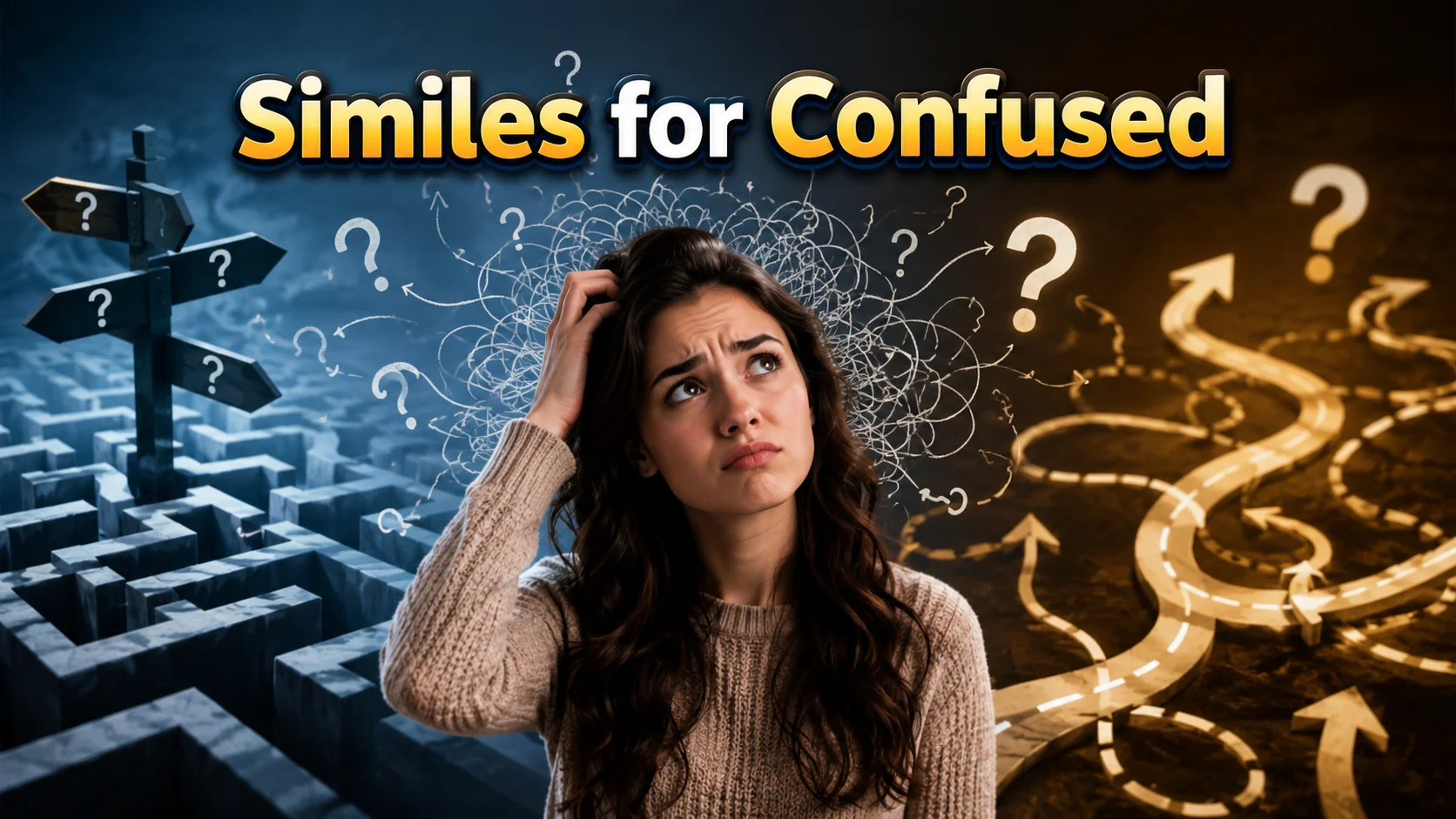
Similes for Confused (With Examples) make confusion easier to explain, using vivid comparisons that turn uncertain feelings into clear words.
When you’re bewildered, puzzled, or lost in thought, similes can capture the essence of being confused and make abstract feelings easier to understand. In life situations, confusion may feel like a stormy sea, with your minds that swirl while searching for an exit from a maze.
This comparison makes uncertainty more relatable for writers, students, and creative people who want to express mental chaos with flair and depth. For example, being like a light feather drifting through a storm creates vivid imagery and colorful descriptions. These comparisons can turn ordinary moments into memorable literary works, while improving communication, storytelling, and writing skills.
Lets Dive
1. Like a Compass Spinning Without Direction
Meaning: This simile describes someone who feels completely unsure about which direction to take.
Detailed explanation:
A compass normally helps you find your direction. When you imagine one spinning endlessly, it represents a mind that can’t settle on an answer or decision. This is especially useful when someone feels lost between several choices.
Example:
“I felt like a compass spinning without direction when everyone gave me different advice.”
3 other ways to say it:
- Like a map with no marked roads
- Like a traveler without a destination
- Like a ship drifting without a course
2. Like a Puzzle With Missing Pieces
Meaning: This describes feeling confused because you don’t have all the information needed to understand something.
Detailed explanation:
A puzzle becomes difficult when important pieces are missing. In the same way, a person may struggle to understand a situation because some facts, details, or explanations are unavailable.
Example:
“His explanation left me like a puzzle with missing pieces.”
3 other ways to say it:
- Like a picture with parts missing
- Like a mystery without clues
- Like a story with missing pages
3. Like a Foggy Road at Midnight
Meaning: This simile describes deep uncertainty when the way forward isn’t clear.
Detailed explanation:
A foggy road at night makes it difficult to see what lies ahead. The comparison works well when someone doesn’t know what will happen next or which choice is safest.
Example:
“After hearing the unexpected news, the future seemed like a foggy road at midnight.”
3 other ways to say it:
- Like walking through thick fog
- Like driving with a blurred windshield
- Like traveling through darkness without a light
4. Like a Jigsaw Scattered Across the Floor
Meaning: This means your thoughts or information feel disorganized and difficult to put together.
Detailed explanation:
A completed jigsaw gives you a clear picture. Scattered pieces, however, offer no obvious answer. This simile is useful when someone has many thoughts but cannot organize them into a clear understanding.
Example:
“My thoughts were like a jigsaw scattered across the floor after the meeting.”
3 other ways to say it:
- Like pieces of a puzzle thrown everywhere
- Like a picture broken into fragments
- Like scattered clues waiting to connect
5. Like a Traffic Circle With No Exit
Meaning: This describes feeling stuck in repeated thoughts without knowing how to move forward.
Detailed explanation:
A traffic circle is designed to help drivers choose an exit. Imagining one with no exit creates a strong picture of someone going around and around without reaching a solution.
Example:
“My mind felt like a traffic circle with no exit as I considered every possible answer.”
3 other ways to say it:
- Like running in circles
- Like walking through a maze without an exit
- Like being stuck on a road that never ends
6. Like a Radio Between Stations
Meaning: This means your thoughts feel unclear, mixed, or filled with conflicting information.
Detailed explanation:
When a radio sits between stations, you may hear fragments of different sounds instead of one clear broadcast. Similarly, confusion can happen when several thoughts compete for your attention.
Example:
“After everyone started talking at once, my mind was like a radio between stations.”
3 other ways to say it:
- Like a television losing its signal
- Like several voices speaking at once
- Like a message buried under static
7. Like a Maze Without a Map
Meaning: This describes being unsure which path to follow.
Detailed explanation:
A maze can be challenging even when you know your destination. Without a map, every turn becomes uncertain. This simile works particularly well for difficult decisions and unfamiliar situations.
Example:
“Choosing between the two careers felt like a maze without a map.”
3 other ways to say it:
- Like wandering through an unfamiliar maze
- Like searching for a door in the dark
- Like taking turns without knowing where they lead
8. Like a Book Written in a Foreign Language
Meaning: This describes something that feels impossible to understand.
Detailed explanation:
If you cannot understand the language of a book, the words may be visible but their meaning remains inaccessible. This simile is helpful when a complicated explanation or unfamiliar subject leaves someone puzzled.
Example:
“The technical instructions looked like a book written in a foreign language.”
3 other ways to say it:
- Like reading words you don’t understand
- Like listening to an unfamiliar language
- Like staring at symbols without a key
9. Like a Ship Lost at Sea
Meaning: This means feeling uncertain, directionless, or emotionally lost.
Detailed explanation:
A ship at sea needs navigation to reach its destination. A ship that loses its course can drift without knowing where it will end up. The image can describe both practical uncertainty and emotional confusion.
Example:
“After graduating, I felt like a ship lost at sea, unsure of what to do next.”
3 other ways to say it:
- Like a boat drifting without an anchor
- Like a sailor without a compass
- Like a vessel without a destination
10. Like a Cloud of Questions
Meaning: This describes having so many unanswered questions that clear thinking becomes difficult.
Detailed explanation:
A cloud can obscure your view. In the same way, numerous questions can fill your mind and make it difficult to see a clear answer.
Example:
“After the sudden change in plans, my mind was like a cloud of questions.”
3 other ways to say it:
- Like a head full of unanswered questions
- Like thoughts covered in mist
- Like a mind crowded with doubts
11. Like a Clock With All the Hands Moving
Meaning: This describes feeling overwhelmed by too many thoughts, possibilities, or priorities at once.
Detailed explanation:
A clock is normally easy to read because its hands follow a predictable pattern. If every hand moved unpredictably, reading it would become difficult. This comparison captures mental overload.
Example:
“With deadlines, messages, and decisions piling up, I felt like a clock with all the hands moving.”
3 other ways to say it:
- Like trying to follow several clocks at once
- Like watching time move in every direction
- Like having too many thoughts ticking at once
12. Like Walking Through a Hall of Mirrors
Meaning: This simile describes confusion caused by multiple possibilities, distorted impressions, or uncertainty about what is real or correct.
Detailed explanation:
A hall of mirrors can make it difficult to tell where you are going because every direction shows a different reflection. It works well when someone receives contradictory information.
Example:
“Trying to understand everyone’s conflicting stories was like walking through a hall of mirrors.”
3 other ways to say it:
- Like looking at countless reflections
- Like trying to find the real path among illusions
- Like standing among endless confusing images
13. Like a Crossword With Every Clue Blurred
Meaning: This means feeling unable to find answers because the information you have isn’t clear enough.
Detailed explanation:
A crossword depends on clues. If those clues become unreadable, even someone who normally enjoys puzzles may struggle. This simile emphasizes a lack of clarity rather than a lack of intelligence.
Example:
“The instructions were like a crossword with every clue blurred.”
3 other ways to say it:
- Like solving a puzzle with unclear clues
- Like answering questions without enough information
- Like searching for answers behind a blur
14. Like a Traveler at a Road With Ten Signs
Meaning: This describes confusion caused by too many choices or directions.
Detailed explanation:
Having several options can sometimes make a decision harder rather than easier. A traveler facing ten signs may hesitate because each direction promises a different destination.
Example:
“With so many job offers, I felt like a traveler at a road with ten signs.”
3 other ways to say it:
- Like standing at a crossroads with endless choices
- Like choosing between too many paths
- Like a traveler surrounded by conflicting directions
15. Like a Computer With Too Many Windows Open
Meaning: This describes a mind that feels overloaded with thoughts, tasks, and information.
Detailed explanation:
When too many computer windows are open, it becomes difficult to focus on one task. The same thing can happen mentally when several concerns compete for your attention.
Example:
“My brain felt like a computer with too many windows open after studying all night.”
3 other ways to say it:
- Like a computer overloaded with tasks
- Like having dozens of thoughts running at once
- Like a screen crowded with information
16. Like a Detective Without Any Clues
Meaning: This means feeling unable to understand a situation because there isn’t enough evidence or information.
Detailed explanation:
A detective depends on clues to solve a mystery. Without clues, even careful reasoning has limits. This simile is useful when someone wants an explanation but hasn’t been given enough information.
Example:
“When they refused to explain what happened, I felt like a detective without any clues.”
3 other ways to say it:
- Like a detective with no evidence
- Like solving a mystery without clues
- Like searching for an answer with no leads
17. Like a Needle Lost in a Haystack
Meaning: This describes difficulty finding one clear answer among many possibilities.
Detailed explanation:
A needle hidden in a haystack is difficult to locate because it disappears among countless pieces of material. Similarly, one useful answer can become difficult to identify when too much information surrounds it.
Example:
“Finding the correct answer among all those explanations felt like looking for a needle in a haystack.”
3 other ways to say it:
- Like searching for one voice in a crowd
- Like finding one answer among hundreds
- Like looking for a tiny clue in a mountain of information
18. Like a Dream You Can’t Quite Remember
Meaning: This simile describes a vague or unclear feeling that you understand something only partially.
Detailed explanation:
Sometimes you wake from a dream knowing that something happened but cannot remember the details. This comparison works beautifully for unclear memories, feelings, or ideas that seem almost understandable.
Example:
“The conversation felt like a dream I couldn’t quite remember.”
3 other ways to say it:
- Like trying to hold onto a fading dream
- Like remembering only pieces of a memory
- Like reaching for something just beyond understanding
19. Like a Map Turned Upside Down
Meaning: This describes having information but struggling to interpret or use it correctly.
Detailed explanation:
A map is supposed to provide direction, but turning it around can make familiar places seem unfamiliar. This simile shows that confusion can sometimes come from looking at the right information from the wrong perspective.
Example:
“I understood the instructions, but applying them felt like reading a map turned upside down.”
3 other ways to say it:
- Like following a map backward
- Like seeing familiar directions from the wrong angle
- Like trying to navigate with an inverted map
20. Like Standing at a Crossroads in the Dark
Meaning: This means feeling uncertain about which choice to make when the consequences aren’t clear.
Detailed explanation:
A crossroads represents a moment of choice. Darkness makes every path harder to judge. Together, the images create a powerful way to describe uncertainty, especially when someone cares deeply about making the right decision.
Example:
“After receiving two very different opportunities, I felt like standing at a crossroads in the dark.”
3 other ways to say it:
- Like choosing a path without seeing where it leads
- Like standing between two uncertain futures
- Like making a decision without knowing the outcome
MCQs:
- Which simile best describes someone who doesn’t know which direction to take?
A. Like a cloud of questions
B. Like a compass spinning without direction
C. Like a book written in a foreign language
D. Like a dream you can’t quite remember
Answer: B — Like a compass spinning without direction
- Which simile suggests missing information?
A. Like a puzzle with missing pieces
B. Like a ship lost at sea
C. Like a traffic circle with no exit
D. Like a clock with all the hands moving
Answer: A — Like a puzzle with missing pieces
- “The instructions made no sense to me” could be compared to:
A. A ship with a destination
B. A clear road
C. A book written in a foreign language
D. A finished puzzle
Answer: C — Like a book written in a foreign language
- Which simile describes repeated thoughts with no clear solution?
A. Like a traffic circle with no exit
B. Like a crossword with every clue blurred
C. Like a ship lost at sea
D. Like a map turned upside down
Answer: A — Like a traffic circle with no exit
- Which simile best represents mental overload?
A. Like a computer with too many windows open
B. Like a traveler with one clear destination
C. Like a compass pointing north
D. Like a completed crossword
Answer: A — Like a computer with too many windows open
- “I had so many unanswered questions” best matches:
A. Like a cloud of questions
B. Like a ship lost at sea
C. Like a map turned upside down
D. Like a traveler at a road with ten signs
Answer: A — Like a cloud of questions
- Which simile describes conflicting information?
A. Like a hall of mirrors
B. Like a completed puzzle
C. Like a clear road
D. Like a compass with one direction
Answer: A — Like a hall of mirrors
- Which simile best describes too many choices?
A. Like a detective without clues
B. Like a traveler at a road with ten signs
C. Like a dream you remember clearly
D. Like a book you understand perfectly
Answer: B — Like a traveler at a road with ten signs
- Someone who lacks evidence to understand a situation is like:
A. A detective without any clues
B. A traveler with a map
C. A ship with a compass
D. A reader with a clear book
Answer: A — Like a detective without any clues
- Which simile represents a vague memory or unclear feeling?
A. Like a dream you can’t quite remember
B. Like a traffic circle with no exit
C. Like a computer with too many windows open
D. Like a compass spinning without direction
Answer: A — Like a dream you can’t quite remember
- Which simile describes information that is difficult to interpret correctly?
A. Like a map turned upside down
B. Like a cloud of questions
C. Like a ship lost at sea
D. Like a detective without clues
Answer: A — Like a map turned upside down
- “I couldn’t find the one useful answer among all the information” best matches:
A. Like a needle lost in a haystack
B. Like a radio between stations
C. Like a foggy road at midnight
D. Like a dream you can’t remember
Answer: A — Like a needle lost in a haystack
- Which simile best describes uncertainty about the future?
A. Like standing at a crossroads in the dark
B. Like reading a clear map
C. Like finishing a puzzle
D. Like following a familiar road
Answer: A — Like standing at a crossroads in the dark
- A mind receiving fragments of different information can be compared to:
A. A radio between stations
B. A compass pointing correctly
C. A completed puzzle
D. A marked road
Answer: A — Like a radio between stations
- Which simile best describes thoughts that are scattered and difficult to organize?
A. Like a jigsaw scattered across the floor
B. Like a clear road
C. Like a finished book
D. Like a compass with a fixed direction
Answer: A — Like a jigsaw scattered across the floor
FAQs:
What is a simile for confused?
A useful simile for confused is “like a lost traveler without a map.” It shows uncertainty, difficulty finding direction, and not knowing what to do next.
What are some good similes for feeling confused?
Popular examples include “like wandering through a maze,” “like a ship lost at sea,” and “as confused as a puzzle with missing pieces.” Each creates a clear mental picture.
How do you describe confusion in a creative way?
Use a familiar situation to represent the feeling. For example, “My thoughts were like tangled headphones” makes confusion easy to imagine while keeping the expression natural.
Why are similes useful for describing confusion?
Similes turn abstract emotions into visual images. Instead of simply saying you’re confused, you can compare your feelings to something readers already understand.
What is a short simile for confused?
A simple option is “confused like a lost traveler.” It’s short, natural, and works well in conversations, captions, stories, and creative writing.
Conclusion:
Similes for Confused (With Examples) make it easier to explain feelings that can be difficult to put into words. When your thoughts feel like a stormy sea or as confusing as a maze, comparisons give others a clearer picture of your emotions.
They add vivid imagery, depth, and emotional resonance to everyday communication. Whether you’re writing stories, poems, essays, or songs, the right simile can make confusion feel more relatable and memorable. Keep exploring different comparisons, and choose expressions that match the situation, feeling, and message you want to share.