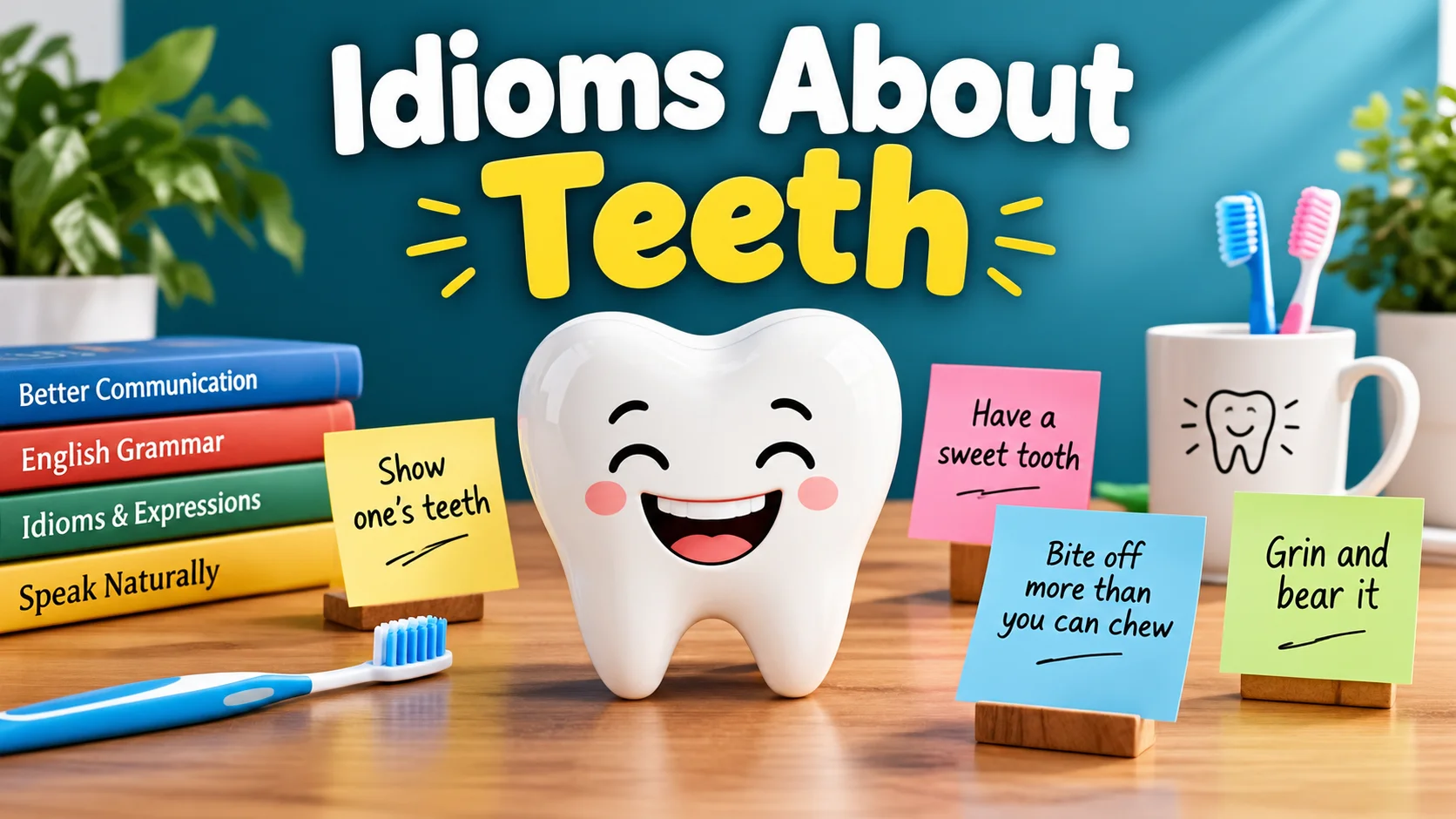
Idioms About Teeth (With Examples) help English learners understand vivid phrases, figurative meanings, and common sayings in everyday English. Teeth, idioms, and sayings make the English language more vivid and memorable when you focus on the real meaning instead of the literal meaning of each phrase.
For example, by the skin of your teeth describes success after a difficult struggle, while like pulling teeth shows difficulty and frustration when a task feels especially hard. These tooth idioms may seem silly to an English learner, but their figurative language becomes easier to understand when you consider the context and see clear examples.
This guide presents useful expressions in a practical list, including two example sentences, a clear meaning, and alternative ways to express the same idea. Common phrases include has teeth, which suggests power and authority, cut your teeth, which refers to gaining experience and developing skill, and armed to the teeth, which shows readiness or being fully prepared.
1. Fight Tooth and Nail
Meaning: To fight or struggle with great determination and effort.
Detailed explanation:
When someone fights tooth and nail, they use every possible effort to achieve something or protect what matters to them. The phrase suggests intense resistance and persistence. It doesn’t usually describe a literal physical fight. Instead, it often describes someone defending an idea, goal, position, relationship, or right.
Example:
“She fought tooth and nail to keep her family business open.”
Three other ways to say it:
- Fight with everything you have
- Struggle fiercely
- Give it your all
2. Lie Through Your Teeth
Meaning: To tell a deliberate and obvious lie.
Detailed explanation:
If someone lies through their teeth, they knowingly say something untrue while often appearing confident or convincing. The idiom emphasizes that the person knows they’re lying. It can describe anything from a small excuse to a serious deception.
Example:
“He lied through his teeth when he said he had never seen the missing documents.”
Three other ways to say it:
- Tell a blatant lie
- Deliberately deceive someone
- Be completely dishonest
3. By the Skin of Your Teeth
Meaning: To succeed or escape something by an extremely narrow margin.
Detailed explanation:
When you accomplish something by the skin of your teeth, you barely manage to do it. The expression often describes narrowly avoiding failure, danger, or a missed opportunity. It adds drama to situations where success comes at the very last moment.
Example:
“We caught the last train by the skin of our teeth.”
Three other ways to say it:
- Barely succeed
- Just make it
- By a very narrow margin
4. Long in the Tooth
Meaning: To be getting old or older than expected.
Detailed explanation:
Long in the tooth is a humorous way to refer to aging. It can describe a person, animal, object, or even an idea that has existed for a long time. The phrase often sounds playful, although you should use it carefully when talking about someone’s age.
Example:
“That old laptop is getting long in the tooth, so it may be time for an upgrade.”
Three other ways to say it:
- Getting old
- Past its prime
- Showing its age
5. Cut Your Teeth
Meaning: To gain your first important experience in a particular activity or profession.
Detailed explanation:
When you cut your teeth doing something, you learn valuable skills through early experience. The phrase often describes the beginning of someone’s career or development. Those first opportunities may be challenging, but they help prepare you for bigger responsibilities.
Example:
“She cut her teeth as a young reporter covering local events.”
Three other ways to say it:
- Gain early experience
- Learn the ropes
- Get your first real experience
6. Get Your Teeth Into Something
Meaning: To become deeply involved in an interesting or challenging task.
Detailed explanation:
When you get your teeth into something, you become fully engaged with it. The expression often suggests enthusiasm, concentration, and determination. It works especially well for demanding projects that require serious attention.
Example:
“I can’t wait to get my teeth into this new research project.”
Three other ways to say it:
- Dive into something
- Become deeply involved
- Tackle something seriously
7. Sink Your Teeth Into Something
Meaning: To become fully engaged with something substantial or challenging.
Detailed explanation:
Sink your teeth into has a similar meaning to “get your teeth into.” It suggests that you’re ready to give something your full attention. You might use it for a difficult project, an exciting book, a complex problem, or a satisfying meal.
Example:
“After finishing the routine tasks, she finally sank her teeth into the main assignment.”
Three other ways to say it:
- Dig into something
- Take on a challenge
- Give something your full attention
8. Grit Your Teeth
Meaning: To endure something painful, difficult, or unpleasant with determination.
Detailed explanation:
When you grit your teeth, you mentally prepare yourself to tolerate a difficult situation. The expression comes from the physical action of pressing your teeth together. In everyday speech, it often represents patience and resilience rather than literal pain.
Example:
“He gritted his teeth and finished the final mile of the race.”
Three other ways to say it:
- Endure the difficulty
- Tough it out
- Push through the pain
9. Pull Teeth
Meaning: To have great difficulty getting information or cooperation from someone.
Detailed explanation:
If getting an answer from someone feels like pulling teeth, that person is probably reluctant, uncommunicative, or difficult to persuade. The expression exaggerates the difficulty to make the situation sound more vivid.
Example:
“It was like pulling teeth to get the witness to explain what happened.”
Three other ways to say it:
- Struggle to get an answer
- Have trouble getting information
- Work hard to get cooperation
10. Like Pulling Teeth
Meaning: Something is extremely difficult or frustrating to accomplish.
Detailed explanation:
Like pulling teeth describes a task that requires far more effort than it should. It often applies to conversations, requests, or situations where another person refuses to cooperate easily. The phrase is informal and expressive.
Example:
“Getting everyone to agree on a meeting time was like pulling teeth.”
Three other ways to say it:
- Extremely difficult
- A real struggle
- Hard work for little progress
Read This: 20 Similes for Brain (With Examples)
11. Sweet Tooth
Meaning: A strong liking for sweet foods.
Detailed explanation:
Someone with a sweet tooth enjoys desserts, candy, chocolate, pastries, or other sugary treats. This expression is usually friendly and casual. It can describe a lasting preference rather than an occasional craving.
Example:
“My sister has a serious sweet tooth, especially when it comes to chocolate cake.”
Three other ways to say it:
- Love sweets
- Have a craving for desserts
- Enjoy sugary treats
12. Tooth and Nail
Meaning: With maximum effort, determination, or resistance.
Detailed explanation:
The phrase tooth and nail often appears in expressions such as “fight tooth and nail.” On its own, it conveys the idea of using every available means to resist something or achieve a goal. It emphasizes strong commitment.
Example:
“The community defended the historic building tooth and nail.”
Three other ways to say it:
- With all your strength
- With fierce determination
- With every possible effort
13. Armed to the Teeth
Meaning: Carrying or possessing a very large amount of weapons or equipment.
Detailed explanation:
Someone or something described as armed to the teeth is heavily equipped or prepared for conflict. The expression is often used figuratively too, especially when someone has an unusually large amount of resources or tools for a particular purpose.
Example:
“The expedition team arrived armed to the teeth with safety equipment.”
Three other ways to say it:
- Heavily equipped
- Fully prepared
- Loaded with equipment
14. Tooth for a Tooth
Meaning: The idea of responding to harm with equivalent retaliation.
Detailed explanation:
Tooth for a tooth expresses the principle of returning an injury or wrong in equal measure. It relates to the older expression “an eye for an eye, a tooth for a tooth.” In modern conversation, it can describe revenge or proportional retaliation.
Example:
“He believed in a tooth-for-a-tooth approach whenever someone wronged him.”
Three other ways to say it:
- Equal retaliation
- Return the same treatment
- Repay harm with equivalent harm
15. Bare Your Teeth
Meaning: To show anger, aggression, or a willingness to fight back.
Detailed explanation:
To bare your teeth originally refers to exposing your teeth as an animal might do when threatened. Figuratively, it means showing that you’re prepared to defend yourself or resist pressure. The phrase can suggest strength and warning.
Example:
“The small company bared its teeth when a larger competitor threatened its market.”
Three other ways to say it:
- Show your strength
- Stand your ground
- Show you’re ready to fight back
16. Get Your Teeth Kicked In
Meaning: To suffer a severe defeat or setback.
Detailed explanation:
Get your teeth kicked in is an informal and strongly expressive idiom. It can describe a literal fight, but it’s also commonly used figuratively for losing badly in competition or facing a harsh setback. Because the wording is aggressive, it fits casual contexts better than formal writing.
Example:
“Our team got its teeth kicked in during the championship match.”
Three other ways to say it:
- Suffer a heavy defeat
- Lose badly
- Take a serious beating
17. Give Someone a Taste of Their Own Medicine
Meaning: To treat someone in the same unpleasant way they treated others.
Detailed explanation:
This expression doesn’t directly contain the word “teeth,” but it often appears in discussions of biting, harsh behavior, and retaliation. It means responding to someone’s behavior by giving them a similar experience. The phrase can be playful or critical depending on the situation.
Example:
“She decided to give him a taste of his own medicine after he repeatedly interrupted her.”
Three other ways to say it:
- Return the same treatment
- Give someone what they gave you
- Respond in kind
18. Eye Tooth
Meaning: A canine tooth, especially one located beneath or near the eye.
Detailed explanation:
An eye tooth is a traditional term for a canine tooth. The name comes from the tooth’s position below the eye area. Although this expression is more literal than many other tooth-related idioms, it appears in everyday and descriptive language.
Example:
“The dentist explained that her eye tooth needed careful treatment.”
Three other ways to say it:
- Canine tooth
- Pointed tooth
- Canine
19. Toothsome
Meaning: Attractive, appealing, or delicious, depending on context.
Detailed explanation:
Toothsome has an interesting double sense. It can describe food that tastes delicious or someone who looks attractive. The food-related meaning is less common today, while the attractive-person meaning can sound old-fashioned or playful.
Example:
“The bakery displayed a toothsome selection of fresh pastries.”
Three other ways to say it:
- Delicious
- Appetizing
- Tempting
20. Have a Bone to Pick
Meaning: To have a complaint or disagreement that you want to discuss.
Detailed explanation:
Although this idiom uses bone rather than tooth, it belongs naturally with expressions about the mouth and chewing. If you have a bone to pick with someone, you have an issue you want to raise. The phrase can sound serious, but people also use it humorously.
Example:
“I have a bone to pick with you about what happened at yesterday’s meeting.”
Three other ways to say it:
- Have an issue to discuss
- Have a complaint
- Want to settle a disagreement
MCQs:
1. What does “fight tooth and nail” mean?
A. Eat quickly
B. Fight with great determination
C. Visit a dentist
D. Avoid an argument
Answer: B. Fight with great determination
2. If someone “lies through their teeth,” they are:
A. Whispering
B. Confused
C. Deliberately lying
D. Speaking quietly
Answer: C. Deliberately lying
3. What does “by the skin of your teeth” mean?
A. You succeed easily
B. You barely succeed
C. You fail completely
D. You change your plans
Answer: B. You barely succeed
4. Someone who has “a sweet tooth” usually loves:
A. Spicy food
B. Salty snacks
C. Sweet foods
D. Sour drinks
Answer: C. Sweet foods
5. What does “cut your teeth” mean?
A. Gain early experience
B. Lose confidence
C. Avoid responsibility
D. Make a mistake
Answer: A. Gain early experience
6. If you “grit your teeth,” you are usually:
A. Giving up
B. Enduring something difficult
C. Laughing loudly
D. Eating dessert
Answer: B. Enduring something difficult
7. What does “long in the tooth” usually suggest?
A. Being young
B. Being energetic
C. Being old or aging
D. Being wealthy
Answer: C. Being old or aging
8. If getting information is “like pulling teeth,” it is:
A. Very easy
B. Extremely difficult
C. Completely unnecessary
D. Very entertaining
Answer: B. Extremely difficult
9. What does “bare your teeth” mean figuratively?
A. Show anger or readiness to resist
B. Smile politely
C. Hide your feelings
D. Tell a joke
Answer: A. Show anger or readiness to resist
10. Someone who is “armed to the teeth” is:
A. Poorly prepared
B. Heavily equipped
C. Completely relaxed
D. Uninterested
Answer: B. Heavily equipped
11. What does “sink your teeth into something” mean?
A. Avoid a task
B. Become deeply involved
C. Finish something instantly
D. Forget a responsibility
Answer: B. Become deeply involved
12. What does “tooth for a tooth” suggest?
A. Forgiveness
B. Equal retaliation
C. Friendship
D. Cooperation
Answer: B. Equal retaliation
13. What does “get your teeth kicked in” often mean figuratively?
A. Win easily
B. Suffer a heavy defeat
C. Become famous
D. Gain experience
Answer: B. Suffer a heavy defeat
14. What does “have a bone to pick” mean?
A. Have a complaint or disagreement
B. Have a meal
C. Need dental care
D. Start exercising
Answer: A. Have a complaint or disagreement
15. What does “toothsome” mean when describing food?
A. Bitter
B. Tasteless
C. Delicious or appetizing
D. Expensive
Answer: C. Delicious or appetizing
FAQs:
What are idioms about teeth?
Idioms about teeth are common English expressions that use teeth or tooth-related words to express an idea beyond their literal meaning. For example, “by the skin of your teeth” means achieving something by a very narrow margin.
What does “by the skin of your teeth” mean?
“By the skin of your teeth” means succeeding or escaping something by a very small margin. For example, you might say, “I passed the exam by the skin of my teeth.”
What does “like pulling teeth” mean?
“Like pulling teeth” describes something that is extremely difficult, slow, or frustrating to accomplish. It can also describe getting information from someone who doesn’t want to talk.
What does “cut your teeth” mean?
“Cut your teeth” means gaining your first important experience in a particular activity, job, or field. It often refers to learning valuable skills through practical experience.
What does “armed to the teeth” mean?
“Armed to the teeth” means being extremely well-equipped or fully prepared for a situation. It can describe people, groups, or even organizations that have everything they need to deal with a challenge.
Conclusion:
Idioms About Teeth (With Examples) show how simple words can carry powerful and unexpected meanings. From by the skin of your teeth to like pulling teeth, these expressions make everyday
English more vivid, natural, and memorable. Learning their meanings and seeing them in context can help you speak with confidence, understand native English more easily, and add personality to your writing.
Whether you’re an English learner, writer, student, or simply curious about unusual phrases, adding teeth idioms to your vocabulary is a smart way to improve your communication skills. Keep practicing these expressions in real conversations, writing, and reading, and soon you’ll know exactly when to use the right idiom.














1 thought on “20 Idioms About Teeth (With Examples)”