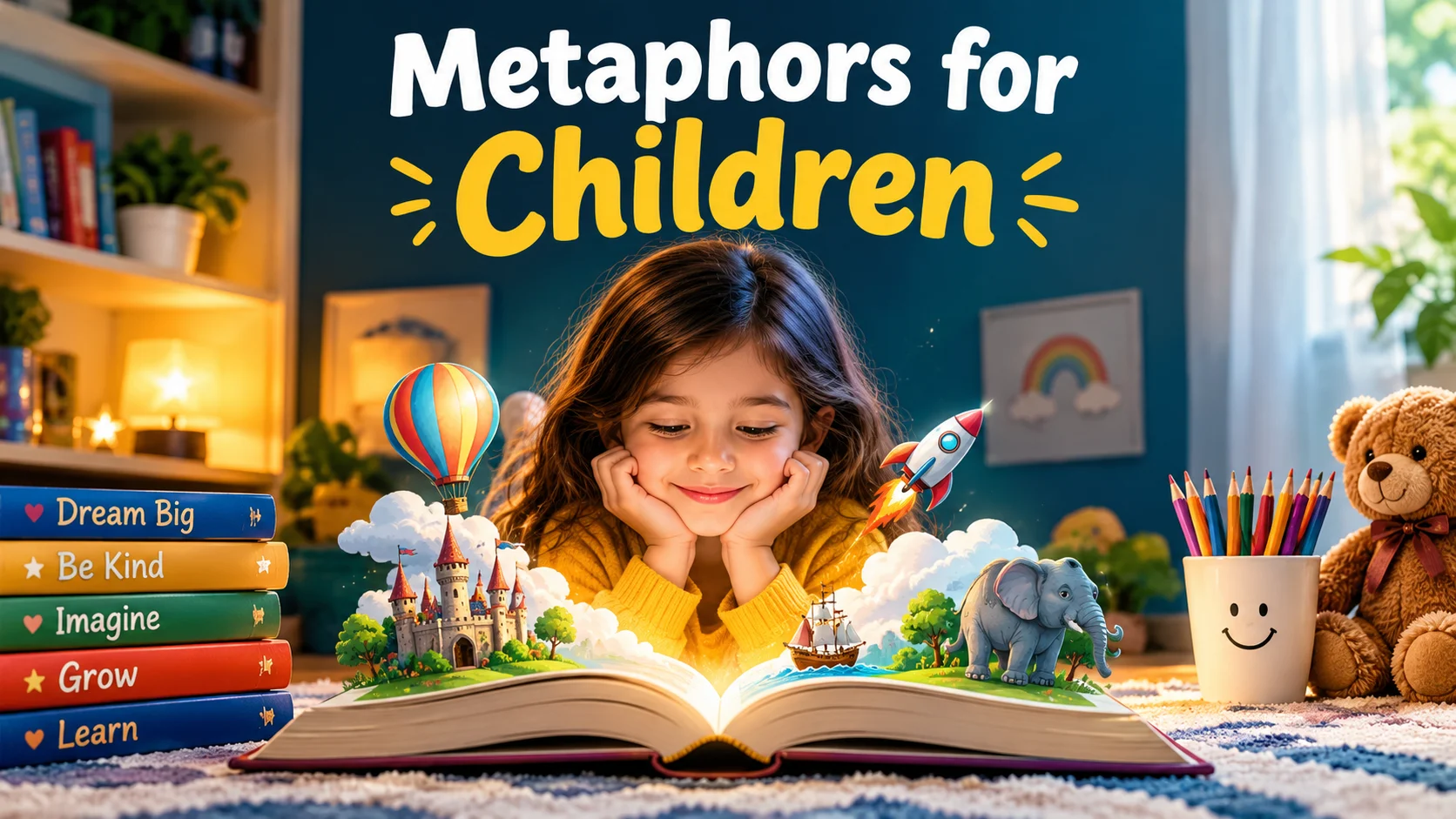
Metaphors for Children (With Examples) can help kids, children, and students learn language through simple, fun, friendly, child-simple, and easy-to-understand comparisons. A metaphor lets you describe one thing as another thing; for example, saying “The classroom was a zoo” doesn’t mean real animals are present, but suggests the room is noisy, busy, or hard to control.
This comparison makes an idea clear, creative, and meaningful, helping children remember concepts and learn faster. Unlike similes, metaphors make direct comparisons. In real life, real-life experience, conversations, and everyday uses, children can use familiar language naturally.
A helpful guide or article can include metaphor examples, a sample sentence, the meaning, and ways to say it, making learning more playful instead of confusing. Parents and teachers can also use metaphorical imagery to help readers understand emotion, thought, and feeling connected with abstract ideas. Vivid, sensory experiences make these comparisons easier to picture.
The moon, for instance, has inspired writers for centuries because its constant, mysterious movement, tides, darkness, shifts, shape, and disappearing appearance can work as a literary symbol for emotional gravity, solitude, romance, longing, rebirth, secrecy, guidance, and illusion.
Natural elements can create layered resonance, giving writers a powerful way to express human emotions.
Lets Dive:
1. A Little Ray of Sunshine
Meaning: A child who brings happiness, warmth, and positive energy into other people’s lives.
This metaphor compares a cheerful child to a ray of sunshine. Sunlight can brighten a dark room, and a joyful child can brighten a difficult day. It works especially well when describing a child whose smile, laughter, or personality lifts everyone around them.
The metaphor also carries an emotional sense of comfort and hope. You might use it in a birthday message, family tribute, school writing, or personal note.
Example sentence:
“Mia is a little ray of sunshine who makes every morning brighter.”
Three other ways to say it:
- A beam of happiness
- A source of warmth
- A bright spot in everyone’s day
2. A Budding Flower
Meaning: A child who is growing, developing, and discovering their potential.
A budding flower represents something beautiful that hasn’t reached its full bloom yet. This makes it an especially meaningful metaphor for childhood because children are constantly learning new skills, forming opinions, and discovering who they are.
The comparison emphasizes growth rather than perfection. It reminds readers that childhood is a process. A child doesn’t need to have everything figured out because their personality and abilities are still unfolding.
Example sentence:
“Every day, Noah grows into a more confident budding flower.”
Three other ways to say it:
- A flower waiting to bloom
- A growing blossom
- A young seedling
3. A Spark of Joy
Meaning: A child who brings excitement, happiness, and lively energy into a situation.
A spark is small, yet it can start something much larger. This metaphor suggests that a child’s laughter, curiosity, or enthusiasm can spread through an entire room.
It’s useful when you want to describe a child who quickly changes the mood around them. The phrase also works beautifully in sentimental writing because it suggests that small moments of childhood can create lasting happiness.
Example sentence:
“Her laughter is a spark of joy that fills the house.”
Three other ways to say it:
- A burst of happiness
- A flicker of delight
- A little flame of joy
4. A Little Explorer
Meaning: A child who is curious, adventurous, and eager to discover the world.
Children naturally ask questions, investigate unfamiliar objects, and explore their surroundings. Calling a child a little explorer celebrates this curiosity rather than treating it as troublesome behavior.
This metaphor works particularly well for adventurous children who love nature, science, travel, books, or new experiences. It suggests that every question can become the beginning of an exciting discovery.
Example sentence:
“Ethan is a little explorer, always searching for something new to discover.”
Three other ways to say it:
- A young adventurer
- A curious traveler
- A tiny discoverer
5. A Blank Canvas
Meaning: A child who has many possibilities ahead and plenty of room to shape their future.
An artist uses a blank canvas to create something original. In the same way, childhood offers countless opportunities for learning, creativity, and personal growth.
This metaphor doesn’t mean children have no personality or identity. Instead, it emphasizes that their future contains many possible directions. Their experiences, choices, relationships, and education help shape the picture they eventually create.
Example sentence:
“Every child is a blank canvas ready to create a unique story.”
Three other ways to say it:
- A fresh page
- An unfinished masterpiece
- An open book
6. A Little Star
Meaning: A child who stands out, inspires others, or brings brightness into people’s lives.
Stars shine against the darkness, which makes this metaphor especially powerful when describing a child’s presence. It can suggest talent, confidence, kindness, or simply the special place that child holds in someone’s heart.
You can use this expression for a child who performs on stage, succeeds at school, helps others, or simply makes their family proud.
Example sentence:
“Our little star shines brightly wherever she goes.”
Three other ways to say it:
- A shining light
- A bright star
- A tiny beacon
7. A Butterfly in the Making
Meaning: A child who is changing, learning, and gradually becoming more confident.
A butterfly begins life in a very different form before undergoing a remarkable transformation. This makes the butterfly a powerful metaphor for childhood development.
The phrase focuses on potential and transformation. It can describe a shy child becoming confident, a learner developing new skills, or someone discovering their unique identity.
Example sentence:
“With every new experience, she is becoming a beautiful butterfly in the making.”
Three other ways to say it:
- A child spreading new wings
- A future butterfly
- A young spirit preparing to soar
8. A Little Seed of Hope
Meaning: A child who represents future possibilities, renewal, and hope.
A seed may look small, but it carries the potential to become something much larger. This metaphor captures the idea that children represent the future.
Parents and teachers can use this comparison when talking about education, dreams, community, or personal development. It highlights how small beginnings can lead to meaningful futures.
Example sentence:
“Every child is a little seed of hope planted in tomorrow.”
Three other ways to say it:
- A seed of possibility
- A young promise
- A growing hope
9. A Treasure
Meaning: A child who is considered precious, deeply valued, and irreplaceable.
Treasure represents something rare and valuable. Calling a child a treasure expresses deep affection without describing them in a literal way.
This metaphor works particularly well in family messages and heartfelt writing. It communicates that the child’s presence has emotional value far beyond material possessions.
Example sentence:
“Her family considers her a treasure beyond measure.”
Three other ways to say it:
- A precious gem
- A priceless gift
- A cherished jewel
10. A Little Book of Wonders
Meaning: A child who is full of curiosity, surprises, questions, and discoveries.
Books contain stories, ideas, characters, and unexpected moments. Comparing a child to a little book of wonders suggests that there is always something new to discover about them.
This metaphor is especially fitting for imaginative children. It captures their ability to surprise adults with unusual questions, funny observations, creative ideas, and unexpected wisdom.
Example sentence:
“Every conversation with Leo feels like opening a little book of wonders.”
Three other ways to say it:
- A bundle of surprises
- A world of curiosity
- A story waiting to unfold
Read This: 20 Metaphors for Chaos (With Examples)
11. A Little Mountain Climber
Meaning: A child who faces challenges, keeps trying, and gradually reaches new goals.
Mountains symbolize obstacles and achievements. A child who keeps practicing after making mistakes can be compared to a mountain climber who continues upward despite difficult terrain.
This metaphor teaches an important lesson about persistence. It focuses on progress rather than immediate success.
Example sentence:
“Despite every setback, Daniel remains a little mountain climber determined to reach the top.”
Three other ways to say it:
- A young climber
- A determined adventurer
- A small warrior of perseverance
12. A Garden of Possibilities
Meaning: A child whose future contains many opportunities, talents, dreams, and paths.
A garden can contain different flowers, plants, colors, and shapes. Similarly, a child’s future may develop in countless directions.
This metaphor works well in educational writing because teachers often help children discover their abilities. It suggests that every child has different strengths that deserve room to grow.
Example sentence:
“Her imagination is a garden of possibilities waiting to bloom.”
Three other ways to say it:
- A field of possibilities
- A world of potential
- A garden waiting to flourish
13. A Little Compass
Meaning: A child who has a strong sense of curiosity, direction, values, or purpose.
A compass helps people find their direction. When you call a child a little compass, you can suggest that their curiosity guides them toward new experiences or that their values help shape their choices.
It can also describe a child who reminds adults about what matters most, such as kindness, honesty, wonder, or simple happiness.
Example sentence:
“Her curiosity acts as a little compass, guiding her toward new adventures.”
Three other ways to say it:
- A tiny guide
- A young navigator
- A source of direction
14. A Little Firecracker
Meaning: A child who is energetic, lively, bold, and full of personality.
A firecracker produces a sudden burst of energy. This metaphor suits children who rarely sit still, speak their minds, laugh loudly, or bring excitement wherever they go.
The phrase has a playful tone. It’s especially useful when you want to celebrate a child’s spirited personality.
Example sentence:
“Jake is a little firecracker who turns every family gathering into an adventure.”
Three other ways to say it:
- A bundle of energy
- A burst of excitement
- A tiny dynamo
15. A Young Tree
Meaning: A child who is growing stronger, developing roots, and preparing for the future.
Trees need roots, water, sunlight, and time to grow. Children also need support, guidance, education, encouragement, and patience.
This metaphor emphasizes steady development. It reminds us that meaningful growth doesn’t happen overnight. A child gradually develops confidence, knowledge, independence, and character.
Example sentence:
“With every lesson and experience, she grows stronger like a young tree.”
Three other ways to say it:
- A growing sapling
- A tree taking root
- A young branch reaching upward
16. A Little Moonbeam
Meaning: A child who brings gentle comfort, peace, and quiet happiness.
Unlike the bright energy of sunlight, moonlight has a softer quality. This metaphor works beautifully for a calm, affectionate, thoughtful, or peaceful child.
It can also describe the comfort a child provides during difficult moments. The image feels tender without becoming overly dramatic.
Example sentence:
“Her quiet smile is a little moonbeam during difficult evenings.”
Three other ways to say it:
- A gentle light
- A soft glow
- A peaceful beam
17. A Pocketful of Dreams
Meaning: A child who carries many hopes, ambitions, fantasies, and possibilities.
Children often imagine becoming astronauts, artists, athletes, scientists, writers, explorers, or countless other things. Calling them a pocketful of dreams celebrates that imaginative stage of life.
The metaphor also suggests that big dreams can begin in very small places. A simple childhood idea may eventually become a lifelong passion.
Example sentence:
“She walks into the future with a pocketful of dreams.”
Three other ways to say it:
- A bundle of dreams
- A heart full of possibilities
- A suitcase of hopes
18. A Little Storyteller
Meaning: A child whose imagination, experiences, and observations create endless stories.
Children often turn ordinary moments into imaginative adventures. A cardboard box becomes a spaceship. A blanket becomes a castle. A backyard becomes an unexplored planet.
Calling a child a little storyteller celebrates this ability to transform everyday life through imagination.
Example sentence:
“Oliver is a little storyteller who can turn a rainy afternoon into an epic adventure.”
Three other ways to say it:
- A young narrator
- A walking storybook
- A keeper of adventures
19. A Little Lighthouse
Meaning: A child who provides hope, comfort, guidance, or emotional brightness to others.
Lighthouses guide ships through uncertain waters. This metaphor can describe a child whose kindness or presence gives people a sense of hope.
It’s particularly meaningful when writing about a child who encourages others, shows compassion, or remains positive during challenging situations.
Example sentence:
“Her kindness makes her a little lighthouse for everyone around her.”
Three other ways to say it:
- A beacon of hope
- A guiding light
- A small source of direction
20. A Rainbow After the Rain
Meaning: A child who represents hope, renewal, happiness, and beauty after difficult moments.
Rainbows often appear after rain, making them a natural symbol of hope following hardship. This metaphor can express the emotional impact a child has on a family or community.
It doesn’t suggest that childhood must carry the burden of solving adult problems. Instead, it highlights how a child’s laughter, presence, curiosity, and affection can bring renewed happiness.
Example sentence:
“Her laughter feels like a rainbow after the rain.”
Three other ways to say it:
- A sign of hope
- A bright new beginning
- A beautiful light after darkness
MCQs:
1. Which phrase is a metaphor for a cheerful child?
A. A little ray of sunshine
B. A blue chair
C. A school notebook
D. A wooden table
Answer: A
2. What does “a budding flower” suggest about a child?
A. The child dislikes nature
B. The child is growing and developing
C. The child is always sleeping
D. The child is physically a flower
Answer: B
3. Which metaphor best describes a curious child?
A. A little explorer
B. A silent wall
C. A heavy stone
D. A locked door
Answer: A
4. What does “a blank canvas” emphasize?
A. A child has no personality
B. A child has many possibilities ahead
C. A child enjoys painting
D. A child dislikes learning
Answer: B
5. Which metaphor describes a child who brings happiness and warmth?
A. A little ray of sunshine
B. A mountain
C. A closed book
D. A dark cloud
Answer: A
6. What does “a little star” commonly suggest?
A. The child is made of light
B. The child stands out or brings brightness
C. The child lives in space
D. The child studies astronomy
Answer: B
7. Which metaphor focuses on transformation and growth?
A. A butterfly in the making
B. A wooden box
C. A glass cup
D. A quiet chair
Answer: A
8. What does “a little seed of hope” represent?
A. A child’s potential and future possibilities
B. A child who only likes gardening
C. A small piece of food
D. A child who dislikes plants
Answer: A
9. Which metaphor best expresses that a child is deeply valued?
A. A treasure
B. A notebook
C. A window
D. A pencil
Answer: A
10. What does “a little firecracker” describe?
A. A quiet object
B. A child who is energetic and lively
C. A child who dislikes playing
D. A piece of furniture
Answer: B
11. Which metaphor represents perseverance?
A. A little mountain climber
B. A sleeping kitten
C. A blank wall
D. A closed window
Answer: A
12. What does “a garden of possibilities” emphasize?
A. A child’s many opportunities and talents
B. A child’s dislike of flowers
C. A child’s gardening skills only
D. A physical garden
Answer: A
13. Which metaphor best describes a child full of imagination?
A. A little storyteller
B. A concrete road
C. A locked cabinet
D. A heavy stone
Answer: A
14. What does “a little lighthouse” suggest?
A. The child works on a ship
B. The child provides hope, comfort, or guidance
C. The child lives beside the ocean
D. The child studies architecture
Answer: B.
15. Which metaphor can represent hope after difficult times?
A. A rainbow after the rain
B. A closed door
C. A heavy backpack
D. A broken pencil
Answer: A
FAQs:
What is a metaphor for a child?
A metaphor for a child is a creative comparison that describes the child through another image or object. For example, “She is a little sunflower” suggests that she brings warmth and happiness.
What is a good metaphor for a happy child?
“A little ray of sunshine” is an expressive metaphor for a happy child. It suggests that the child brings warmth, brightness, and joy to people around them.
What metaphor describes a child’s growth?
“A budding flower” is an effective metaphor for childhood growth. It represents someone who is developing, learning, and gradually becoming more confident.
What metaphor describes a curious child?
“A little explorer” works well for a curious child. It suggests someone who enjoys asking questions, discovering new things, and exploring the world.
Why should writers use metaphors when describing children?
Metaphors make descriptions more vivid, emotional, and memorable. They help readers visualize qualities such as curiosity, innocence, energy, imagination, growth, and hope instead of simply stating those qualities directly.
Conclusion:
Metaphors for Children (With Examples) can make language easier, more creative, and more enjoyable to understand. When children learn that a classroom can be called a “zoo” or that the moon can become a “lantern,” they begin to see how words can create strong pictures in the mind.
These comparisons help kids, students, and young readers understand feelings, ideas, places, and experiences in a simple way. Metaphors also encourage children to think creatively and express themselves with confidence.
With regular practice, they can use metaphors in stories, poems, conversations, school essays, and everyday writing. Parents and teachers can make learning even more effective by using familiar examples and asking children to create their own comparisons.
A little practice can turn ordinary sentences into colorful and memorable expressions. Whether your child is just starting or already enjoys creative writing, metaphors offer a simple way to make communication more vivid, meaningful, and exciting.












1 thought on “20 Metaphors for Children (With Examples)”