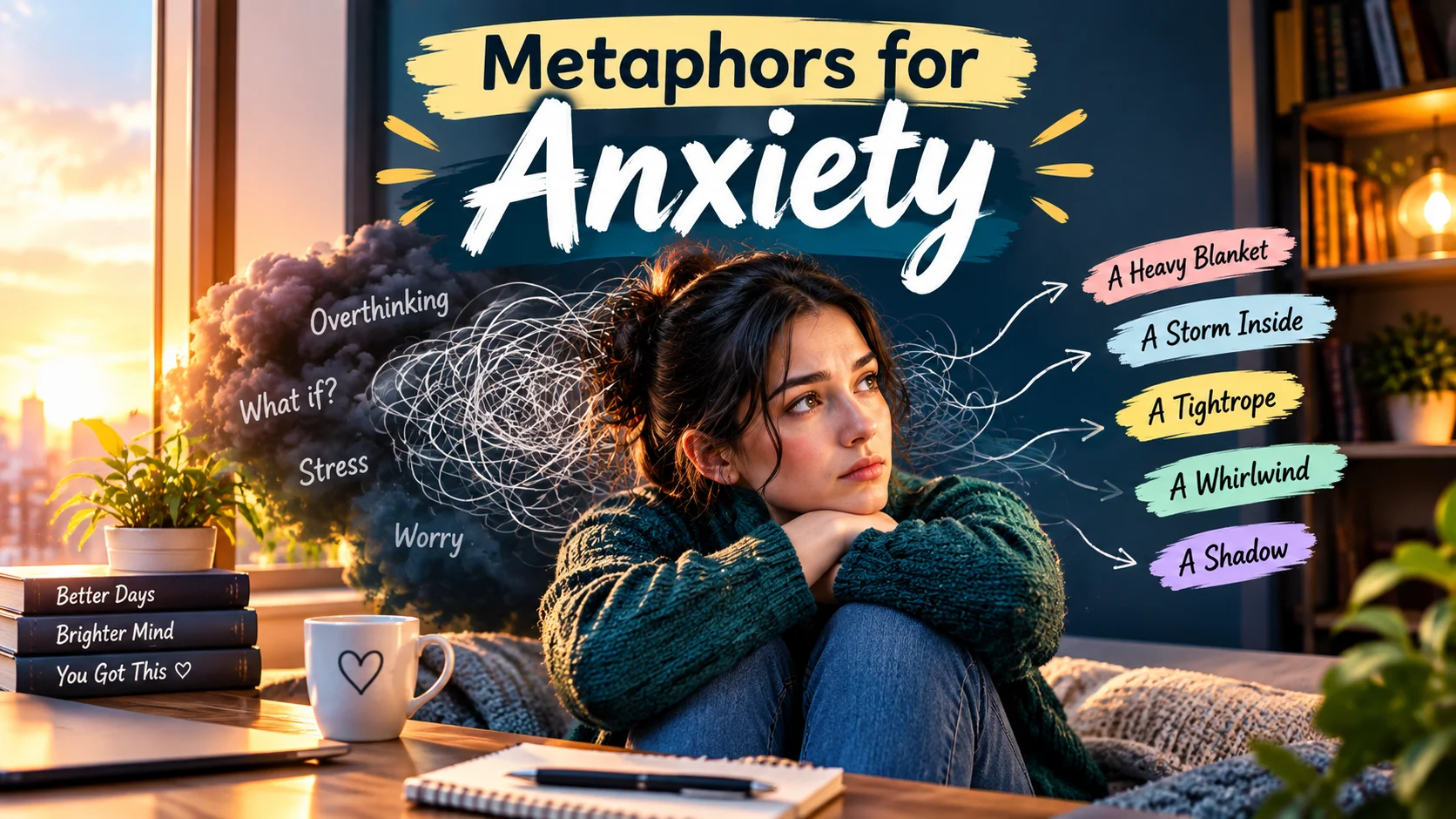
Metaphors for Anxiety (With Examples) turn hidden anxiety into clear images, helping readers understand anxious thoughts, feelings, and pressure.
When anxiety feels heavy, restless, confusing, or overwhelming, vivid images can make those anxious thoughts and anxious feelings easier to explain. In writing, a story, poem, speech, journal entry, or school assignment, original metaphors can make ideas more creative and memorable.
A metaphor works as a bridge between emotion and understanding by comparing an experience with tangible imagery. Invisible feelings such as stress can be difficult to describe, so images like a storm cloud, tightening knot, or ticking clock can show a powerful, internal, and silent struggle. These comparisons can communicate urgency, pressure, and resilience, while giving readers enough emotional texture to feel the weight a person carries.
Anxiety can also be explained through similes when it remains invisible while someone appears completely calm. A person’s thoughts may feel crowded, restless, and uncertain, while a well-chosen simile gives a hidden feeling a concrete image that readers can understand.
Lets Dive In:
1. Anxiety Is a Storm
Meaning: Anxiety can feel like a storm inside your mind, bringing confusion, fear, and emotional turbulence.
Detailed explanation:
A storm starts with changing conditions and can quickly become intense. Anxiety often works similarly. One small worry may gather strength until several concerns seem to arrive at once. The metaphor captures the chaotic and overwhelming nature of anxious thoughts. It also suggests that the storm can eventually pass.
Example sentences:
- “My anxiety is a storm raging inside my head.”
- “Her thoughts became a storm before the presentation.”
- “I’m waiting for this emotional storm to settle.”
3 other ways to say it:
- Anxiety is a hurricane in my thoughts.
- Anxiety is thunder rolling through my mind.
- Anxiety is a sudden downpour of worries.
2. Anxiety Is a Shadow
Meaning: Anxiety can be a shadow that follows you, even when everything around you appears calm.
Detailed explanation:
A shadow stays close without making much noise. Anxiety can behave the same way. You might laugh, work, or spend time with people while an underlying worry remains nearby. This metaphor emphasizes the persistent presence of anxiety rather than a sudden emotional reaction.
Example sentences:
- “Anxiety follows me like a shadow I can’t shake.”
- “Even during happy moments, her anxiety remained a quiet shadow.”
- “There’s a shadow of worry hanging over my day.”
3 other ways to say it:
- Anxiety is a dark cloud following me.
- Anxiety is a silent companion beside me.
- Anxiety is a lingering fog behind my thoughts.
3. Anxiety Is a Cage
Meaning: Anxiety can feel like a cage that limits your choices, confidence, and freedom.
Detailed explanation:
A cage represents restriction. Anxiety may convince you that certain situations are too risky, embarrassing, or frightening to face. As a result, you may avoid experiences you actually want. This metaphor highlights how anxiety can create a sense of being trapped by fear.
Example sentences:
- “My anxiety feels like a cage around my confidence.”
- “Fear built a cage that kept him from speaking up.”
- “She felt trapped inside a cage of anxious thoughts.”
3 other ways to say it:
- Anxiety is a locked room in my mind.
- Anxiety is a wall between me and freedom.
- Anxiety is a prison built from worries.
4. Anxiety Is an Alarm That Won’t Stop Ringing
Meaning: Anxiety can act like an alarm that keeps warning you about danger, even when there’s no immediate threat.
Detailed explanation:
An alarm exists to protect you. However, an alarm that never stops becomes exhausting. Anxiety can create a similar experience by constantly signaling that something might go wrong. The metaphor shows how the mind can remain stuck in high-alert mode.
Example sentences:
- “My anxiety is an alarm that keeps ringing.”
- “Her mind sounded an alarm over every small mistake.”
- “I wish I could turn down the alarm in my head.”
3 other ways to say it:
- Anxiety is a warning siren in my mind.
- Anxiety is a security system that never powers down.
- Anxiety is a red light flashing inside my thoughts.
5. Anxiety Is a Ticking Clock
Meaning: Anxiety can feel like a clock constantly reminding you that time is running out.
Detailed explanation:
A ticking clock creates pressure because every second feels significant. Anxiety often makes ordinary deadlines, decisions, or uncertain situations feel urgent. Even when you have enough time, your mind may insist that you need to act immediately.
Example sentences:
- “Anxiety is a ticking clock inside my chest.”
- “Every unanswered message feels like another tick.”
- “The deadline made my anxiety sound louder than ever.”
3 other ways to say it:
- Anxiety is a countdown in my head.
- Anxiety is a stopwatch I can’t pause.
- Anxiety is time chasing me through the day.
6. Anxiety Is a Heavy Backpack
Meaning: Anxiety can feel like a heavy backpack filled with invisible worries that you carry everywhere.
Detailed explanation:
A backpack becomes heavier when you add more items. Anxiety can work the same way. One concern may feel manageable, but several worries can accumulate until the emotional weight becomes difficult to carry. This metaphor makes anxiety feel like a burden that travels with you.
Example sentences:
- “I carry anxiety like a heavy backpack.”
- “Each new worry feels like another stone in my bag.”
- “She looked calm, but she was carrying an emotional backpack full of fears.”
3 other ways to say it:
- Anxiety is a suitcase full of worries.
- Anxiety is a weight on my shoulders.
- Anxiety is a load I carry through every room.
7. Anxiety Is a Whirlpool
Meaning: Anxiety can be a whirlpool that pulls your thoughts into repetitive cycles.
Detailed explanation:
A whirlpool keeps water moving around the same center. An anxious mind can do something similar. You may revisit the same question repeatedly without finding a satisfying answer. The metaphor captures the circular nature of overthinking.
Example sentences:
- “My thoughts became a whirlpool of what-ifs.”
- “Anxiety pulled her into a whirlpool of second-guessing.”
- “I keep circling the same worry like a whirlpool.”
3 other ways to say it:
- Anxiety is a spiral of endless questions.
- Anxiety is a current dragging my thoughts around.
- Anxiety is a mental vortex.
8. Anxiety Is a Fog
Meaning: Anxiety can feel like fog that makes everything unclear and difficult to navigate.
Detailed explanation:
Fog reduces visibility. You can still move forward, but you can’t see very far ahead. Anxiety often creates the same uncertainty. You may struggle to predict outcomes, make decisions, or trust yourself. This metaphor focuses on confusion and uncertainty.
Example sentences:
- “Anxiety wrapped my mind in a thick fog.”
- “The fog of worry made every decision seem complicated.”
- “I couldn’t see past the anxious fog surrounding me.”
3 other ways to say it:
- Anxiety is mist covering my thoughts.
- Anxiety is a haze over my judgment.
- Anxiety is a cloud blocking the road ahead.
9. Anxiety Is a Broken Record
Meaning: Anxiety can become a broken record that repeats the same frightening thought again and again.
Detailed explanation:
A broken record repeats a section instead of moving forward. Anxiety can trap you in repetitive thinking. You might replay a conversation, imagine a future problem, or analyze one decision countless times. The metaphor clearly describes mental repetition and rumination.
Example sentences:
- “My anxiety is a broken record repeating every possible mistake.”
- “Her mind kept playing the same fearful thought.”
- “I’m tired of hearing the same anxious record all day.”
3 other ways to say it:
- Anxiety is a song stuck on repeat.
- Anxiety is a thought trapped in a loop.
- Anxiety is a replay button I can’t find.
10. Anxiety Is a Thorn
Meaning: Anxiety can be like a thorn that keeps causing discomfort even when everything else seems peaceful.
Detailed explanation:
A thorn is small, but its sharpness demands attention. Anxiety doesn’t always need to be overwhelming to affect your day. Sometimes one persistent concern can irritate your thoughts repeatedly. This metaphor works especially well when describing quiet but persistent anxiety.
Example sentences:
- “There’s a thorn of anxiety beneath my calm.”
- “That unanswered question became a thorn in her thoughts.”
- “The worry stayed like a thorn I couldn’t ignore.”
3 other ways to say it:
- Anxiety is a splinter in my mind.
- Anxiety is a sharp ache beneath the surface.
- Anxiety is a tiny wound that keeps demanding attention.
Read This: 20 Metaphors for Animals (With Examples)
11. Anxiety Is a Locked Door
Meaning: Anxiety can feel like a locked door standing between you and something you want to do.
Detailed explanation:
A locked door suggests possibility on the other side but prevents immediate access. Anxiety may make opportunities seem unreachable because fear tells you to stay where you feel safe. The metaphor emphasizes hesitation, avoidance, and uncertainty.
Example sentences:
- “Anxiety feels like a locked door between me and confidence.”
- “Her fear became a locked door she struggled to approach.”
- “I know the opportunity is there, but anxiety keeps the door shut.”
3 other ways to say it:
- Anxiety is a barrier in my path.
- Anxiety is a gate I’m afraid to open.
- Anxiety is a wall blocking my next step.
12. Anxiety Is a Loud Neighbor
Meaning: Anxiety can resemble a noisy neighbor who constantly interrupts your peace.
Detailed explanation:
A loud neighbor doesn’t necessarily control your entire life, but their constant noise can make relaxation difficult. Anxiety can behave similarly. Even during quiet moments, anxious thoughts may interrupt your attention. This metaphor adds a relatable and conversational tone.
Example sentences:
- “Anxiety is like a loud neighbor living inside my head.”
- “I finally sat down, and my anxious neighbor started shouting.”
- “The day was peaceful until my inner noise returned.”
3 other ways to say it:
- Anxiety is a noisy roommate.
- Anxiety is a radio that never turns off.
- Anxiety is background noise that keeps getting louder.
13. Anxiety Is a Tight Knot
Meaning: Anxiety can feel like a knot tightening inside your thoughts, chest, or stomach.
Detailed explanation:
A knot becomes harder to untangle when you pull it tighter. Anxiety can create a similar sensation. Worry about one issue may trigger another concern, making everything feel increasingly tangled. This metaphor communicates emotional tension and internal pressure.
Example sentences:
- “Anxiety tied my thoughts into a tight knot.”
- “I felt a knot of worry forming before the interview.”
- “Every unanswered question tightened the knot inside me.”
3 other ways to say it:
- Anxiety is tangled thread in my mind.
- Anxiety is a rope pulled too tight.
- Anxiety is a tangle I can’t easily unravel.
14. Anxiety Is a Leaking Faucet
Meaning: Anxiety can be like a faucet that constantly drips small worries into your mind.
Detailed explanation:
A dripping faucet may seem harmless at first. Over time, however, the repeated sound becomes difficult to ignore. Anxiety can work the same way. A steady stream of small concerns may gradually drain your energy. This metaphor fits persistent low-level anxiety particularly well.
Example sentences:
- “My anxiety is a leaking faucet that never stops dripping.”
- “One small worry after another kept dripping into her mind.”
- “The constant thoughts felt like water slowly filling a sink.”
3 other ways to say it:
- Anxiety is a steady drip of worry.
- Anxiety is a tap that refuses to close.
- Anxiety is a slow leak in my peace of mind.
15. Anxiety Is a Wild Horse
Meaning: Anxiety can feel like a wild horse that moves unpredictably and refuses to follow your direction.
Detailed explanation:
A wild horse represents energy, speed, and lack of control. An anxious mind can suddenly race ahead, imagining possibilities before you can process them. This metaphor captures the restless and unpredictable movement of anxious thoughts.
Example sentences:
- “My thoughts ran like a wild horse through an open field.”
- “Anxiety took off like a horse I couldn’t control.”
- “Her imagination became a wild horse running toward every possible disaster.”
3 other ways to say it:
- Anxiety is a runaway train.
- Anxiety is a racing engine.
- Anxiety is a restless animal inside my thoughts.
16. Anxiety Is a Fire
Meaning: Anxiety can be a fire that starts small but grows when fueled by fear and overthinking.
Detailed explanation:
Fire needs fuel to keep burning. Anxious thoughts can gain strength when you repeatedly replay frightening possibilities. One worry can ignite another until your emotions feel overwhelming. This metaphor explains how rumination can intensify anxiety.
Example sentences:
- “One worried thought became a fire in my mind.”
- “Every what-if added another spark.”
- “Her anxiety burned hotter as the deadline approached.”
3 other ways to say it:
- Anxiety is a flame fed by uncertainty.
- Anxiety is a spark that becomes an emotional blaze.
- Anxiety is a fire fueled by fearful thoughts.
17. Anxiety Is an Invisible Weight
Meaning: Anxiety can feel like an invisible weight pressing down on you.
Detailed explanation:
Unlike a physical object, emotional pressure has no visible shape. Yet it can still influence your energy, focus, and behavior. This metaphor helps explain why someone may look fine while privately struggling. It emphasizes the hidden burden of anxiety.
Example sentences:
- “I carried an invisible weight through the entire day.”
- “Nobody could see the weight anxiety placed on her.”
- “His smile hid the invisible weight sitting on his mind.”
3 other ways to say it:
- Anxiety is pressure no one else can see.
- Anxiety is a hidden burden.
- Anxiety is an unseen stone on my shoulders.
18. Anxiety Is a Maze
Meaning: Anxiety can feel like a maze filled with confusing turns, dead ends, and endless questions.
Detailed explanation:
A maze makes you question which direction to take. Anxiety often creates the same uncertainty. You may think through multiple outcomes without knowing which one is realistic. The metaphor captures overthinking and difficulty finding a clear path forward.
Example sentences:
- “My mind became a maze of possibilities.”
- “Anxiety sent me through one mental dead end after another.”
- “I kept searching the maze for an answer that wasn’t there.”
3 other ways to say it:
- Anxiety is a tangled road.
- Anxiety is a hallway full of confusing doors.
- Anxiety is a puzzle with too many pieces.
19. Anxiety Is a Wave
Meaning: Anxiety can be a wave that rises, peaks, and eventually loses its strength.
Detailed explanation:
Waves naturally rise and fall. This makes the metaphor especially useful when you want to describe anxiety without suggesting that the feeling will last forever. It reminds you that emotions can change. A difficult moment can build in intensity and later recede.
Example sentences:
- “Anxiety hit me like a wave crashing over the shore.”
- “I’m riding an anxious wave, waiting for it to settle.”
- “The wave felt enormous, but it eventually passed.”
3 other ways to say it:
- Anxiety is a tide that rises and falls.
- Anxiety is a swell moving through my emotions.
- Anxiety is a surge that eventually fades.
20. Anxiety Is a Cage of What-Ifs
Meaning: Anxiety can become a cage built from endless “what-if” questions.
Detailed explanation:
“What if?” can be a useful question when planning. However, repeated fearful possibilities can create mental restrictions. You may start imagining every negative outcome before taking a simple step. This metaphor combines fear, overthinking, and avoidance into one vivid image.
Example sentences:
- “I felt trapped inside a cage of what-ifs.”
- “Her anxiety built walls from every possible negative outcome.”
- “The more I asked ‘what if,’ the smaller my world felt.”
3 other ways to say it:
- Anxiety is a prison made of possibilities.
- Anxiety is a web of fearful questions.
- Anxiety is a trap woven from uncertainty.
MCQs:
1. Which metaphor describes anxiety as something that follows you quietly?
A. Anxiety is a ticking clock.
B. Anxiety is a shadow.
C. Anxiety is a wild horse.
D. Anxiety is a fire.
Answer: B. Anxiety is a shadow.
2. Which metaphor best represents repetitive anxious thoughts?
A. Anxiety is a broken record.
B. Anxiety is a wave.
C. Anxiety is a thorn.
D. Anxiety is a backpack.
Answer: A. Anxiety is a broken record.
3. What does “anxiety is a storm” suggest?
A. Anxiety is always peaceful.
B. Anxiety creates emotional turbulence.
C. Anxiety improves concentration.
D. Anxiety disappears instantly.
Answer: B. Anxiety creates emotional turbulence.
4. Which metaphor represents feeling restricted by fear?
A. Anxiety is a cage.
B. Anxiety is a faucet.
C. Anxiety is fog.
D. Anxiety is a wave.
Answer: A. Anxiety is a cage.
5. Which metaphor compares anxiety to constant mental pressure from time?
A. Anxiety is a maze.
B. Anxiety is a ticking clock.
C. Anxiety is a thorn.
D. Anxiety is a shadow.
Answer: B. Anxiety is a ticking clock.
6. What does “anxiety is a fog” emphasize?
A. Physical strength
B. Emotional excitement
C. Confusion and uncertainty
D. Happiness and confidence
Answer: C. Confusion and uncertainty.
7. Which metaphor describes anxiety as something you carry throughout the day?
A. Anxiety is a heavy backpack.
B. Anxiety is a locked door.
C. Anxiety is a storm.
D. Anxiety is a broken record.
Answer: A. Anxiety is a heavy backpack.
8. Which metaphor best describes thoughts that keep circling the same issue?
A. Anxiety is a whirlpool.
B. Anxiety is a cage.
C. Anxiety is a thorn.
D. Anxiety is a locked door.
Answer: A. Anxiety is a whirlpool.
9. What does “anxiety is an alarm that won’t stop ringing” mean?
A. Anxiety creates constant feelings of alertness.
B. Anxiety makes people sleep better.
C. Anxiety removes uncertainty.
D. Anxiety creates physical freedom.
Answer: A. Anxiety creates constant feelings of alertness.
10. Which metaphor represents persistent but relatively small discomfort?
A. Anxiety is a thorn.
B. Anxiety is a hurricane.
C. Anxiety is a maze.
D. Anxiety is a ticking clock.
Answer: A. Anxiety is a thorn.
11. Which metaphor describes anxiety as something blocking access to confidence or opportunity?
A. Anxiety is a locked door.
B. Anxiety is a wave.
C. Anxiety is a faucet.
D. Anxiety is a backpack.
Answer: A. Anxiety is a locked door.
12. What does “anxiety is a tight knot” communicate?
A. Relaxation
B. Emotional tension and internal pressure
C. Physical speed
D. Celebration
Answer: B. Emotional tension and internal pressure.
13. Which metaphor describes anxiety as a repeated stream of small worries?
A. Anxiety is a leaking faucet.
B. Anxiety is a cage.
C. Anxiety is a storm.
D. Anxiety is a wild horse.
Answer: A. Anxiety is a leaking faucet.
14. Which metaphor suggests that anxiety can rise and eventually fade?
A. Anxiety is a locked door.
B. Anxiety is a wave.
C. Anxiety is a broken record.
D. Anxiety is an invisible weight.
Answer: B. Anxiety is a wave.
15. Which metaphor best describes anxiety caused by endless “what-if” thoughts?
A. Anxiety is a cage of what-ifs.
B. Anxiety is a leaking faucet.
C. Anxiety is a thorn.
D. Anxiety is a loud neighbor.
Answer: A. Anxiety is a cage of what-ifs.
FAQs:
What is a metaphor for anxiety?
A metaphor for anxiety compares anxious feelings to something familiar without using “like” or “as.” For example, “Anxiety is a storm in my mind” compares emotional turmoil to a storm.
What is the best metaphor for anxiety?
There isn’t one universal choice. “Anxiety is a storm” works well for overwhelming emotions, while “anxiety is a shadow” fits persistent worry. Choose the image that matches your experience.
How can metaphors help describe anxiety?
Metaphors make abstract emotions easier to visualize. They give readers or listeners a concrete image for feelings such as fear, uncertainty, pressure, and overthinking.
What is a metaphor for severe anxiety?
For intense anxiety, metaphors such as “a raging storm,” “a runaway train,” “a wildfire,” or “a crashing wave” can communicate a strong sense of urgency and emotional intensity.
Can I use these anxiety metaphors in everyday conversation?
Yes. You can use them in personal conversations, journaling, creative writing, poetry, speeches, and supportive messages. Choose language that feels natural and respectful to your situation.
Conclusion:
Metaphors for Anxiety (With Examples) can make difficult emotions easier to understand and explain. Anxiety often feels invisible, but the right metaphor can give that feeling a clear shape, image, or story.
A storm cloud can show worry that seems to follow you, while a tightening knot can represent growing pressure and emotional tension. These comparisons help readers connect with experiences that may otherwise be hard to describe.
They can also make writing, poetry, storytelling, journaling, and school assignments more meaningful and memorable. The best metaphors do more than sound creative; they communicate emotion in a simple and powerful way.
When creating your own metaphors, think about how anxiety feels, what it reminds you of, and which image best captures that experience. With practice, you can turn complicated thoughts into vivid language that readers can easily picture, understand, and remember.













1 thought on “20 Metaphors for Anxiety (With Examples)”