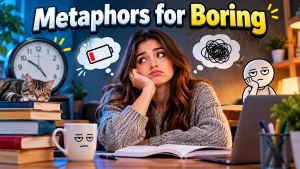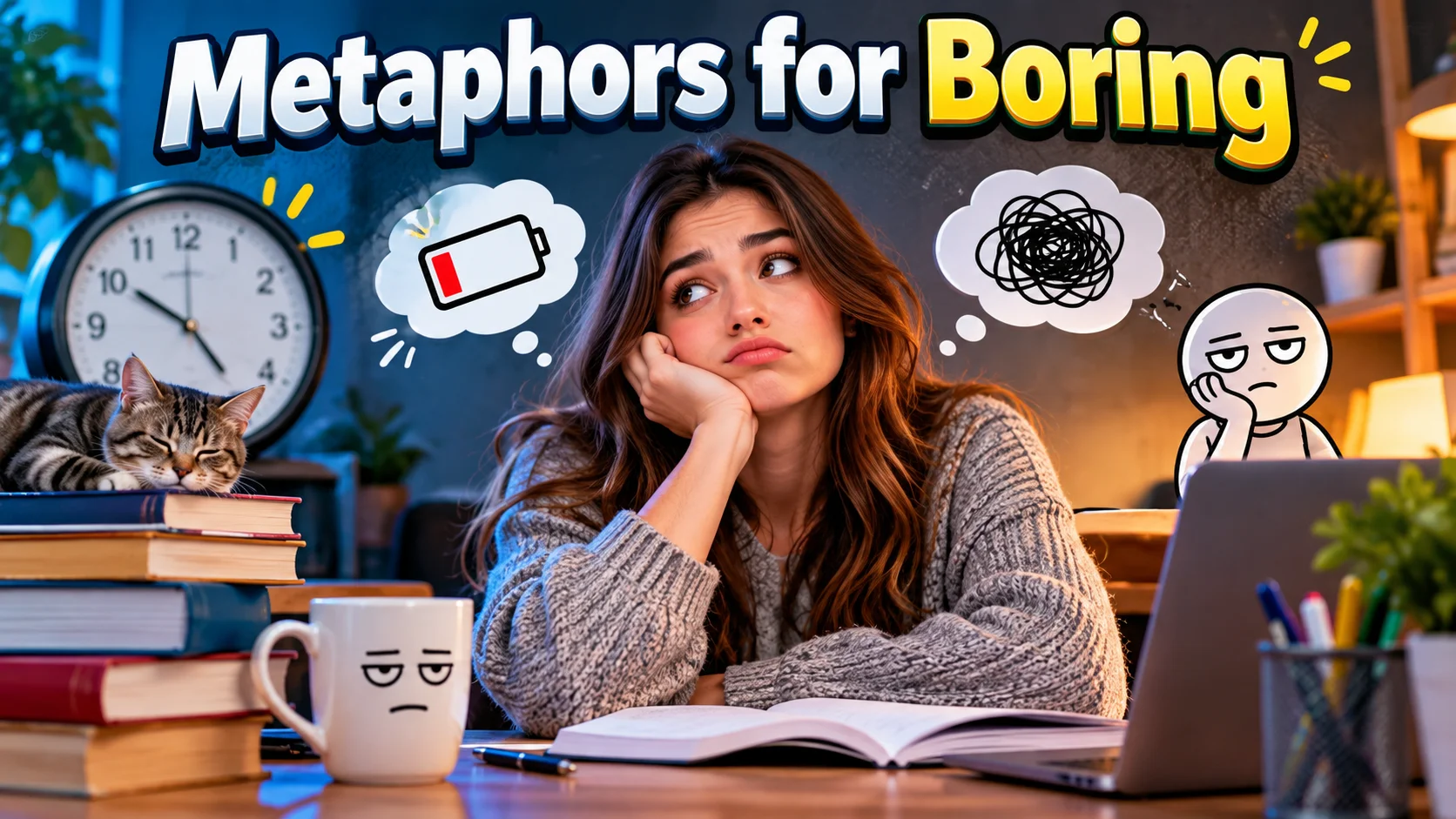
Metaphors for Boring (With Examples) can turn an ordinary moment into a vivid picture when boredom makes time feel endless. A boring meeting may feel like a clock that has forgotten how to move, while minutes seem dragged across the room and every sentence sounds familiar.
Even coffee may not rescue you from that strange power. For writers, a metaphor gives a sharper way to capture a feeling than plain descriptions. Images allow readers to instantly recognize something dull, such as a stalled train, blank page, or song stuck on one note. Similes, vivid comparisons, and relatable examples give boring moments more personality and make dullness impossible to overlook.
A metaphor for boring can turn simple descriptions into memorable metaphors, comparisons, and creative imagery. Monotonous, repetitive routines create stillness, inactivity, a slow passage of time, and a tedious, uninteresting, lifeless sense of lack of excitement. Familiar sentences, endless minutes, and a stalled, blank, or stuck experience show why stronger imagery matters.
Similes make Boring moments and dull experiences easier to understand because vivid images help readers instantly feel what repetitive, slow, and emotionally flat situations are like. The right simile can add color, clarity, and imagination to words used in classrooms, meetings, stories, and conversations.
Boredom is a universal feeling, so describing it creatively makes writing more relatable, engaging, and expressive.
1. A Parked Car
Meaning: Something that doesn’t move, change, or create excitement.
Explanation: A parked car has the ability to travel, but while it sits still, nothing happens. Calling something a “parked car” suggests that it has become completely stagnant. This metaphor works especially well for meetings, conversations, projects, or situations that make no progress.
Example:
“The meeting was a parked car, sitting there for two hours without going anywhere.”
3 other ways to say it:
- The meeting went nowhere.
- The discussion was completely stagnant.
- Nothing moved forward.
2. A Flat Tire
Meaning: Something that has lost its energy and momentum.
Explanation: A flat tire prevents a vehicle from moving properly. As a metaphor, it describes an experience that starts with potential but quickly becomes slow, tiresome, and frustrating. It works particularly well when something should have been exciting but fails to maintain momentum.
Example:
“The movie started with promise but became a flat tire halfway through.”
3 other ways to say it:
- The movie lost all momentum.
- The story became sluggish.
- The excitement disappeared.
3. A Silent Radio
Meaning: Something that provides no stimulation or interesting content.
Explanation: A radio normally fills a room with voices, music, or information. A silent radio offers none of those things. This metaphor captures the feeling of being surrounded by something that should provide entertainment but delivers nothing.
Example:
“His presentation was a silent radio, leaving the entire room searching for something interesting.”
3 other ways to say it:
- The presentation lacked energy.
- The talk offered little stimulation.
- There was nothing engaging about it.
4. A Gray Photograph
Meaning: Something lacking excitement, emotion, or vividness.
Explanation: A gray photograph can suggest a scene stripped of brightness and contrast. Calling a story or experience a gray photograph implies that it feels emotionally flat and visually uninspiring. It’s useful when you want to describe boredom with a slightly poetic tone.
Example:
“The entire afternoon felt like a gray photograph, quiet and empty of excitement.”
3 other ways to say it:
- The afternoon felt lifeless.
- Nothing stood out.
- The day lacked color and energy.
5. A Broken Record
Meaning: Something repetitive and predictable.
Explanation: A broken record repeats the same section again and again. This metaphor works perfectly when boredom comes from hearing the same information repeatedly. It’s especially useful for repetitive complaints, lectures, conversations, or routines.
Example:
“His complaints became a broken record, repeating the same points every few minutes.”
3 other ways to say it:
- He kept repeating himself.
- The conversation went in circles.
- The same point came up repeatedly.
6. A Long Elevator Ride
Meaning: An uncomfortable, slow, and uneventful experience.
Explanation: An elevator ride usually doesn’t last long, yet even a short ride can feel lengthy when nothing happens. This metaphor highlights slow-moving time and awkward silence. It fits conversations, waiting periods, meetings, and social situations.
Example:
“The dinner conversation felt like a long elevator ride with no one knowing what to say.”
3 other ways to say it:
- The conversation dragged.
- The silence felt endless.
- Every minute felt longer than the last.
7. A Cold Cup of Coffee
Meaning: Something that has lost its warmth, energy, or appeal.
Explanation: Fresh coffee often represents comfort, energy, and enjoyment. Cold coffee suggests that those qualities have faded. As a metaphor, it describes something that once seemed appealing but has become stale or disappointing.
Example:
“The second half of the event was a cold cup of coffee, missing the energy of the beginning.”
3 other ways to say it:
- The event lost its spark.
- The excitement had faded.
- The experience became stale.
8. A Locked Door
Meaning: Something that offers no access, discovery, or possibility.
Explanation: A locked door prevents you from entering or discovering what lies beyond it. Calling an activity a locked door suggests that it doesn’t invite curiosity or provide anything rewarding to explore.
Example:
“The book felt like a locked door, giving me no reason to keep turning the pages.”
3 other ways to say it:
- The book failed to capture my attention.
- The story offered no curiosity.
- There was nothing pulling me forward.
9. A Desert Without Footprints
Meaning: A completely empty and uneventful experience.
Explanation: A desert can stretch endlessly with little visible activity. Without footprints, it feels even more untouched and empty. This metaphor creates a strong image of silence, repetition, isolation, and inactivity.
Example:
“The workday was a desert without footprints, with nothing unexpected happening.”
3 other ways to say it:
- The day was uneventful.
- Nothing interesting happened.
- The hours passed without incident.
10. A Clock Without Hands
Meaning: Something that makes time feel meaningless or difficult to measure.
Explanation: A clock without hands cannot tell you how much time has passed. This metaphor describes experiences where time seems to stop because the activity feels painfully dull.
Example:
“That three-hour lecture was a clock without hands; I had no idea when it would end.”
3 other ways to say it:
- Time seemed to stop.
- The lecture felt endless.
- Every minute crawled by.
Read This: 20 Metaphors for Books (With Examples)
11. A Blank Page
Meaning: Something with little substance, excitement, or memorable content.
Explanation: A blank page contains endless possibilities, yet it also contains nothing until someone adds meaning. As a metaphor for boredom, it describes an experience that feels empty, undeveloped, or lacking memorable moments.
Example:
“The weekend was a blank page, with no plans and nothing memorable to fill it.”
3 other ways to say it:
- The weekend was uneventful.
- Nothing memorable happened.
- The day felt empty.
12. A Slow-Moving Train
Meaning: Something that progresses painfully slowly.
Explanation: Trains can move quickly, but a slow-moving train makes every mile feel longer. This metaphor emphasizes sluggish progress and growing impatience. It’s useful for projects, meetings, lessons, and stories.
Example:
“The project became a slow-moving train, taking weeks to complete simple tasks.”
3 other ways to say it:
- The project moved painfully slowly.
- Progress was sluggish.
- Everything took too long.
13. A Lukewarm Shower
Meaning: Something that fails to create a strong emotional response.
Explanation: A lukewarm shower isn’t freezing or comfortably hot. It sits somewhere in the middle. This makes it a useful metaphor for experiences that aren’t terrible but also aren’t exciting. They simply feel bland and underwhelming.
Example:
“The concert was a lukewarm shower—pleasant enough, but hardly memorable.”
3 other ways to say it:
- The concert was underwhelming.
- It failed to leave an impression.
- The experience felt bland.
14. An Empty Theater
Meaning: Something that lacks energy, audience engagement, or emotional connection.
Explanation: A theater usually comes alive through performers and an attentive audience. An empty theater feels strangely quiet. This metaphor describes an experience that seems devoid of enthusiasm or emotional energy.
Example:
“His speech felt like an empty theater, with no reaction from the audience.”
3 other ways to say it:
- The speech lacked audience engagement.
- The room felt lifeless.
- Nobody seemed interested.
15. A Reheated Meal
Meaning: Something repetitive that feels used or unoriginal.
Explanation: A reheated meal isn’t necessarily unpleasant, but it lacks the freshness of something newly prepared. As a metaphor, it describes ideas, stories, conversations, or entertainment that feel recycled.
Example:
“The sequel was a reheated meal, serving the same story with different packaging.”
3 other ways to say it:
- The story felt recycled.
- The idea wasn’t fresh.
- It repeated familiar material.
16. A Dry Well
Meaning: Something that has run out of ideas, energy, or inspiration.
Explanation: A dry well contains no water despite once being useful. This metaphor works when boredom comes from a lack of creativity or fresh material. Writers, speakers, performers, and conversationalists can all experience this feeling.
Example:
“After several hours of discussion, the team became a dry well of ideas.”
3 other ways to say it:
- The team ran out of ideas.
- Creativity had disappeared.
- There was no fresh thinking left.
17. A Road With No Turns
Meaning: Something predictable from beginning to end.
Explanation: A road with no turns offers no surprises or changes in direction. This metaphor captures boredom caused by complete predictability. It’s particularly effective for describing predictable plots, routines, or conversations.
Example:
“The novel was a road with no turns; I knew exactly what would happen next.”
3 other ways to say it:
- The plot was predictable.
- Nothing surprised me.
- The story followed an obvious path.
18. A Flickering Streetlight
Meaning: Something weak, repetitive, and barely stimulating.
Explanation: A flickering streetlight provides inconsistent illumination. It isn’t completely dark, but it doesn’t provide enough brightness either. This metaphor describes something that has a little energy but never enough to become genuinely engaging.
Example:
“The conversation was a flickering streetlight, occasionally interesting but mostly dull.”
3 other ways to say it:
- The conversation had little energy.
- It was only occasionally interesting.
- The discussion lacked consistency.
19. A Waiting Room
Meaning: Something that feels like you’re simply waiting for it to end.
Explanation: Waiting rooms are designed around delay rather than excitement. Calling an experience a waiting room suggests that your attention has shifted toward the ending rather than the activity itself.
Example:
“The final hour of the conference felt like a waiting room, with everyone watching the clock.”
3 other ways to say it:
- Everyone was waiting for it to finish.
- The final hour dragged.
- Nobody wanted to stay longer.
20. A River of Molasses
Meaning: Something extremely slow, heavy, and difficult to endure.
Explanation: Molasses moves much more slowly than ordinary water. A river of molasses creates an exaggerated image of time crawling forward. It’s a colorful metaphor for situations that feel painfully slow and mentally exhausting.
Example:
“The paperwork moved like a river of molasses, with every tiny step taking forever.”
3 other ways to say it:
- The process was painfully slow.
- Everything moved at a crawl.
- Progress was frustratingly gradual.
MCQs:
1. The repetitive lecture was like ______.
A. a broken record
B. a fireworks display
C. a racing motorcycle
D. a thunderstorm
Answer: A. a broken record
2. The project moved as slowly as ______.
A. a shooting star
B. a river of molasses
C. a speeding train
D. a falling leaf
Answer: B. a river of molasses
3. The predictable movie was ______.
A. a road with no turns
B. a roaring ocean
C. a bright sunrise
D. a racing engine
Answer: A. a road with no turns
4. The empty afternoon felt like ______.
A. a carnival
B. a blank page
C. a thunderstorm
D. a busy airport
Answer: B. a blank page
5. The stalled meeting was ______.
A. a parked car
B. a rocket
C. a waterfall
D. a racehorse
Answer: A. a parked car
6. The underwhelming concert was ______.
A. a blazing fire
B. a lukewarm shower
C. a shooting star
D. a roaring river
Answer: B. a lukewarm shower
7. The recycled sequel felt like ______.
A. a fresh garden
B. a reheated meal
C. a new adventure
D. a sunrise
Answer: B. a reheated meal
8. The lifeless presentation resembled ______.
A. an empty theater
B. a packed stadium
C. a fireworks show
D. a busy marketplace
Answer: A. an empty theater
9. The endless lecture felt like ______.
A. a clock without hands
B. a speeding rocket
C. a short race
D. a flashing camera
Answer: A. a clock without hands
10. The dull conversation was ______.
A. a silent radio
B. a roaring engine
C. a celebration
D. a marching band
Answer: A. a silent radio
11. The slow process was ______.
A. a lightning bolt
B. a slow-moving train
C. a falling star
D. a racing car
Answer: B. a slow-moving train
12. The story lacked fresh ideas and became ______.
A. a dry well
B. a flowing river
C. a blooming garden
D. a bright lamp
Answer: A. a dry well
13. The final hour felt like ______.
A. a waiting room
B. a roller coaster
C. a dance floor
D. a race
Answer: A. a waiting room
14. The afternoon lacked energy and looked like ______.
A. a gray photograph
B. a festival
C. a sunrise
D. a fireworks display
Answer: A. a gray photograph
15. The conversation occasionally became interesting but mostly felt like ______.
A. a flickering streetlight
B. a blazing sun
C. a thunderstorm
D. a bright spotlight
Answer: A. a flickering streetlight
FAQs:
What is a metaphor for boring?
A metaphor for boring compares something dull or uninteresting to another image without using “like” or “as.” Examples include “a broken record,” “a parked car,” and “a clock without hands.”
What is a creative way to say something is boring?
You can say something is “a road with no turns,” “a gray photograph,” “a waiting room,” or “a river of molasses.” Each phrase describes a different type of boredom.
What metaphor describes something very repetitive?
“A broken record” is one of the clearest metaphors for repetition. It suggests that the same words, actions, or ideas keep returning.
What metaphor describes something extremely slow?
“A river of molasses” creates a strong image of extreme slowness. “A slow-moving train” also works when something progresses gradually.
Why use metaphors instead of simply saying boring?
Metaphors make your writing more vivid, specific, and memorable. Instead of simply labeling an experience as boring, you show readers what that boredom feels like.
Conclusion:
Boredom can make even the simplest moment feel endless, but metaphors for boring can turn that dull feeling into something vivid and memorable.
Instead of simply saying that a meeting, class, story, or conversation was boring, you can compare it to a stalled train, a blank page, or a clock watching itself tick.
These creative comparisons give your writing more personality, emotion, and clarity. They also help readers visualize what boredom actually feels like rather than simply being told about it.
Whether you are a student, writer, poet, or content creator, using figurative language can make ordinary descriptions more engaging. The best metaphors feel natural, specific, and easy to understand. With practice, you can transform repetitive or lifeless moments into descriptions that readers remember.
Choose comparisons that match the mood, setting, and emotion, and let your imagination turn even the dullest experience into meaningful writing.