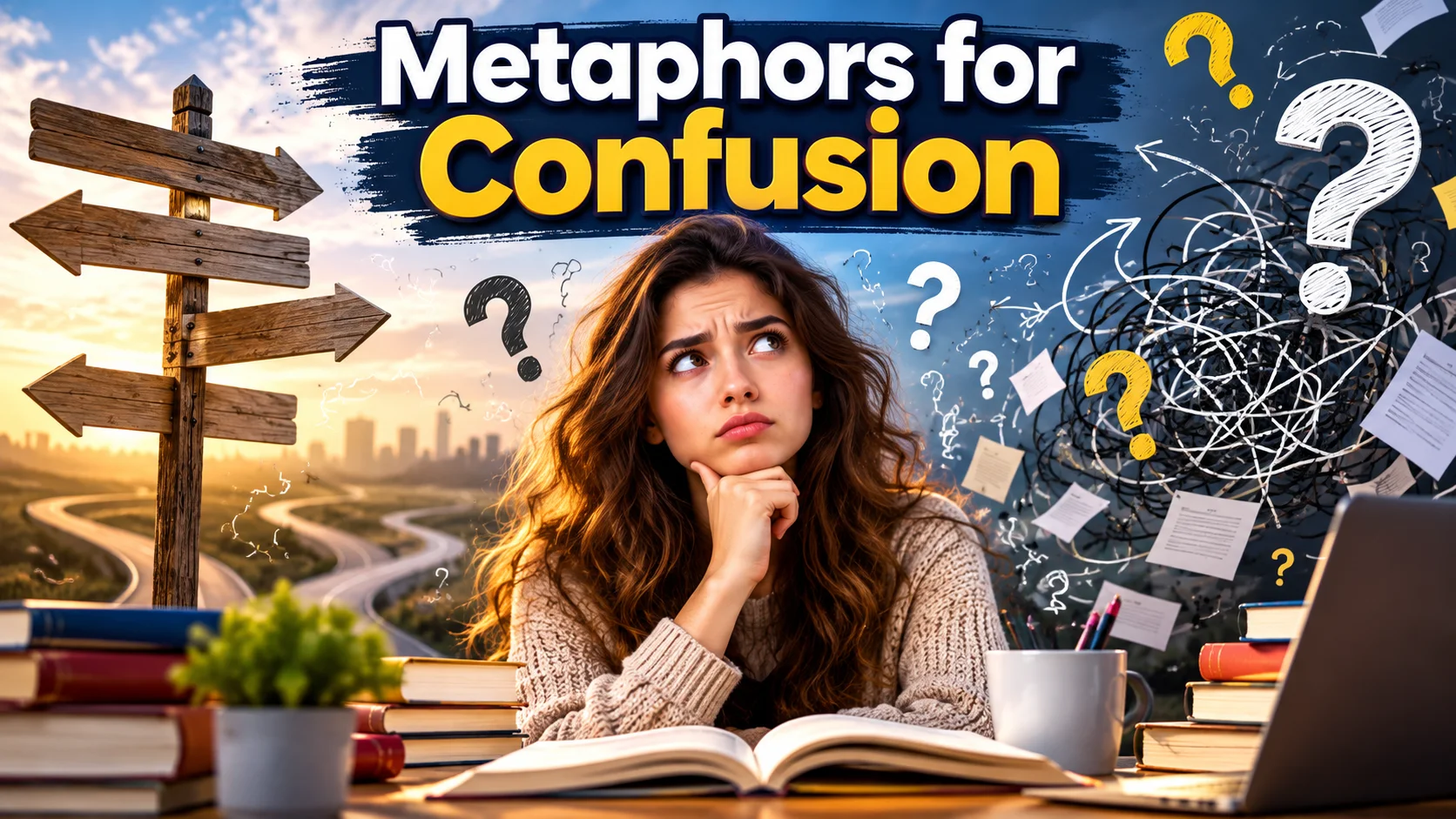
Metaphors for Confusion (With Examples) help writers turn mixed thoughts, unclear feelings, and mental chaos into clear, relatable pictures. When you feel confused, confusion can fill your mind with thoughts that seem mixed up.
You may know something but still don’t know what to do, so you stop, think, and ask, “What do I do now?” This is a normal feeling for everyone, from kids to grown-ups. The lesson is to learn how a picture, metaphor, or comparison can make confusing ideas better and easier to understand. When you talk about emotions, feelings, and your mental state, metaphors for confusion offer fun and smart ways to express uncertainty, an unclear thought, or a puzzled, bewildered, and unsure mind.
A person lost in thought may have abstract feelings that become easier to understand when connected with relatable life situations. Clarity can appear when the mind becomes a moving scene: distant minds may swirl like a stormy sea, while a maze with no exit shows uncertainty.
1. My Mind Is a Maze
Meaning
This metaphor describes confusion as a maze with many paths and no obvious exit.
Detailed Explanation
A maze represents a situation where you can see several possible directions but don’t know which one will lead you toward the answer. This metaphor works especially well when someone has considered many possibilities and still feels uncertain.
It suggests that confusion isn’t simply a lack of information. Instead, the person may have too many choices, thoughts, or directions competing for attention.
Example Sentences
- “My mind is a maze, and every answer seems to lead to another question.”
- “Trying to understand the situation feels like walking through a maze.”
- “Her thoughts became a maze of possibilities.”
3 Other Ways to Say It
- My thoughts feel like a labyrinth.
- I can’t find my way through my thoughts.
- I’m wandering through a maze of uncertainty.
2. My Thoughts Are a Tangled Knot
Meaning
This metaphor compares confusion to strings or ropes twisted together.
Detailed Explanation
A tangled knot suggests that different thoughts, emotions, facts, and concerns have become intertwined. You may understand each individual piece, yet you can’t easily separate them.
This expression works particularly well when emotional confusion makes rational thinking difficult.
Example Sentences
- “My thoughts are a tangled knot that I can’t seem to loosen.”
- “Everything I’m feeling has tied itself into one enormous knot.”
- “His questions formed a tangled knot in his mind.”
3 Other Ways to Say It
- My thoughts are all tangled together.
- My mind feels twisted up.
- I can’t untangle what I’m thinking.
3. I’m Lost in a Fog
Meaning
This metaphor describes confusion as walking through thick fog without knowing where you are going.
Detailed Explanation
Fog hides landmarks and makes familiar surroundings difficult to recognize. In the same way, confusion can hide the next step.
This metaphor often expresses uncertainty, hesitation, and lack of direction rather than complete mental overload.
Example Sentences
- “I’m lost in a fog of uncertainty.”
- “After hearing all those explanations, I still feel like I’m walking through fog.”
- “Her future looked hidden behind a thick fog.”
3 Other Ways to Say It
- I can’t see the path forward.
- Everything feels hazy right now.
- I’m struggling to see things clearly.
4. My Mind Is a Storm
Meaning
This metaphor compares confusion to a violent storm filled with wind, rain, and movement.
Detailed Explanation
A storm captures the emotional intensity that sometimes accompanies confusion. Thoughts can race around like strong winds while worries crash down like heavy rain.
Use this metaphor when confusion feels chaotic, stressful, or emotionally intense.
Example Sentences
- “My mind is a storm of questions and doubts.”
- “Her thoughts raged like a storm she couldn’t calm.”
- “Everything inside me feels like a storm right now.”
3 Other Ways to Say It
- My thoughts are swirling like a storm.
- My mind feels chaotic.
- I’m caught in a whirlwind of thoughts.
5. I’m Standing at a Crossroads
Meaning
This metaphor describes confusion as standing where several roads meet without knowing which road to take.
Detailed Explanation
A crossroads represents a difficult decision. You may understand the available options but remain uncertain about which choice will lead to the future you want.
It’s particularly useful for career choices, relationships, major decisions, and life changes.
Example Sentences
- “I’m standing at a crossroads and don’t know which direction to choose.”
- “After graduation, she felt as though she were standing at a crossroads.”
- “We reached a crossroads where every choice seemed important.”
3 Other Ways to Say It
- I’m unsure which path to take.
- I’m caught between several directions.
- I don’t know which road leads forward.
6. My Thoughts Are a Jigsaw Puzzle
Meaning
This metaphor compares confusion to a puzzle with scattered pieces.
Detailed Explanation
A jigsaw puzzle becomes difficult when the pieces are mixed together. You may possess all the necessary information, yet you haven’t figured out how the pieces fit.
This metaphor suggests that understanding may come gradually as separate facts begin forming a complete picture.
Example Sentences
- “My thoughts are a jigsaw puzzle with half the pieces missing.”
- “I’m trying to fit the facts together like pieces of a puzzle.”
- “The entire situation feels like a puzzle I haven’t solved yet.”
3 Other Ways to Say It
- I’m trying to piece everything together.
- The situation doesn’t fit together yet.
- I’m missing pieces of the picture.
7. My Mind Is a Swirling Whirlpool
Meaning
This metaphor portrays confusion as water spinning rapidly in a circular motion.
Detailed Explanation
A whirlpool suggests movement without progress. Your thoughts may keep circling around the same questions without reaching a conclusion.
It works especially well when someone feels trapped inside repetitive thinking.
Example Sentences
- “My mind is a swirling whirlpool of questions.”
- “Every new thought pulls me deeper into the whirlpool.”
- “I keep circling the same problem in my mind.”
3 Other Ways to Say It
- My thoughts keep going in circles.
- I’m trapped in a cycle of uncertainty.
- My mind won’t stop spinning.
8. My Thoughts Are a Jumbled Drawer
Meaning
This metaphor compares confusion to a drawer filled with mixed-up objects.
Detailed Explanation
A messy drawer contains useful things, but finding one specific item can become frustrating. Likewise, your mind may contain plenty of information, yet everything feels disorganized.
This expression creates a more casual and relatable image than metaphors involving storms or mazes.
Example Sentences
- “My thoughts feel like a jumbled drawer.”
- “Everything is in my head, but it’s arranged like a messy drawer.”
- “I know the answer is somewhere in this jumbled drawer of thoughts.”
3 Other Ways to Say It
- My thoughts are all mixed up.
- My mind feels disorganized.
- I can’t sort through everything in my head.
9. I’m Swimming in Questions
Meaning
This metaphor presents confusion as being surrounded by an overwhelming amount of questions.
Detailed Explanation
Water surrounds a swimmer on every side. Similarly, questions can surround your thinking until you struggle to focus on one issue.
This metaphor is useful when confusion comes from too many unanswered questions.
Example Sentences
- “I’m swimming in questions and can’t find a clear answer.”
- “After the meeting, I was swimming in questions.”
- “She felt as though she were swimming in questions with no shore nearby.”
3 Other Ways to Say It
- I’m overwhelmed by questions.
- I have more questions than answers.
- My mind is flooded with uncertainty.
10. My Mind Is a Clouded Mirror
Meaning
This metaphor compares confusion to a mirror covered by mist or dust.
Detailed Explanation
A mirror normally reflects things clearly. When it becomes clouded, the image remains present but difficult to see.
That makes this metaphor especially effective for describing situations where you almost understand something but can’t see it clearly enough.
Example Sentences
- “My mind is a clouded mirror, so I can’t see the situation clearly.”
- “Doubt turned her thoughts into a clouded mirror.”
- “The answer was there, but my confused mind reflected it poorly.”
3 Other Ways to Say It
- My judgment feels clouded.
- I can’t get a clear picture.
- Everything looks unclear to me.
Read This: 20 Metaphors for Buildings (With Examples)
11. I’m Buried Under a Mountain of Thoughts
Meaning
This metaphor compares mental confusion to being buried beneath something enormous and heavy.
Detailed Explanation
A mountain represents size and weight. When your thoughts pile up, you may feel unable to process them one by one.
This metaphor emphasizes mental overload more strongly than simple uncertainty.
Example Sentences
- “I’m buried under a mountain of thoughts.”
- “She felt buried beneath worries, questions, and unfinished decisions.”
- “A mountain of thoughts kept him from concentrating.”
3 Other Ways to Say It
- I’m overwhelmed by my thoughts.
- My thoughts feel too heavy to process.
- I have too much on my mind.
12. My Thoughts Are Spaghetti
Meaning
This playful metaphor compares confused thinking to a bowl of noodles twisted together.
Detailed Explanation
Spaghetti rarely sits in perfect lines. The strands overlap, twist, and intertwine. That makes it an accessible metaphor for thoughts that have become difficult to organize.
It works well in casual conversations, humorous writing, and friendly messages.
Example Sentences
- “My thoughts are spaghetti right now.”
- “After that complicated discussion, my brain feels like a bowl of spaghetti.”
- “Everything sounded clear at first, but now my thoughts are spaghetti.”
3 Other Ways to Say It
- My thoughts are a tangled mess.
- My brain feels scrambled.
- Everything is mixed together in my head.
13. I’m Wandering Through a Labyrinth
Meaning
This metaphor describes confusion as walking through a complicated maze with many twists and turns.
Detailed Explanation
A labyrinth suggests a longer and more complicated journey than a simple maze. It can represent a problem that requires patience before reaching clarity.
This metaphor suits complex problems, philosophical questions, emotional struggles, and difficult decisions.
Example Sentences
- “I’m wandering through a labyrinth of conflicting ideas.”
- “Understanding his explanation felt like entering a labyrinth.”
- “Her thoughts became a labyrinth with no obvious exit.”
3 Other Ways to Say It
- I’m navigating a maze of uncertainty.
- I’m trying to find my way through complexity.
- I feel lost among too many possibilities.
14. My Brain Is a Traffic Jam
Meaning
This metaphor compares confusion to cars packed tightly together on a crowded road.
Detailed Explanation
A traffic jam creates movement without meaningful progress. Cars may inch forward, stop, and start again.
The metaphor works perfectly for moments when too many thoughts compete for attention.
Example Sentences
- “My brain is a traffic jam of ideas.”
- “I have so many thoughts competing at once that my mind feels like rush-hour traffic.”
- “Every idea is trying to move forward, but my brain is completely jammed.”
3 Other Ways to Say It
- My thoughts are stuck in traffic.
- My brain feels overloaded.
- Too many thoughts are competing for attention.
15. I’m Drifting on a Sea of Uncertainty
Meaning
This metaphor describes confusion as floating without a clear destination.
Detailed Explanation
The sea can stretch endlessly in every direction. Without a map, shoreline, or compass, a person can lose their sense of direction.
This metaphor emphasizes uncertainty and lack of control.
Example Sentences
- “I’m drifting on a sea of uncertainty.”
- “Without a clear answer, she felt like a boat drifting at sea.”
- “He was drifting through a sea of doubts.”
3 Other Ways to Say It
- I don’t know where I’m headed.
- I feel directionless.
- I’m unsure about what comes next.
16. My Thoughts Are a Foggy Window
Meaning
This metaphor compares confusion to looking through a window covered with condensation.
Detailed Explanation
A foggy window allows you to see shapes without seeing details. That perfectly captures a situation where you have a general sense of what’s happening but lack enough clarity to understand it completely.
Example Sentences
- “My thoughts are like a foggy window; I can see something, but not clearly.”
- “The confusing instructions left my understanding behind a foggy window.”
- “I’m trying to wipe away the fog from my thoughts.”
3 Other Ways to Say It
- I can see the outline but not the details.
- My understanding is blurry.
- I need more clarity before deciding.
17. I’m Holding a Map With No Labels
Meaning
This metaphor describes having information without enough guidance to understand it.
Detailed Explanation
A map normally provides direction. Without labels, however, you can see roads and landmarks without knowing what they mean.
This metaphor is useful when you have facts, options, or instructions but lack context.
Example Sentences
- “I feel like I’m holding a map with no labels.”
- “The information gave me details but no direction, like a map with no labels.”
- “I know the options, but I don’t know what any of them lead to.”
3 Other Ways to Say It
- I have information but no direction.
- I don’t know how the pieces connect.
- I’m missing the context I need.
18. My Mind Is a Broken Compass
Meaning
This metaphor compares confusion to using a compass that cannot point toward the correct direction.
Detailed Explanation
A compass normally provides guidance. When it breaks, you may move confidently while heading in the wrong direction.
This metaphor works particularly well when someone doesn’t trust their judgment or instincts.
Example Sentences
- “My mind feels like a broken compass.”
- “Every decision seems to point somewhere different, like a broken compass.”
- “I can’t trust my sense of direction right now.”
3 Other Ways to Say It
- I don’t know which direction is right.
- My judgment feels unreliable.
- I’ve lost my sense of direction.
19. I’m Inside a Puzzle Box
Meaning
This metaphor compares confusion to being faced with a complicated box that requires a hidden solution.
Detailed Explanation
A puzzle box can look simple from the outside while hiding complicated mechanisms inside. Likewise, a situation may appear straightforward until you examine it closely.
This metaphor suggests mystery, complexity, and intellectual frustration.
Example Sentences
- “This situation feels like a puzzle box with no obvious opening.”
- “Her explanation left me feeling trapped inside a puzzle box.”
- “Every answer revealed another hidden mechanism.”
3 Other Ways to Say It
- I can’t figure out the solution.
- The situation has hidden complications.
- I’m struggling to understand how everything works.
20. My Thoughts Are a House With Too Many Rooms
Meaning
This metaphor describes confusion as having too many mental spaces to explore at once.
Detailed Explanation
A huge house can contain countless rooms, hallways, doors, and corners. When your mind feels similarly crowded, you may move from one thought to another without settling anywhere.
This metaphor captures complex thinking, distraction, emotional conflict, and mental overload.
Example Sentences
- “My thoughts are a house with too many rooms, and I keep opening the wrong doors.”
- “Her mind felt like a huge house filled with unfinished conversations.”
- “I’m walking from one thought to another without finding the room I need.”
3 Other Ways to Say It
- My mind has too many things happening at once.
- I keep jumping from one thought to another.
- I can’t settle on one clear idea.
MCQs:
1. Which metaphor suggests that someone cannot find a clear way forward?
A. My mind is a storm
B. My mind is a maze
C. My thoughts are spaghetti
D. I’m swimming in questions
Answer: B. My mind is a maze
2. Which metaphor best represents a difficult decision between several choices?
A. Standing at a crossroads
B. Clouded mirror
C. Jumbled drawer
D. Puzzle box
Answer: A. Standing at a crossroads
3. “My thoughts are a tangled knot” mainly suggests:
A. Happiness
B. Physical exhaustion
C. Interconnected and difficult thoughts
D. Complete confidence
4. Which metaphor emphasizes mental overload?
A. Broken compass
B. Mountain of thoughts
C. Foggy window
D. Map with no labels
Answer: B. Mountain of thoughts
5. “I’m lost in a fog” mainly communicates:
A. Confusion and uncertainty
B. Excitement
C. Anger
D. Confidence
Answer: A. Confusion and uncertainty
6. Which metaphor represents thoughts moving without meaningful progress?
A. Swirling whirlpool
B. Crossroads
C. Puzzle box
D. House with too many rooms
Answer: A. Swirling whirlpool
7. “My brain is a traffic jam” suggests:
A. Peaceful thinking
B. Too many thoughts competing at once
C. A clear decision
D. Complete silence
Answer: B. Too many thoughts competing at once
8. Which metaphor suggests that someone has information but lacks direction?
A. Storm
B. Tangled knot
C. Map with no labels
D. Spaghetti
Answer: C. Map with no labels
9. What does a “broken compass” represent?
A. Reliable judgment
B. A lack of direction or trust in one’s judgment
C. Physical movement
D. A solved problem
Answer: B. A lack of direction or trust in one’s judgment
10. Which metaphor is especially useful for casual or playful confusion?
A. My thoughts are spaghetti
B. I’m standing at a crossroads
C. I’m drifting on a sea of uncertainty
D. My mind is a broken compass
Answer: A. My thoughts are spaghetti
11. Which metaphor compares confusion to scattered pieces that need to fit together?
A. Jigsaw puzzle
B. Storm
C. Traffic jam
D. Foggy window
Answer: A. Jigsaw puzzle
12. “I’m swimming in questions” suggests:
A. Having many unanswered questions
B. Having no questions
C. Feeling physically tired
D. Making a final decision
Answer: A. Having many unanswered questions
13. Which metaphor suggests that someone can see something but cannot understand it clearly?
A. Clouded mirror
B. Mountain of thoughts
C. Crossroads
D. Puzzle box
Answer: A. Clouded mirror
14. Which metaphor best describes confusion caused by moving from one thought to another?
A. House with too many rooms
B. Broken compass
C. Fog
D. Sea of uncertainty
Answer: A. House with too many rooms
15. Which metaphor most strongly suggests being overwhelmed by intense emotions?
A. Jumbled drawer
B. Mind is a storm
C. Map with no labels
D. Puzzle box
Answer: B. Mind is a storm
FAQs:
What is a common metaphor for confusion?
A common metaphor is “My mind is a maze.” It suggests that someone has trouble finding a clear path through complicated thoughts or choices.
What metaphor describes overwhelming thoughts?
“My mind is a storm” and “I’m buried under a mountain of thoughts” both describe overwhelming thinking. The first emphasizes emotional chaos, while the second emphasizes mental weight.
What is a metaphor for feeling unsure about a decision?
“I’m standing at a crossroads” is an effective metaphor for uncertainty about a decision. It suggests that several paths are available, but you don’t know which one to choose.
How can metaphors make confusion easier to explain?
Metaphors turn an abstract feeling into a familiar mental image. Saying “my thoughts are a tangled knot” gives the listener a clearer sense of how difficult it feels to organize those thoughts.
What is a simple metaphor for confusion?
“My thoughts are all tangled up” is simple and natural. For casual conversation, “My brain is a traffic jam” also works well when you have too many thoughts competing for attention.
Conclusion:
Metaphors for Confusion (With Examples) make difficult feelings easier to describe and understand. They turn uncertainty, mixed thoughts, and mental chaos into clear images such as a maze, stormy sea, or jumbled puzzle.
These comparisons help readers connect confusing experiences with familiar situations. They also give writers, students, and creative minds better ways to express emotions, ideas, and moments when the mind feels unclear.
By using meaningful metaphors, you can bring clarity to complicated thoughts and make your writing more engaging, relatable, and memorable. Whether you are describing everyday confusion or a deeper emotional experience, the right metaphor can act like a bridge between what you feel and what you want others to understand.













1 thought on “20 Metaphors for Confusion (With Examples)”