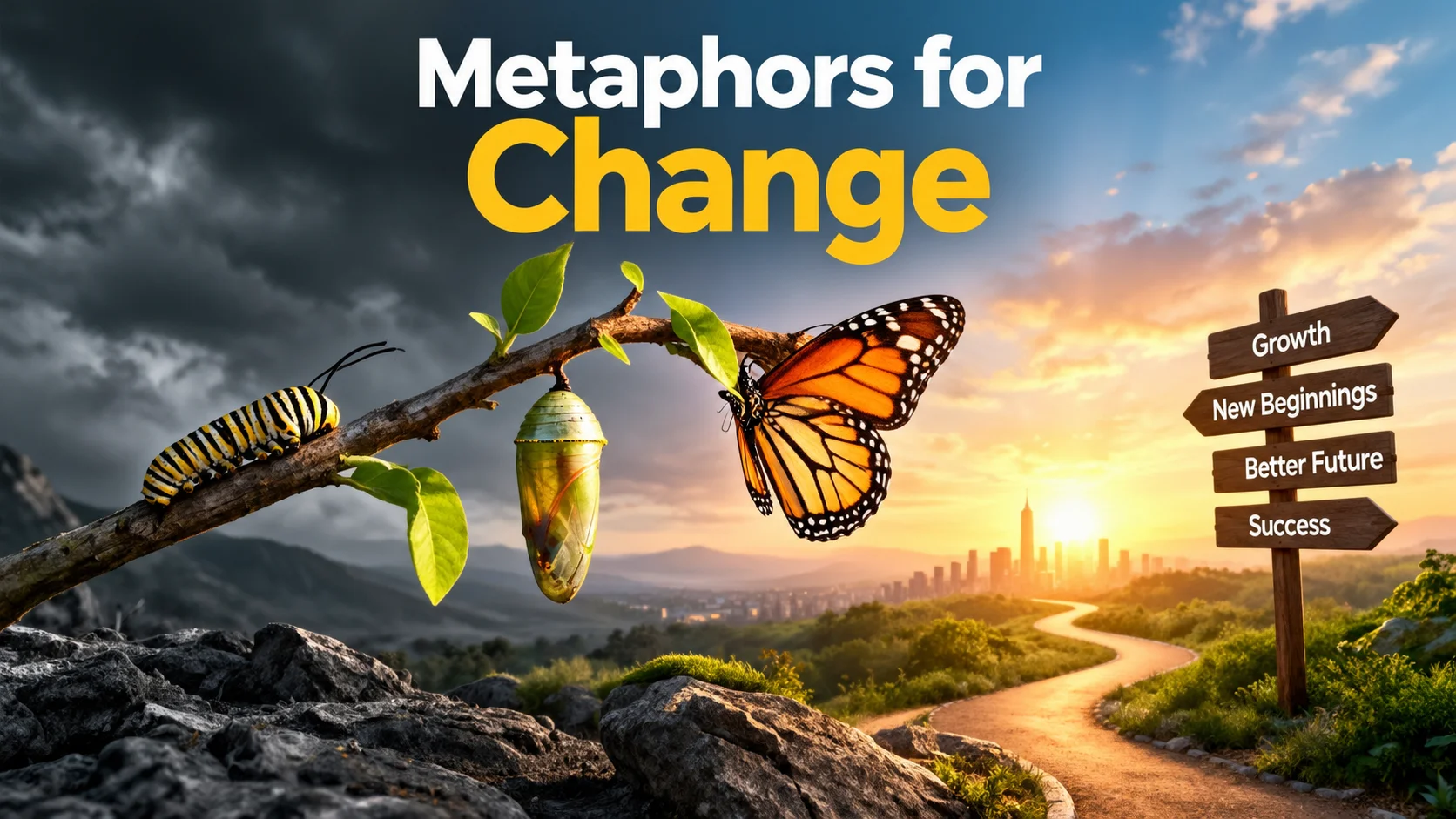
Metaphors for Change (With Examples) make life’s transition easier to understand by turning abstract ideas into clear, tangible experiences.
Change is an ever-present force in our lives, shaping growth, new beginnings, opportunities, and personal development.
A metaphor can show this evolution as a journey, path, river, or bridge toward new states. These images give readers stronger mental models and anchors, making writing more emotional, memorable, and engaging. In English, Metaphor Examples can connect the literal world with the abstract nature of change.
This approach helps convey the essence of change through powerful images that resonate with different perspective and wisdom.
Change also appears through challenges, struggle, battle, and gradual transformation, so a good metaphor can make difficult ideas easier to follow.
This can support action, enable progress, and help people create meaning from ideas, nature, and the world around me.
Lets Dive:
1. Change Is a New Chapter
Meaning: This metaphor compares change to starting a new chapter in a book.
Detailed explanation:
Life often feels like a story made from different chapters. Some chapters contain familiar people, routines, and experiences. Others introduce completely different circumstances. Calling change a new chapter suggests that one stage has ended while another is beginning. It doesn’t necessarily mean the previous stage was wrong. Instead, it emphasizes progress, movement, and possibility.
This metaphor works especially well when someone starts a new career, moves somewhere new, enters a relationship, finishes school, or begins a different phase of life.
Examples:
- “Moving to a new city feels like opening a new chapter in my life.”
- “Her graduation marked a new chapter filled with possibilities.”
- “Leaving that job wasn’t an ending; it was the beginning of a new chapter.”
3 other ways to say it:
- Starting a new page
- Beginning a fresh chapter
- Entering a new stage
2. Change Is a River
Meaning: This metaphor compares change to a river that continually moves forward.
Detailed explanation:
A river rarely stays completely still. It bends, widens, narrows, speeds up, and sometimes changes direction. Life can behave in much the same way. The metaphor suggests that change is continuous and natural. You may not control every turn, but you can learn how to move with the current.
This comparison is useful when discussing uncertainty, personal development, or life’s unpredictable direction.
Examples:
- “Life is a river, and change carries us toward places we never expected.”
- “She learned to stop fighting the current and let change guide her forward.”
- “Our plans shifted like a river changing its course.”
3 other ways to say it:
- Moving with the current
- Following life’s flow
- Traveling a changing path
3. Change Is a Butterfly Emerging
Meaning: This metaphor compares transformation to a caterpillar becoming a butterfly.
Detailed explanation:
The butterfly represents one of the clearest images of personal transformation. The creature doesn’t simply improve its old form. It undergoes a dramatic transformation and emerges differently. This metaphor highlights the idea that meaningful change can require patience, uncertainty, and an unfamiliar process.
It works particularly well when describing emotional growth, confidence, maturity, or a major personal transformation.
Examples:
- “After years of struggle, she emerged like a butterfly from its cocoon.”
- “His confidence transformed him into someone who finally spread his wings.”
- “Sometimes growth requires a quiet period before the transformation becomes visible.”
3 other ways to say it:
- Spreading your wings
- Emerging transformed
- Growing into a new self
4. Change Is a Sunrise
Meaning: This metaphor compares change to the arrival of a new sunrise after darkness.
Detailed explanation:
A sunrise symbolizes hope, renewal, and a fresh beginning. It suggests that difficult periods don’t necessarily last forever. When change brings a new opportunity, comparing it to sunrise creates an optimistic image without ignoring the darkness that came before it.
This metaphor fits messages about recovery, new opportunities, fresh starts, and hopeful transitions.
Examples:
- “Her new beginning felt like a sunrise after a long night.”
- “The opportunity brought a sunrise to a difficult season.”
- “Every morning reminds us that change can bring another dawn.”
3 other ways to say it:
- A new dawn
- A light after darkness
- The beginning of a brighter day
5. Change Is a Seed Becoming a Tree
Meaning: This metaphor compares change to a small seed gradually growing into a strong tree.
Detailed explanation:
Some changes happen slowly. You may not notice progress every day, yet something meaningful can develop underneath the surface. A seed represents potential, while the tree represents maturity and visible growth. The metaphor reminds us that transformation often requires time, patience, care, and persistence.
It’s especially useful when talking about education, relationships, careers, habits, and personal growth.
Examples:
- “Her small efforts were seeds that eventually grew into remarkable achievements.”
- “Personal growth is like planting a seed and patiently watching it become a tree.”
- “Every lesson became another root in the tree of his experience.”
3 other ways to say it:
- Growing from a seed
- Putting down new roots
- Growing into something stronger
6. Change Is a Door Opening
Meaning: This metaphor presents change as a door opening to a new possibility.
Detailed explanation:
A closed door can represent the familiar, while an open door suggests opportunity and discovery. This metaphor doesn’t promise that everything beyond the door will be easy. Instead, it emphasizes the courage required to step into something unfamiliar.
Use it when describing new jobs, relationships, opportunities, moves, or personal decisions.
Examples:
- “Losing that position unexpectedly became a door opening to something different.”
- “Her decision to study abroad opened a door to new experiences.”
- “Every major transition gives you another door to walk through.”
3 other ways to say it:
- Opening a new possibility
- Stepping through a new door
- Entering unfamiliar territory
7. Change Is Turning the Page
Meaning: This metaphor compares change to turning a page in a book.
Detailed explanation:
Turning a page means leaving what you’ve already read behind while discovering what comes next. It captures the emotional balance between closure and curiosity. The past remains part of the story, but it no longer occupies the current page.
This metaphor works well when someone is ready to move forward after a difficult experience.
Examples:
- “I’m ready to turn the page and begin again.”
- “She turned the page after leaving her old routine behind.”
- “Sometimes healing means turning the page without forgetting the story.”
3 other ways to say it:
- Moving to the next page
- Leaving the past behind
- Beginning the next part
8. Change Is a Storm
Meaning: This metaphor compares difficult change to a powerful storm.
Detailed explanation:
Not every change feels peaceful. Some transitions arrive suddenly and create confusion. A storm captures the feelings of uncertainty, disruption, fear, and emotional turbulence. However, storms eventually pass, which can make this metaphor especially meaningful when discussing difficult periods.
Examples:
- “The sudden move felt like a storm sweeping through our lives.”
- “Her emotions were caught in a storm of uncertainty.”
- “The changes shook his routine like a powerful storm.”
3 other ways to say it:
- A turbulent season
- An emotional whirlwind
- A period of upheaval
9. Change Is a Road
Meaning: This metaphor compares change to traveling along a road toward a new destination.
Detailed explanation:
A road represents movement, direction, and discovery. It also suggests that you don’t always know exactly what lies ahead. Some roads are smooth, while others contain obstacles. This metaphor emphasizes that change is often a journey rather than a single event.
Examples:
- “Personal growth is a road with unexpected turns.”
- “She started walking down a new road after graduation.”
- “The journey wasn’t easy, but every obstacle became part of the road forward.”
3 other ways to say it:
- Walking a new path
- Taking a different route
- Traveling toward a new destination
10. Change Is a Phoenix Rising
Meaning: This metaphor compares transformation to a phoenix rising from its ashes.
Detailed explanation:
The phoenix symbolizes rebirth, resilience, and renewal. It works particularly well when someone experiences a major setback and rebuilds their life. The image suggests that destruction doesn’t always represent the final chapter. Sometimes it becomes the starting point for something new.
Examples:
- “After the failure, she rose like a phoenix from the ashes.”
- “His recovery became a story of rebirth and resilience.”
- “The company rebuilt itself like a phoenix rising after the fire.”
3 other ways to say it:
- Rising again
- Rebuilding from the ashes
- Starting stronger after hardship
Read This: 20 Metaphors for Cats (With Examples)
11. Change Is a Blank Canvas
Meaning: This metaphor compares change to a blank canvas waiting for a new picture.
Detailed explanation:
A blank canvas contains possibilities rather than limitations. It suggests that a transition gives you space to create, experiment, and make new choices. This metaphor places emphasis on personal agency. Instead of simply reacting to change, you can help shape what comes next.
Examples:
- “Moving into her own apartment felt like a blank canvas.”
- “The new position gave him a blank canvas for his ideas.”
- “After leaving the past behind, she saw her future as an untouched canvas.”
3 other ways to say it:
- A fresh canvas
- A chance to create anew
- A new space to shape
12. Change Is a Caterpillar Shedding Its Skin
Meaning: This metaphor compares change to outgrowing an old form.
Detailed explanation:
Sometimes change happens because an old version of your life no longer fits. Like a creature shedding an outer layer, you may need to release old habits, beliefs, routines, or identities. The metaphor focuses on growth that requires letting go.
Examples:
- “She had to shed old fears like a caterpillar leaving behind its skin.”
- “His new mindset showed that he had outgrown his former habits.”
- “Change sometimes means releasing the version of yourself that no longer fits.”
3 other ways to say it:
- Outgrowing the old self
- Shedding old habits
- Leaving an old identity behind
13. Change Is the Wind
Meaning: This metaphor compares change to wind that moves through life and alters its direction.
Detailed explanation:
You can’t see wind directly, but you can see its effects. Change can work the same way. You may not notice the exact moment transformation begins, yet eventually you see its impact. The wind metaphor also suggests movement, unpredictability, and forces beyond your control.
Examples:
- “Change arrived like a sudden wind through her quiet life.”
- “The new opportunity became the wind beneath his wings.”
- “Sometimes life changes direction because the wind shifts unexpectedly.”
3 other ways to say it:
- A shifting wind
- A breeze of change
- A force moving you forward
14. Change Is a Mountain Climb
Meaning: This metaphor compares change to climbing a mountain toward a higher point.
Detailed explanation:
Major changes can require effort, patience, courage, and persistence. A mountain represents the difficulty of the journey, while reaching the summit represents progress. You may stop to rest without actually giving up. That makes this metaphor useful for long-term personal development.
Examples:
- “Recovering from failure felt like climbing a steep mountain.”
- “Every small achievement brought her closer to the summit.”
- “Change isn’t always easy; sometimes you have to climb for every step forward.”
3 other ways to say it:
- Climbing toward growth
- Reaching a higher ground
- Making your way uphill
15. Change Is a New Season
Meaning: This metaphor compares life transitions to the changing seasons of nature.
Detailed explanation:
Seasons change naturally, and each one brings different conditions. Spring represents renewal, summer can suggest abundance, autumn often represents transition, and winter can symbolize rest. This metaphor reminds us that every stage has a purpose.
Examples:
- “Leaving college felt like entering a new season of life.”
- “Their relationship entered a quieter season of understanding.”
- “Sometimes life changes because one season has naturally ended.”
3 other ways to say it:
- Entering a new season
- Moving into another phase
- Beginning a different period
16. Change Is a Puzzle Coming Together
Meaning: This metaphor compares change to individual puzzle pieces gradually forming a complete picture.
Detailed explanation:
Change can feel confusing when you’re experiencing it one piece at a time. You may not immediately understand why something happened. Later, separate experiences can connect and reveal a clearer picture. This metaphor emphasizes patience, perspective, and gradual understanding.
Examples:
- “Every experience became another piece of the puzzle of her life.”
- “The decision didn’t make sense then, but later the pieces came together.”
- “Change can feel confusing until the bigger picture appears.”
3 other ways to say it:
- Putting the pieces together
- Seeing the bigger picture
- Connecting the missing pieces
17. Change Is a Tide
Meaning: This metaphor compares change to the ocean tide that rises and falls naturally.
Detailed explanation:
The tide reminds us that some things move according to natural rhythms. You can’t permanently stop the ocean from changing. Similarly, life contains periods of arrival, departure, growth, and release. The metaphor encourages acceptance rather than constant resistance.
Examples:
- “Change came like a rising tide, slowly reshaping everything.”
- “She learned to move with the tide of life’s transitions.”
- “Some changes are like tides; they arrive whether you’re ready or not.”
3 other ways to say it:
- Riding the tide
- Moving with the waves
- Following life’s rhythm
18. Change Is a Bridge
Meaning: This metaphor compares change to a bridge connecting one stage of life to another.
Detailed explanation:
A bridge connects two places that would otherwise remain separated. In the same way, change can connect where you are now with where you’re going. The metaphor is especially useful when talking about education, career transitions, recovery, or personal development.
Examples:
- “Education became a bridge between her dreams and her future.”
- “That difficult experience served as a bridge to greater maturity.”
- “Change can become the bridge between an old life and a new one.”
3 other ways to say it:
- A path between two stages
- A connection to the future
- A passage into something new
19. Change Is a Winding Trail
Meaning: This metaphor compares change to a trail that twists through unfamiliar territory.
Detailed explanation:
A winding trail doesn’t reveal the entire journey at once. You see only the section directly ahead. This makes it a powerful metaphor for uncertainty. It suggests that you don’t need to know everything about the future before taking the next step.
Examples:
- “Her career became a winding trail full of unexpected turns.”
- “Life doesn’t always reveal the destination; sometimes you simply follow the trail.”
- “Every unexpected turn taught him something valuable.”
3 other ways to say it:
- A winding path
- An unfamiliar journey
- A trail of discovery
20. Change Is a Rising Tide of Possibility
Meaning: This metaphor presents change as a rising tide that brings new possibilities into view.
Detailed explanation:
A rising tide gradually covers the shoreline and changes the landscape. Likewise, meaningful change can slowly introduce opportunities that weren’t visible before. This metaphor has an optimistic tone while still recognizing that change can reshape familiar surroundings.
It’s useful for motivational writing, personal growth, career development, and messages about new opportunities.
Examples:
- “The new technology created a rising tide of possibilities.”
- “Her decision sparked a wave of opportunities.”
- “Change can feel overwhelming, yet it may also bring possibilities you couldn’t see before.”
3 other ways to say it:
- A wave of opportunity
- An expanding horizon
- A growing field of possibilities
MCQs:
Choose the metaphor that best completes each sentence.
1. After years of hard work, she finally felt ready to begin ________.
A. a storm
B. a new chapter
C. a closed door
D. an old season
Answer: B — a new chapter
2. His recovery felt like ________ after a long period of hardship.
A. a sunrise
B. a locked room
C. a broken road
D. a fading shadow
Answer: A — a sunrise
3. Personal growth can be compared to ________ becoming a tree.
A. a river
B. a seed
C. a mountain
D. a bridge
Answer: B — a seed
4. When someone rebuilds their life after a major setback, which metaphor fits best?
A. A blank page
B. A phoenix rising
C. A quiet room
D. A closed window
Answer: B — a phoenix rising
5. A transition that feels confusing and turbulent can be described as ________.
A. a storm
B. a sunrise
C. a garden
D. a bridge
Answer: A — a storm
6. A new opportunity can be described as ________.
A. a door opening
B. a fading road
C. a winter ending
D. a broken branch
Answer: A — a door opening
7. Which metaphor best represents continuous movement and uncertainty?
A. A river
B. A wall
C. A chair
D. A photograph
Answer: A — a river
8. Someone starting over may describe the future as ________.
A. a blank canvas
B. a closed book
C. a finished road
D. a dark room
Answer: A — a blank canvas
9. Which metaphor emphasizes the difficulty of achieving personal growth?
A. A sunrise
B. A mountain climb
C. A blank canvas
D. A page
Answer: B — a mountain climb
10. Change that connects your present life to your future can be called ________.
A. a bridge
B. a storm
C. a shadow
D. a wall
Answer: A — a bridge
11. Which metaphor suggests that change happens according to natural cycles?
A. A new season
B. A locked door
C. A puzzle piece
D. A blank canvas
Answer: A — a new season
12. A person who outgrows old habits can be compared to ________.
A. a caterpillar shedding its skin
B. a river freezing
C. a mountain falling
D. a door closing
Answer: A — a caterpillar shedding its skin
13. Which metaphor represents experiences gradually making sense?
A. A storm
B. A puzzle coming together
C. A sunrise
D. A tide
Answer: B — a puzzle coming together
14. Which metaphor best describes accepting life’s natural movement?
A. A tide
B. A wall
C. A cage
D. A photograph
Answer: A — a tide
15. Which metaphor best describes a journey with unexpected turns?
A. A winding trail
B. A blank canvas
C. A sunrise
D. A closed book
Answer: A — a winding trail
FAQs:
What is a metaphor for change?
A metaphor for change compares transformation or transition to something familiar. For example, “change is a new chapter” compares a life transition to moving forward in a book.
What is the best metaphor for positive change?
“Change is a sunrise” is an effective metaphor for positive change because it represents hope, renewal, and a fresh beginning.
What metaphor describes personal growth?
“Change is a seed becoming a tree” strongly represents personal growth. It emphasizes patience, development, roots, and gradual transformation.
What metaphor describes difficult change?
“Change is a storm” works well for difficult transitions. It communicates uncertainty, disruption, emotional turbulence, and temporary hardship.
How can I use metaphors for change in writing?
Choose a metaphor that matches your intended emotion. For example, use “a new chapter” for a fresh beginning, “a mountain climb” for a difficult journey, and “a blank canvas” for new possibilities. Keep the comparison natural and connect it clearly to your message.
Conclusion:
Metaphors for Change (With Examples) show how powerful language can make an ordinary idea easier to understand. Change is a natural part of life, bringing growth, transformation, new beginnings, challenges, opportunities, and personal development.
When you describe change as a journey, river, bridge, or turning point, readers can visualize the experience instead of simply reading about it. This makes your writing more engaging, emotional, and memorable.
The best metaphors also help explain difficult transitions in simple ways. They connect abstract thoughts with familiar experiences and give your readers a clearer perspective. Whether you’re writing essays, speeches, stories, poems, or everyday messages, thoughtful metaphors can make your ideas stronger.
Use them naturally, choose images that fit your meaning, and avoid forcing comparisons. With practice, you can create fresh metaphors that resonate with readers and make your English more expressive, clear, and powerful.














1 thought on “20 Metaphors for Change (With Examples)”