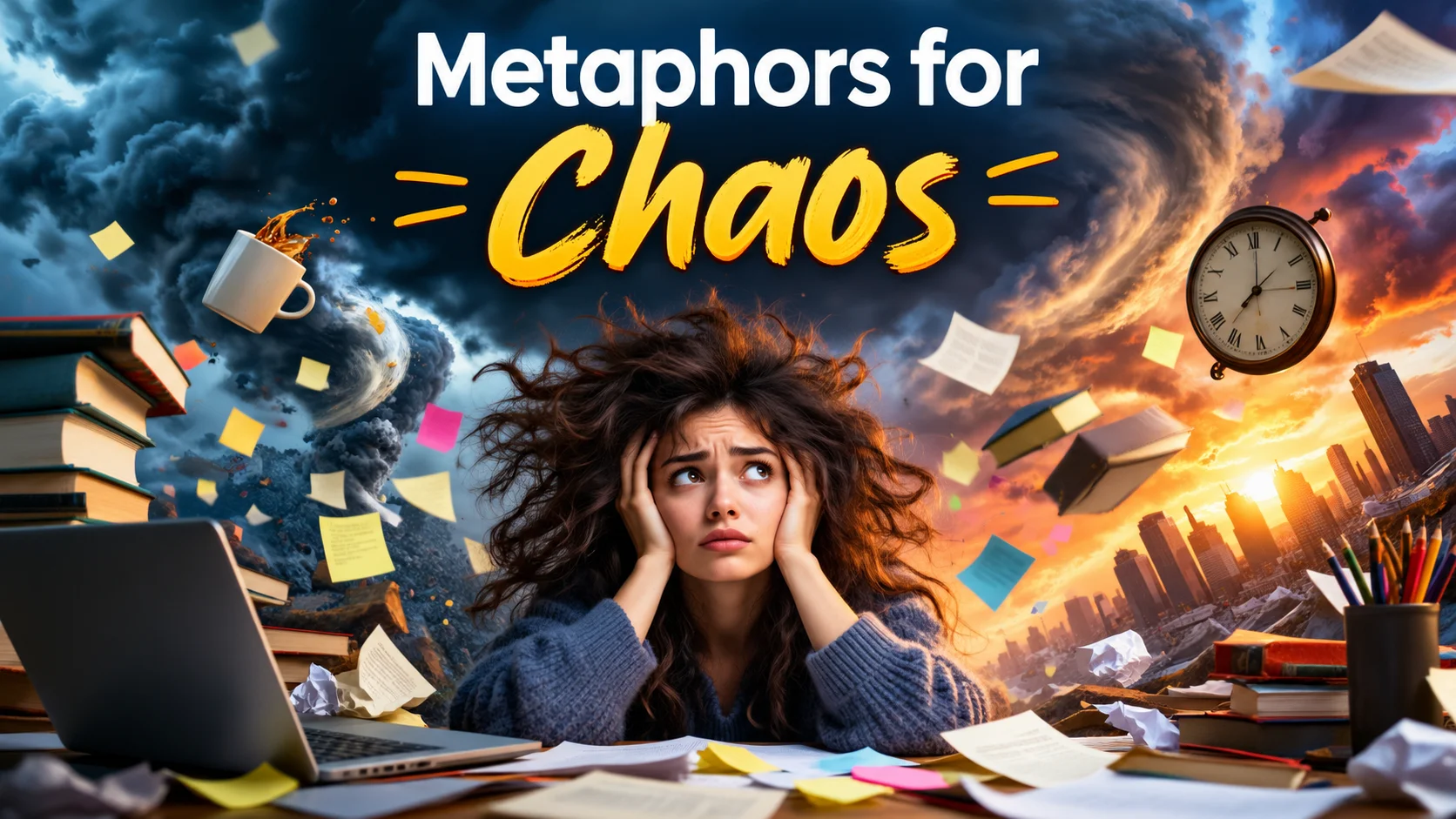
Metaphors for Chaos (With Examples) help writers turn chaos into a clear image of confusion, emotion, and disorder vividly.
When you need to explain a confusing moment in plain words, a strong metaphor can give the reader something they can see, hear, and feel. A thunderstorm is a perfect example because its sky, light, fury, raw energy, and untamed movement create an immediate picture of panic and disorder without sounding vague.
For a student learning figurative language, metaphors strengthen skills by turning abstract ideas into vivid scenes. A collapsing bridge can represent broken plans, while a wildfire moving through dry grass can represent rapidly spreading emotions, events, or experiences. An orchestra without a conductor can show how people lose control when everything becomes mixed, noisy, and unpredictable.
These images help writers transform difficult ideas into powerful, unforgettable scenes filled with fractured routines, uncertainty, tension, movement, and intensity. In literature, speeches, poetry, storytelling, fiction, and essays, symbolic imagery can capture depth, destruction, transformation, freedom, rebellion, passion, and rebirth with precision and artistic beauty.
Lets Dive:
1. A Storm Without a Compass
Meaning: This metaphor describes a situation where everything feels unpredictable and directionless.
Detailed Explanation:
A storm already suggests turbulence, uncertainty, and powerful forces. Adding a compass creates an image of someone trying to navigate without knowing where to go. This metaphor works especially well when people face conflicting priorities, sudden problems, or emotional uncertainty.
Example:
“After the unexpected announcement, the entire department became a storm without a compass.”
Three Other Ways to Say It:
- A situation with no clear direction
- A whirlwind of uncertainty
- A confusing path with no guidance
2. A House of Falling Cards
Meaning: This metaphor describes fragile order that can collapse suddenly.
Detailed Explanation:
A carefully arranged card structure looks organized, but one small disturbance can bring everything down. This metaphor fits situations where many problems depend on one another. When one part fails, the rest may quickly become unstable.
Example:
“Without a proper plan, the project became a house of falling cards.”
Three Other Ways to Say It:
- A fragile system
- An unstable arrangement
- A structure ready to collapse
3. A Tornado in a Library
Meaning: This metaphor describes extreme disorder appearing in a place that should normally be calm and organized.
Detailed Explanation:
A library represents quiet, structure, and order. A tornado represents violent movement and destruction. Putting them together creates a striking contrast. Use this expression when something suddenly disrupts an otherwise peaceful environment.
Example:
“When the children rushed inside after lunch, the classroom became a tornado in a library.”
Three Other Ways to Say It:
- A peaceful place turned upside down
- A whirlwind through a quiet space
- Order suddenly replaced by confusion
4. A Ship Without a Rudder
Meaning: This metaphor describes a group or person moving without direction or control.
Detailed Explanation:
A ship needs a rudder to steer. Without one, currents and waves determine its movement. This makes the metaphor useful when describing organizations, teams, or personal situations that lack leadership, planning, or clear decisions.
Example:
“After the manager resigned, the team felt like a ship without a rudder.”
Three Other Ways to Say It:
- A team without direction
- A journey without guidance
- A group drifting without control
5. A Puzzle With Missing Pieces
Meaning: This metaphor describes a confusing situation where important information is unavailable.
Detailed Explanation:
A puzzle becomes difficult when several pieces are missing. You may understand individual parts but still struggle to see the complete picture. This metaphor works well when confusion comes from incomplete information, unclear instructions, or unanswered questions.
Example:
“The investigation felt like a puzzle with missing pieces.”
Three Other Ways to Say It:
- An incomplete picture
- A mystery with unanswered questions
- A problem lacking essential information
6. A Room Full of Tangled Wires
Meaning: This metaphor describes complicated problems that become difficult to separate or solve.
Detailed Explanation:
Tangled wires connect and overlap in confusing ways. Pulling one wire may affect another. This makes the metaphor useful for describing situations involving multiple connected problems, complicated relationships, or messy plans.
Example:
“Trying to fix the old computer system was a room full of tangled wires.”
Three Other Ways to Say It:
- A complicated mess
- A web of connected problems
- A tangled situation
7. A Broken Traffic Light
Meaning: This metaphor describes a situation where normal rules and signals no longer provide direction.
Detailed Explanation:
Traffic lights help people know when to stop, wait, or move. When one breaks, everyone must make decisions independently. This can create confusion and conflict. The metaphor works well when rules, communication, or systems stop functioning properly.
Example:
“Without clear instructions, the meeting became a broken traffic light.”
Three Other Ways to Say It:
- A system without signals
- Confusion caused by missing rules
- A situation without clear instructions
8. A River Bursting Its Banks
Meaning: This metaphor describes something overwhelming that exceeds normal limits.
Detailed Explanation:
A river normally stays within its banks. When heavy rain causes it to overflow, water spreads beyond its expected boundaries. The image works beautifully for emotions, workloads, responsibilities, or unexpected events that become too much to contain.
Example:
“By Friday, her responsibilities were a river bursting its banks.”
Three Other Ways to Say It:
- An overwhelming flood of problems
- More pressure than anyone can contain
- A situation spilling beyond control
9. A Wildfire in Dry Grass
Meaning: This metaphor describes a small problem that spreads rapidly.
Detailed Explanation:
Dry grass gives fire the perfect conditions to spread quickly. Likewise, a minor disagreement can become a major conflict when emotions, rumors, or misunderstandings fuel it. This metaphor emphasizes speed and escalation.
Example:
“What began as one disagreement became a wildfire in dry grass.”
Three Other Ways to Say It:
- A problem spreading rapidly
- A small issue becoming a major crisis
- A conflict growing out of control
10. A Jumbled Drawer
Meaning: This metaphor describes a messy situation containing many unrelated things at once.
Detailed Explanation:
A junk drawer often contains keys, batteries, receipts, cables, and countless small objects. Nothing necessarily belongs together. This makes it a useful metaphor for everyday chaos that feels messy, crowded, and difficult to organize.
Example:
“After months of unfinished tasks, my schedule looked like a jumbled drawer.”
Three Other Ways to Say It:
- A messy collection of problems
- A cluttered situation
- A pile of unrelated confusion
Read This: 20 Metaphors for Change (With Examples)
11. A Broken Orchestra
Meaning: This metaphor describes people or parts working without coordination.
Detailed Explanation:
An orchestra depends on timing, cooperation, and listening. When musicians ignore the conductor or play different rhythms, the result becomes unpleasant and disorganized. The metaphor works particularly well for teams, workplaces, families, and group projects.
Example:
“Without communication, the committee sounded like a broken orchestra.”
Three Other Ways to Say It:
- A team without coordination
- People working at cross-purposes
- A group out of sync
12. A Maze With Moving Walls
Meaning: This metaphor describes a problem that keeps changing as you try to solve it.
Detailed Explanation:
A normal maze is already challenging. A maze with moving walls becomes even more unpredictable because the route keeps changing. Use this metaphor when circumstances shift constantly and yesterday’s solution no longer works.
Example:
“Managing the changing requirements felt like a maze with moving walls.”
Three Other Ways to Say It:
- A constantly changing problem
- A challenge with shifting rules
- A situation that keeps changing direction
13. A Deck of Cards in the Wind
Meaning: This metaphor describes plans, thoughts, or circumstances scattered by unexpected events.
Detailed Explanation:
Cards are easy to scatter when strong wind hits them. Once they fly apart, putting them back together takes time. This metaphor captures the feeling of losing control after a sudden interruption or setback.
Example:
“The sudden cancellation scattered our plans like a deck of cards in the wind.”
Three Other Ways to Say It:
- Plans scattered by unexpected events
- Everything thrown into confusion
- A carefully made plan falling apart
14. A Web of Knots
Meaning: This metaphor describes a situation where several difficulties are tightly connected.
Detailed Explanation:
A knot becomes harder to untangle when several strands overlap. Similarly, one problem may connect to another until the entire situation feels impossible to separate. This metaphor works well for personal conflicts, business problems, and complicated decisions.
Example:
“The family disagreement had become a web of knots.”
Three Other Ways to Say It:
- A tangled network of problems
- Several difficulties tied together
- A complicated mess of conflicts
15. A Train With No Schedule
Meaning: This metaphor describes activity without timing, organization, or predictability.
Detailed Explanation:
A train schedule gives passengers confidence about when and where they should travel. Without one, people are left waiting and guessing. This metaphor fits situations where deadlines keep changing or nobody knows what happens next.
Example:
“The renovation project became a train with no schedule.”
Three Other Ways to Say It:
- A plan without timing
- An unpredictable process
- A project with no clear schedule
16. A Garden Overrun With Vines
Meaning: This metaphor describes small problems that grow until they overwhelm the original structure.
Detailed Explanation:
Vines can spread across fences, walls, and pathways when nobody controls them. The garden remains there, but its original shape disappears beneath the growth. This metaphor works well for neglected responsibilities, accumulating tasks, and unresolved issues.
Example:
“Unanswered emails had turned into a garden overrun with vines.”
Three Other Ways to Say It:
- Problems growing unchecked
- Responsibilities taking over
- Neglected issues becoming overwhelming
17. A Marketplace at Midnight
Meaning: This metaphor describes a noisy, confusing, and unpredictable environment.
Detailed Explanation:
A busy marketplace already contains voices, movement, negotiations, and competing demands. Imagining that activity at midnight adds an unusual layer of uncertainty. This metaphor suits situations where many things happen simultaneously and nobody seems fully in control.
Example:
“During the emergency, the office felt like a marketplace at midnight.”
Three Other Ways to Say It:
- A noisy scene of confusion
- A crowded environment full of uncertainty
- A place buzzing with disorder
18. A Box of Spilled Marbles
Meaning: This metaphor describes a situation where everything moves unpredictably in different directions.
Detailed Explanation:
Once marbles spill from a box, they roll across the floor without following a planned path. You can see them, but gathering them requires patience. The metaphor works especially well for scattered thoughts, disorganized plans, and unpredictable events.
Example:
“After the announcement, everyone’s thoughts became a box of spilled marbles.”
Three Other Ways to Say It:
- Scattered thoughts
- Ideas moving in every direction
- A situation with no steady pattern
19. A Clock With Every Hand Spinning
Meaning: This metaphor describes a situation where too many things happen simultaneously.
Detailed Explanation:
A clock normally gives you a sense of order and timing. Imagine every hand spinning at a different speed. The familiar system suddenly becomes difficult to understand. This metaphor captures overload, urgency, and competing demands.
Example:
“During the launch, the team felt like a clock with every hand spinning.”
Three Other Ways to Say It:
- Too many things happening at once
- A situation moving in every direction
- Complete overload
20. A Sky Full of Falling Stars
Meaning: This metaphor describes beautiful but overwhelming disorder, especially when many events happen at once.
Detailed Explanation:
A sky full of falling stars creates a powerful image. Each streak is fascinating, yet watching hundreds of them at once could feel overwhelming. This metaphor offers a softer way to describe chaos when the situation contains energy, excitement, emotion, or rapid change rather than pure destruction.
Example:
“The festival was a sky full of falling stars, with music, lights, and people everywhere.”
Three Other Ways to Say It:
- A breathtaking rush of activity
- A dazzling wave of movement
- An overwhelming burst of energy
MCQs:
1. After the manager left, the department was ________.
A. a ship without a rudder
B. a peaceful garden
C. a clear road
D. a quiet lake
Answer: A. a ship without a rudder
2. The disagreement spread through the office like ________.
A. a sleeping cat
B. a wildfire in dry grass
C. a closed book
D. a calm river
Answer: B. a wildfire in dry grass
3. The investigation felt confusing because it was ________.
A. a puzzle with missing pieces
B. a finished painting
C. a straight road
D. a clean window
Answer: A. a puzzle with missing pieces
4. The team worked without coordination like ________.
A. a broken orchestra
B. a perfect clock
C. a quiet garden
D. a steady bridge
Answer: A. a broken orchestra
5. Her responsibilities had become ________.
A. a river bursting its banks
B. a small candle
C. a closed door
D. a smooth road
Answer: A. a river bursting its banks
6. The computer cables were ________.
A. a tangled web of wires
B. a straight line
C. a clean page
D. a polished mirror
Answer: A. a tangled web of wires
7. The changing rules made the project feel like ________.
A. a maze with moving walls
B. a quiet park
C. a finished puzzle
D. a calm sea
Answer: A. a maze with moving walls
8. The sudden cancellation left our plans like ________.
A. a deck of cards in the wind
B. a solid wall
C. a locked box
D. a peaceful lake
Answer: A. a deck of cards in the wind
9. The messy schedule looked like ________.
A. a jumbled drawer
B. a straight road
C. a clean desk
D. a blank page
Answer: A. a jumbled drawer
10. The old system had become ________.
A. a house of falling cards
B. a strong foundation
C. a calm ocean
D. a clear map
Answer: A. a house of falling cards
11. When nobody knew what would happen next, the project was ________.
A. a train with no schedule
B. a perfect timetable
C. a finished journey
D. a quiet station
Answer: A. a train with no schedule
12. The unresolved problems became ________.
A. a garden overrun with vines
B. a clean field
C. a smooth road
D. a blank notebook
Answer: A. a garden overrun with vines
13. During the emergency, the office felt like ________.
A. a marketplace at midnight
B. an empty classroom
C. a silent forest
D. a peaceful bedroom
Answer: A. a marketplace at midnight
14. Her thoughts were scattered like ________.
A. a box of spilled marbles
B. a locked drawer
C. a straight line
D. a still pond
Answer: A. a box of spilled marbles
15. During the busy launch, everyone felt like ________.
A. a clock with every hand spinning
B. a stopped clock
C. a quiet candle
D. a closed book
Answer: A. a clock with every hand spinning
FAQs:
What is a metaphor for chaos?
A metaphor for chaos describes disorder by comparing it directly with a familiar image. For example, “a ship without a rudder” represents a situation without direction or control.
What is a good metaphor for extreme chaos?
“A tornado in a library” is a strong metaphor for extreme disruption in an otherwise organized environment. “A wildfire in dry grass” also works when chaos spreads rapidly.
What metaphor describes a chaotic workplace?
“A broken orchestra” works well for a workplace where people aren’t communicating or coordinating properly. “A ship without a rudder” fits a workplace that lacks leadership.
What metaphor describes emotional chaos?
“A river bursting its banks” can describe emotions that have become difficult to contain. “A storm without a compass” works when emotional uncertainty creates a feeling of being lost.
Why should you use metaphors for chaos?
Metaphors make abstract ideas easier to visualize and remember. Instead of saying that a situation is simply chaotic, you can communicate its specific character, such as confusion, instability, pressure, unpredictability, or rapid change.
Conclusion:
Metaphors for Chaos (With Examples) make difficult moments easier to understand, describe, and remember. Instead of simply saying something is messy or confusing, a well-chosen metaphor creates a vivid picture in the reader’s mind.
A thunderstorm, wildfire, tornado, or collapsing bridge can quickly communicate disorder, uncertainty, pressure, and emotional intensity. These comparisons also make creative writing more powerful because they add color, movement, emotion, and depth without using complicated language.
Whether you’re writing a story, poem, speech, essay, or everyday message, metaphors can help you express chaos in fresh and memorable ways. The key is to choose an image that matches the situation and makes your meaning clear.
With regular practice, you can turn confusing ideas into strong descriptions that readers can easily picture. Explore different metaphors, experiment with original comparisons, and let your writing show the energy and emotion hidden inside chaotic moments.











1 thought on “20 Metaphors for Chaos (With Examples)”