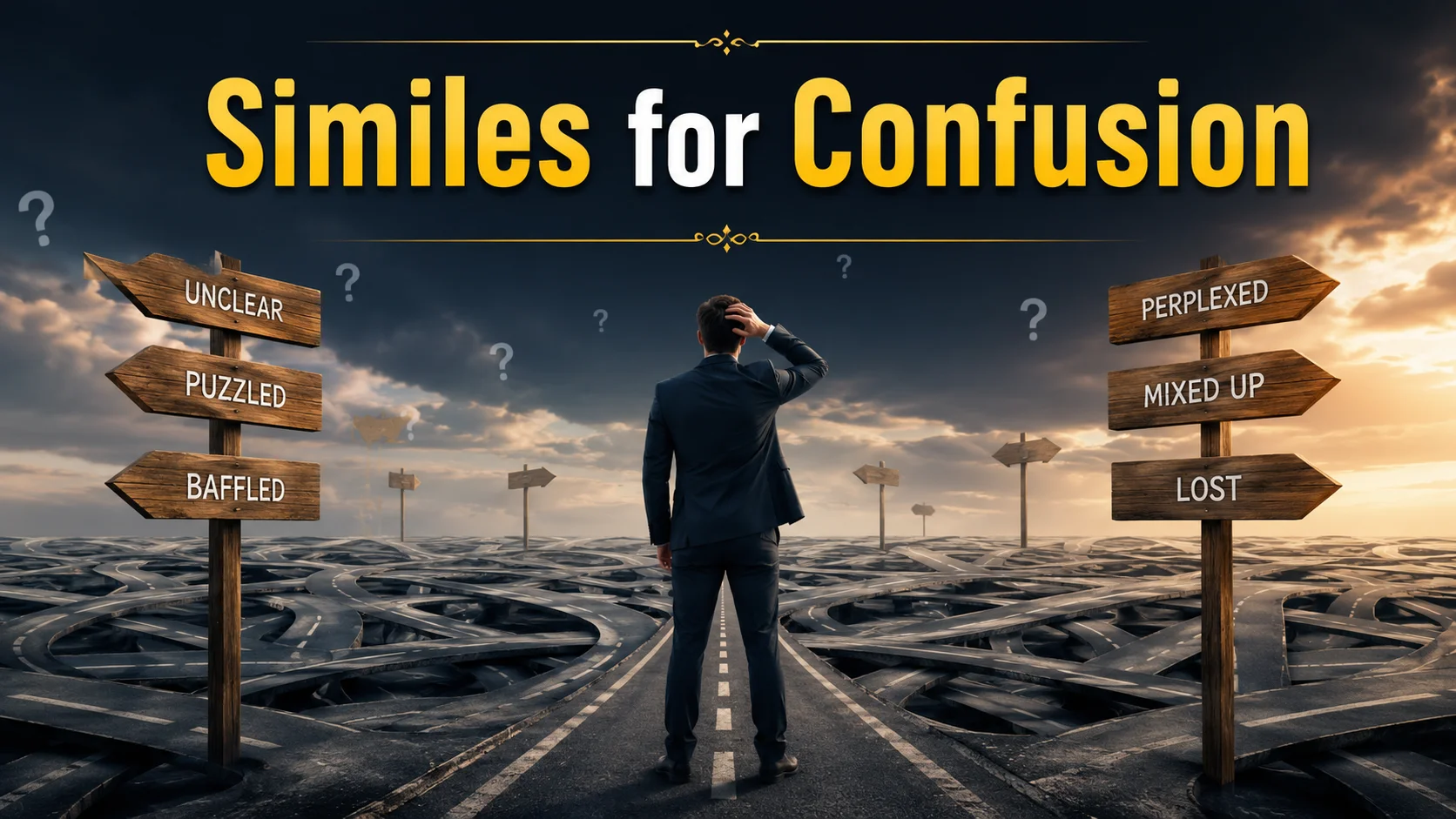
Similes for Confusion (With Examples) make unclear thoughts easier to express by comparing confusion with familiar situations and strong images.
Similes are creative expressions that describe a mental state of uncertainty when thoughts feel unclear or mixed-up. By comparing a confused mind with a tangled web or a lost traveler in fog, you can create strong images that make writing more expressive and relatable.
These figurative expressions are widely used in storytelling, poetry, and everyday writing because they help you express mental states in a vivid way. For writers, students, and creative minds, vivid similes can add flair and depth to literary works, daily conversations, and communication.
When someone feels bewildered, puzzled, or lost in thought, ordinary language may struggle to capture those abstract feelings, but a simile gives confusion a clearer shape.
Lets start:
1. Like a Maze With No Exit
Meaning: Feeling completely unsure about which direction to take.
Explanation:
A maze has many paths, turns, and dead ends. Comparing confusion to a maze with no exit suggests that you’re trying to find an answer but don’t know which way to go. It works well when someone faces a complicated decision or difficult situation.
Example:
“After hearing everyone’s different opinions, my mind felt like a maze with no exit.”
3 other ways to say it:
- My thoughts were going around in circles.
- I felt completely lost.
- I couldn’t find a clear direction.
2. Like a Tangled Ball of Yarn
Meaning: Having thoughts that are mixed together and difficult to organize.
Explanation:
A tangled ball of yarn has strands crossing over one another, making it difficult to find the beginning or end. This simile describes confusion caused by too many thoughts, details, or emotions happening at once.
Example:
“After reading the complicated instructions, my thoughts were like a tangled ball of yarn.”
3 other ways to say it:
- My thoughts were all mixed up.
- I couldn’t sort everything out.
- My mind felt completely tangled.
3. Like a Ship Without a Compass
Meaning: Feeling uncertain because you don’t know where to go or what to do next.
Explanation:
A ship depends on navigation to reach its destination. Without a compass, the journey becomes uncertain. This simile is useful when confusion involves direction, decisions, or uncertainty about the future.
Example:
“After losing my original plan, I felt like a ship without a compass.”
3 other ways to say it:
- I didn’t know which way to turn.
- I was without a clear direction.
- I felt lost about what to do next.
4. Like Walking Through Fog
Meaning: Being unable to see or understand things clearly.
Explanation:
Fog makes it difficult to see what lies ahead. Comparing confusion to walking through fog suggests that the person can move forward only with difficulty because the situation isn’t clear.
Example:
“Trying to understand the conflicting information was like walking through fog.”
3 other ways to say it:
- Everything seemed unclear.
- I couldn’t see the situation clearly.
- I was struggling to make sense of things.
5. Like a Puzzle With Missing Pieces
Meaning: Trying to understand something without having all the necessary information.
Explanation:
A puzzle cannot be completed when important pieces are missing. This simile works particularly well when confusion comes from incomplete facts, missing details, or unanswered questions.
Example:
“The story felt like a puzzle with missing pieces, because nobody explained what had happened.”
3 other ways to say it:
- I didn’t have the complete picture.
- Some important details were missing.
- I was trying to solve an incomplete puzzle.
6. Like a Computer With Too Many Tabs Open
Meaning: Feeling mentally overloaded by too many thoughts or tasks.
Explanation:
When a computer has numerous tabs open, it can become difficult to manage everything at once. This modern simile captures the feeling of having too many ideas competing for attention.
Example:
“After studying for three exams at once, my brain felt like a computer with too many tabs open.”
3 other ways to say it:
- My mind was overloaded.
- I had too much on my mind.
- My thoughts were competing for attention.
7. Like a Crossword With No Clues
Meaning: Feeling unable to understand something because you don’t know where to begin.
Explanation:
A crossword becomes difficult when you have no clues to guide you. This simile describes confusion caused by a lack of guidance or useful information.
Example:
“The new assignment felt like a crossword with no clues.”
3 other ways to say it:
- I didn’t know where to start.
- I had no idea how to approach it.
- I was working without enough information.
8. Like Being Caught in a Web
Meaning: Feeling trapped in a complicated situation or network of problems.
Explanation:
A web has many connected strands. Once you become caught in one, getting free can be difficult. This simile suggests that one confusing issue leads to another.
Example:
“Trying to understand the conflicting explanations was like being caught in a web.”
3 other ways to say it:
- I was caught up in complications.
- One problem led to another.
- I couldn’t untangle the situation.
9. Like a Radio Between Stations
Meaning: Receiving unclear or disconnected information.
Explanation:
A radio between stations produces static instead of a clear signal. This comparison is useful when someone is trying to understand unclear speech, mixed messages, or incomplete communication.
Example:
“His explanation sounded like a radio between stations, and I couldn’t understand what he meant.”
3 other ways to say it:
- His message was unclear.
- I couldn’t get a clear signal.
- What he said didn’t make sense to me.
10. Like Looking at a Map Upside Down
Meaning: Having information but struggling to interpret it correctly.
Explanation:
A map is designed to provide direction, but viewing it incorrectly can make familiar places seem confusing. This simile describes situations where the information is available but difficult to interpret.
Example:
“Reading the complicated chart was like looking at a map upside down.”
3 other ways to say it:
- I couldn’t interpret the information.
- Everything seemed backward.
- I was having trouble understanding what I saw.
11. Like a Jigsaw Puzzle in the Dark
Meaning: Trying to understand something without enough knowledge or visibility.
Explanation:
Putting together a puzzle is challenging enough, but doing it in darkness makes the task much harder. This simile emphasizes uncertainty and lack of understanding.
Example:
“Trying to figure out what happened was like solving a jigsaw puzzle in the dark.”
3 other ways to say it:
- I was trying to understand it without enough information.
- I was working in the dark.
- I had no clear idea what was happening.
12. Like a Traffic Jam in My Head
Meaning: Having so many thoughts that they seem unable to move clearly.
Explanation:
A traffic jam prevents vehicles from moving smoothly. Similarly, a person can experience mental congestion when too many thoughts, questions, or worries compete at once.
Example:
“With three deadlines approaching, it felt like there was a traffic jam in my head.”
3 other ways to say it:
- My thoughts were clogged up.
- I couldn’t think clearly.
- My brain felt overloaded.
13. Like Trying to Read a Book With Missing Pages
Meaning: Struggling to understand something because important information is absent.
Explanation:
A book with missing pages leaves gaps in the story. This simile is especially effective when confusion comes from missing context or incomplete explanations.
Example:
“Understanding the argument was like trying to read a book with missing pages.”
3 other ways to say it:
- I was missing important context.
- The explanation had too many gaps.
- I couldn’t understand the whole story.
14. Like Standing at a Fork in the Road
Meaning: Feeling confused about which choice or direction to take.
Explanation:
A fork in the road presents multiple directions. This simile is especially useful for decision-making confusion, particularly when every option seems possible.
Example:
“After receiving two different job offers, I felt like I was standing at a fork in the road.”
3 other ways to say it:
- I was torn between two choices.
- I didn’t know which path to choose.
- I was uncertain about my decision.
15. Like a Clock With All the Hands Moving
Meaning: Feeling overwhelmed because everything seems to be happening at once.
Explanation:
A normal clock gives you a clear sense of time. If all its hands moved unpredictably, reading it would become difficult. This simile describes a chaotic mental state where nothing seems orderly.
Example:
“With so many changes happening at once, my thoughts felt like a clock with all the hands moving.”
3 other ways to say it:
- Everything felt out of order.
- My thoughts were all over the place.
- I couldn’t keep track of anything.
16. Like a Puzzle With Pieces From Different Boxes
Meaning: Trying to make sense of information that doesn’t seem to belong together.
Explanation:
Puzzle pieces from different boxes may look similar but won’t form one complete picture. This simile describes confusion caused by contradictory information or unrelated details.
Example:
“The explanations I received felt like pieces from different puzzle boxes.”
3 other ways to say it:
- The information didn’t fit together.
- Everything seemed disconnected.
- I couldn’t put the pieces together.
17. Like Being Lost in a Foreign City
Meaning: Feeling unfamiliar with a situation and unsure how to navigate it.
Explanation:
Being in an unfamiliar city can make even simple tasks difficult. This simile communicates uncertainty, unfamiliarity, and a need for guidance.
Example:
“On my first day at the new company, I felt like I was lost in a foreign city.”
3 other ways to say it:
- I felt out of my depth.
- I didn’t know how things worked.
- Everything was unfamiliar to me.
18. Like a Mirror Covered in Steam
Meaning: Having a blurred or unclear understanding of something.
Explanation:
Steam prevents a mirror from showing a clear reflection. This simile creates a softer image of confusion, making it suitable for thoughtful, emotional, or creative writing.
Example:
“After hearing the unexpected news, my understanding felt like a mirror covered in steam.”
3 other ways to say it:
- My thoughts were hazy.
- I couldn’t see things clearly.
- My understanding was blurred.
19. Like Following Footprints in a Snowstorm
Meaning: Trying to find an answer while the available clues keep disappearing or becoming unclear.
Explanation:
Footprints can provide direction, but a snowstorm can quickly cover them. This simile describes confusion when evidence, clues, or guidance are unreliable or constantly changing.
Example:
“Trying to determine who was responsible felt like following footprints in a snowstorm.”
3 other ways to say it:
- The clues kept disappearing.
- I couldn’t follow a clear trail.
- The evidence was hard to interpret.
20. Like a Book Written in a Language You Don’t Know
Meaning: Being completely unable to understand something.
Explanation:
A book written in an unfamiliar language may contain valuable information, but you can’t understand it without knowing the language. This simile expresses deep confusion or complete lack of comprehension.
Example:
“The technical instructions were like a book written in a language I didn’t know.”
3 other ways to say it:
- I couldn’t understand a word of it.
- It was completely unfamiliar to me.
- I had no idea what it meant.
MCQs:
1. Which simile best represents unshakable confidence?
A. Like a butterfly
B. Like a mountain
C. Like a feather
D. Like a cloud
Answer: B. Like a mountain
2. Which simile represents courage and fearlessness?
A. Like a lion
B. Like a candle
C. Like a leaf
D. Like a raindrop
Answer: A. Like a lion
3. Which simile describes quiet and peaceful confidence?
A. Like a thunderstorm
B. Like a racing engine
C. Like a calm sea
D. Like a firework
Answer: C. Like a calm sea
4. “Her confidence shone like a bright star” suggests that her confidence was:
A. Hidden
B. Weak
C. Temporary
D. Noticeable and inspiring
Answer: D. Noticeable and inspiring
5. Which simile suggests protection from criticism?
A. Like a rising sun
B. Like a shield
C. Like a river
D. Like a flower
Answer: B. Like a shield
6. Confidence like a flame mainly represents:
A. Confusion
B. Silence
C. Passion and inner energy
D. Fear
Answer: C. Passion and inner energy
7. Which simile best describes stable confidence?
A. Like a falling leaf
B. Like a rock
C. Like a passing cloud
D. Like a wave
Answer: B. Like a rock
8. “He entered the competition like a champion” suggests that he was:
A. Unprepared
B. Confused
C. Determined and self-assured
D. Afraid
Answer: C. Determined and self-assured
9. Which simile represents confidence that provides guidance?
A. Like a storm
B. Like a stone
C. Like a lighthouse
D. Like a shadow
Answer: C. Like a lighthouse
10. Confidence like an eagle suggests:
A. Hesitation
B. Freedom and focus
C. Weakness
D. Confusion
Answer: B. Freedom and focus
11. Which simile best represents self-respect?
A. Like a broken branch
B. Like a small cloud
C. Like a golden crown
D. Like a falling stone
Answer: C. Like a golden crown
12. “His confidence was like a key” suggests that confidence:
A. Created confusion
B. Opened opportunities
C. Caused failure
D. Encouraged silence
Answer: B. Opened opportunities
13. Which simile best represents consistent confidence?
A. Like a lightning flash
B. Like a steady drumbeat
C. Like a falling leaf
D. Like a disappearing cloud
Answer: B. Like a steady drumbeat
14. Which simile represents strong inner security?
A. Like a feather
B. Like a bubble
C. Like a fortress
D. Like a raindrop
Answer: C. Like a fortress
15. “Her confidence rose like the morning sun” suggests that her confidence:
A. Disappeared quickly
B. Became weaker
C. Grew brighter and stronger
D. Remained unchanged
Answer: C. Grew brighter and stronger
FAQs:
What is a simile for confusion?
A simile for confusion compares a confused feeling to something familiar. For example, “My mind was like a maze with no exit.”
What is a good simile for being confused?
A useful example is “He was as confused as a traveler lost in thick fog.” It clearly shows uncertainty and difficulty finding direction.
How do you describe confusion creatively?
You can describe confusion with images such as a tangled web, a stormy sea, or a maze. These comparisons make your writing more vivid.
Why use similes for confusion?
Similes help readers visualize emotions instead of simply reading about them. They make descriptions more expressive, engaging, and memorable.
What are some common similes for confusion?
Popular examples include “like a maze with no exit,” “like a tangled web,” “like a ship lost at sea,” and “like a traveler in fog.”
Conclusion:
Similes for Confusion (With Examples) give you a simple and creative way to describe uncertainty, mixed-up thoughts, and unclear feelings. Instead of saying someone is simply confused, you can compare that feeling to something familiar, such as a tangled web, a stormy sea, a maze, or a traveler lost in fog.
These comparisons help readers picture the emotion and understand its intensity more clearly. Whether you’re writing a story, poem, essay, social media post, or everyday message, the right simile can make your words more vivid and relatable. Creative expressions also add depth, emotion, and personality to ordinary descriptions.
Once you understand how these comparisons work, you can choose expressions that match different levels of confusion. From mild uncertainty to complete mental chaos, a well-chosen simile can turn a difficult feeling into a clear and memorable image for your readers.













1 thought on “20 Similes for Confusion (With Examples)”